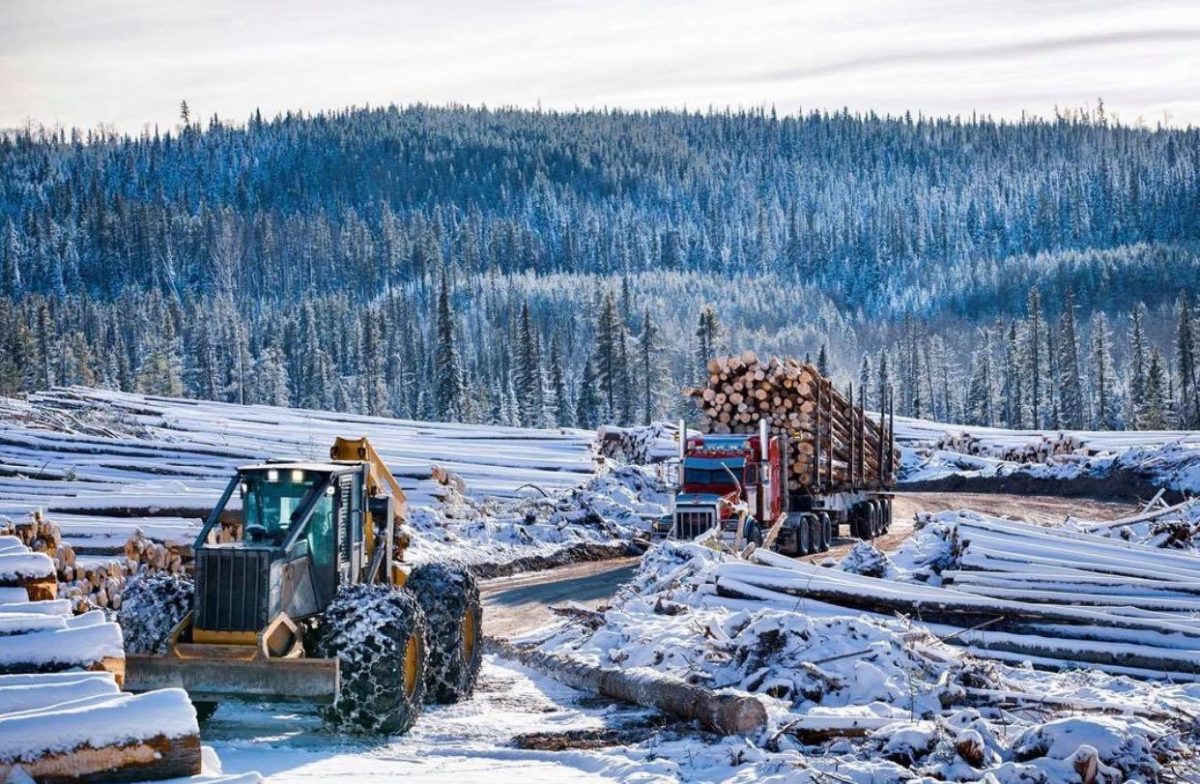
Canada developed its forest industry primarily to cater to the needs of a single customer. As a result, British Columbia is now facing the consequences of this singular focus.
Canada-British Columbia’s latest budget highlights a troubling reality that resource-dependent communities have been grappling with for several years. The province’s forestry industry, once a cornerstone of economic stability, has witnessed a dramatic decline in its public revenue contributions, losing more than half of its financial base in just one economic cycle. Recent projections indicate that forestry revenues are anticipated to plummet to $521 million, a stark contrast to the $1.3 billion generated only a few years ago. This significant downturn underscores the pressing challenges facing the region and its reliance on a dwindling resource sector.

-
That’s a remarkable amount of work hours for a single machine, the Norcar 600 owned by Erkki Rinne is taken well care of, it even has the original Diesel engine.
-
Kieran Anders is a forestry contractor working in the lake district. His work involves hand cutting and extracting timber using a skidder and tractor-trailer forwarder.
-
It is not possible to eliminate chain shot, but there are simple steps that can be taken to reduce the risk.
-
Arwel takes great pride in the fact that the mill has no waste whatsoever, “the peelings are used for children’s playgrounds, gardens and for farm animals in barns in the winter and the sawdust has multiple uses in gardens and farms as well.
-
Timber hauliers need to encourage young blood in, and also look after the hauliers we have, we need make the sector a safe and positive place to work.
FIND US ON
The primary challenge does not stem from a deficiency of fiber, skills, infrastructure, or industrial heritage, all of which are abundant in British Columbia. In numerous regions, current harvesting levels fall significantly below sustainable thresholds. The critical issue lies in the lack of investment-grade data and intelligence that would enable global firms to expedite their processes from site selection to financing and construction.
Concurrently, international manufacturers in sectors such as biofuels, renewable chemicals, engineered wood, and biomaterials are actively seeking stable jurisdictions for the establishment of new facilities. The countries that successfully attract these projects are not necessarily those with the highest availability of fiber; rather, they are those that have effectively mitigated development risks and reduced project timelines.
Finland serves as a pertinent example of innovation within the forest sector, having successfully doubled the sector’s value without increasing harvest levels. This transformation has been achieved through the development of integrated bioproduct complexes that repurpose traditional pulp and paper assets to produce renewable fuels, advanced materials, and engineered wood for global markets. Such initiatives have been facilitated by the establishment of investment-ready industrial ecosystems that enable the rapid and large-scale deployment of capital.
Canada, particularly British Columbia (B.C.), has the potential to be one of the most competitive regions in the world for the next generation of forest-based manufacturing. However, capital for building these facilities continues to flow to the U.S. and Northern Europe. For investors and project developers, the key issue is speed to execution: capital will always favor jurisdictions where timelines are predictable, risks are well understood, and projects can be financed.
What Canada lacks is not ambition in policy but the market-facing infrastructure that enables investors to quickly and confidently identify viable projects.
One of the most overlooked aspects of this infrastructure is investment-grade data and intelligence. Standardized, nationally consistent data sets on biomass availability, infrastructure capacity, workforce readiness, and permitting pathways provide developers and investors with the clarity they need. This allows them to identify optimal locations, such as former mill sites, and make the transition from concept to final investment decision with lower risk.
This type of intelligence is already being generated through Canadian Standards Association-based designations known as biofuel development opportunity zones (BDO zones). These zones translate complex regional data into clear investment signals for global developers and have already been linked to billions of dollars in announced biomanufacturing projects across North America.
For B.C., such projects would create significant construction and operational employment in regions most affected by mill closures, while also restoring long-term demand for residual fiber.

The establishment of the Canadian forest sector transformation task force by the federal government has opened a significant opportunity to address the inherent structural weaknesses within the forest economy. If the aim is to diversify markets, reduce reliance on the United States, and revitalize the economic foundations of resource-dependent regions, the creation of investment-ready development platforms must be integral to the solution.
Sign up for our free monthly newsletter here
Contact forestmachinemagazine@mail.com to get your products and services seen on the world’s largest professional forestry online news network.
#homeoflogging #writtenbyloggersforloggers #loggingallovertheworld
Written by loggers for loggers and dedicated solely to the equipment used in forestry operations.