
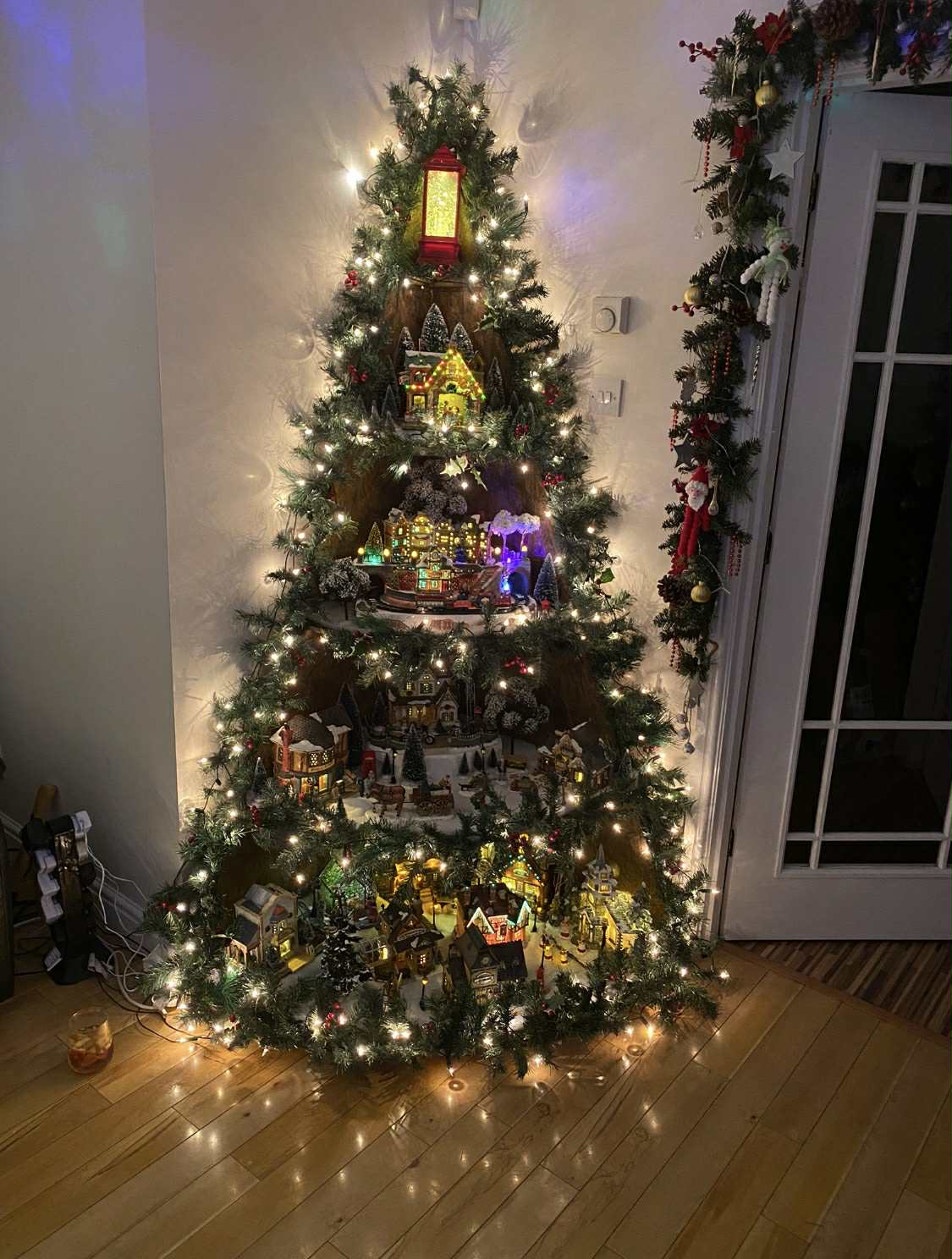
Christmas decorations light up towns and cities, bringing joy to both young and old. But have you ever thought about where this festive celebration really began?
Christmas Decorations-The origins of decorating houses with greenery in December date back even further than the advent of Christianity. Ancient peoples hung evergreen boughs over their doors and windows, hoping to ward off witches, ghosts, evil spirits, and illness. In the northern hemisphere, at the winter solstice, people believed the sun was a god, and winter came every year because he became weak and sick.

-
That’s a remarkable amount of work hours for a single machine, the Norcar 600 owned by Erkki Rinne is taken well care of, it even has the original Diesel engine.
-
Kieran Anders is a forestry contractor working in the lake district. His work involves hand cutting and extracting timber using a skidder and tractor-trailer forwarder.
-
It is not possible to eliminate chain shot, but there are simple steps that can be taken to reduce the risk.
-
Arwel takes great pride in the fact that the mill has no waste whatsoever, “the peelings are used for children’s playgrounds, gardens and for farm animals in barns in the winter and the sawdust has multiple uses in gardens and farms as well.
-
Timber hauliers need to encourage young blood in, and also look after the hauliers we have, we need make the sector a safe and positive place to work.
FIND US ON
They celebrated the winter solstice because it signified that their god was getting better, and evergreen boughs reminded them of the greenery that would grow again when the sun god was strong and summer returned. Ancient Egyptians worshipped a god called Ra, with the head of a hawk, and wore the sun as a blazing disk in his crown. At the winter solstice, when Ra started to strengthen again, the Egyptians filled their homes with green palm rushes, which symbolised the triumph of life over death. The Romans celebrated the winter solstice with a feast called Saturnalia, honouring Saturn, the god of agriculture. They knew the solstice meant that soon the farms and orchards would be green and fruitful, and decorated their homes with evergreen wreaths and temples. Druids decorated their temples with evergreen boughs as a symbol of everlasting life, and the Vikings believed that evergreens were the special plant of Balder, their sun god. The tradition of the Christmas tree began in 16th-century Germany, when devout Christians brought decorated trees into their homes.
Others built pyramid-shaped structures from wood and decorated them with greenery when trees were scarce. It is believed that Martin Luther, a 16th-century Protestant reformer, started the tradition of placing lighted candles on the tree. One winter evening, while walking home and composing a sermon, he was captivated by the brilliance of the stars twinkling amidst the evergreens. To capture this scene for his family, he set up a tree in his main room and wired lighted candles to its branches.
When Christmas trees were introduced in Pennsylvania by German settlers in 1747, many Americans considered them an oddity. The settlers set up community trees, but Americans saw these trees as pagan symbols and strongly opposed the tradition. In response, a law was passed in Massachusetts that made singing Christmas carols, decorating trees, or engaging in any other joyful activities during this period a penal offence, resulting in fines for those who hung decorations.
However, with the arrival of more German and Irish immigrants in America during the 19th century, this law was gradually undermined, allowing people to celebrate once again.
In 1846, the popular royals, Queen Victoria and her German Prince, Albert, featured in the Illustrated London News standing with their children around a Christmas tree. Unlike the previous royal family, Victoria was well-liked by her subjects, and what happened at court quickly became fashionable — not only in Britain but also among the fashionable society on the East Coast of America. Consequently, the Christmas tree officially became a part of the holiday celebration.
By the 1890s, Christmas ornaments were arriving from Germany, and the popularity of Christmas trees was on the rise across the U.S. It was noted that Europeans typically used small trees about four feet tall, while Americans preferred their Christmas trees to reach from floor to ceiling.
In the early 20th century, Americans mainly decorated their trees with homemade ornaments, although the German-American community continued to use apples,

nuts, and marzipan cookies. Dyed popcorn was also added, interlaced with berries and nuts. The introduction of electricity allowed Christmas lights to illuminate trees for days on end, leading to Christmas trees appearing in town squares nationwide and establishing the tradition of having a Christmas tree in homes across America.
**Christmas Trees in Canada**
German settlers migrated to Canada from the United States in the 1700s, bringing with them many beloved Christmas traditions—including Advent calendars, gingerbread houses, cookies, and Christmas trees. The tradition of the Christmas tree gained popularity in England, the United States, and Canada when Queen Victoria’s German husband, Prince Albert, set up a tree at Windsor Castle in 1848.
**Christmas Trees in Mexico**
In most Mexican households, the main holiday decoration is el Nacimiento (Nativity scene). However, many families also incorporate a decorated Christmas tree into their Nacimiento or set it up elsewhere in the home. Since purchasing a natural pine tree often represents a luxury for many Mexican families, the typical *arbolito* (little tree) is often an artificial tree, a bare branch cut from a copal tree (*Bursera microphylla*), or a shrub collected from the countryside.
**Christmas Trees in Great Britain**
The Norway spruce is traditionally used to decorate homes in Britain. This tree was native to the British Isles before the last Ice Age and was reintroduced before the 1500s.

**Christmas Trees in Greenland**
In Greenland, Christmas trees are imported, as no trees grow in such northern climates. These trees are decorated with candles and bright ornaments.
**Christmas Trees in Guatemala**
Thanks to a large German population, Christmas trees have become popular and are often placed alongside the “Nacimiento” (Nativity scene). Gifts are typically left under the tree for children on Christmas morning, while parents and adults exchange gifts on New Year’s Day.
**Christmas Trees in Brazil**
Although Christmas falls during the summer in Brazil, some families decorate pine trees with small pieces of cotton to represent falling snow.
**Christmas Trees in Ireland**
In Ireland, Christmas trees are bought at any point in December and are decorated with coloured lights, tinsel, and baubles. Some people prefer an angel on top of the tree, while others choose a star. Homes are decorated with garlands, candles, holly, and ivy, and wreaths and mistletoe are hung up doors.
**Christmas Trees in Sweden**
Most Swedes buy their Christmas trees well before Christmas Eve, but it’s common to wait until just a few days before the holiday to bring the tree inside and decorate it. Evergreen trees are adorned with stars, sunbursts, and snowflakes made from straw, along with colourful wooden animals and straw centrepieces.
**Christmas Trees in Norway**
Today, many Norwegians take trips to the woods to select a Christmas tree, a tradition that their grandfathers likely did not experience. The Christmas tree was introduced to Norway from Germany in the latter half of the 19th century; it arrived in rural areas even later. On Christmas Eve, the tree is decorated, usually by parents behind closed doors in the living room, while the children wait outside with excitement. Following this, a Norwegian ritual known as “circling the Christmas tree” takes place, where everyone joins hands to form a ring around the tree and walks around it while singing carols. Afterwards, gifts are distributed.
**Christmas Trees in Ukraine**
Christmas, celebrated on December 25th by Catholics and on January 7th by Orthodox Christians, is the most popular holiday in Ukraine. During the Christmas season, which also includes New Year’s Day, people decorate fir trees and hold parties.
**Christmas Trees in Spain**
A popular Christmas custom in Catalonia involves a game called the “lucky strike.” A tree trunk is filled with goodies, and children hit the trunk with sticks to knock out hazelnuts, almonds, toffee, and other treats.
**Christmas Trees in Italy**
In Italy, the presepio (manger or crib) depicts the Holy Family in miniature and is a central feature of Christmas celebrations for families. Guests kneel before it while musicians sing. The figures in the presepio are usually hand-carved with intricate features and clothing. The scene is generally arranged in a triangle shape, forming the base of a pyramid-like structure called the ceppo. This wooden frame creates a pyramid several feet high, supported by slender shelves decorated with coloured paper, gilt pine cones, and miniature coloured pennants. Small candles are attached to the tapering sides, and a star or small doll hangs at the top. The shelves above the manger scene hold small gifts such as fruit, sweets, and presents. The ceppo is part of the historic Tree of Light tradition that eventually developed into the Christmas tree commonly found in other countries. In some households, each child may even have their own ceppo.
**Christmas Trees in Germany**
Many Christmas traditions practised around the world today originated in Germany. It is widely believed that Martin Luther began the tradition of bringing a fir tree into the home. According to one legend, late one evening, Martin Luther was walking through the woods and noticed how beautifully the stars shone through the trees. Wishing to share this beauty with his wife, he cut down a fir tree and brought it home. Inside, he placed small, lighted candles on the branches, signifying the beautiful Christmas sky. Thus, the Christmas tree was born.
Another legend suggests that in the early 16th century, Germans combined two customs from different cultures. The Paradise tree, a fir tree decorated with apples, symbolised the Tree of Knowledge from the Garden of Eden. The Christmas light, a small, pyramid-like frame adorned with glass balls, tinsel, and a candle on top, represented Christ as the Light of the World. By replacing the apples with tinsel balls and cookies and merging this new concept with the light atop, Germans created the Christmas tree as we know it today.
Modern Tannenbaum (Christmas trees) are usually decorated secretly with lights, tinsel, and ornaments by parents. They are then illuminated and revealed on Christmas Eve, often accompanied by cookies, nuts, and gifts placed beneath the branches.
**Christmas Trees in South Africa**
In South Africa, Christmas falls during summer. Although Christmas trees are not commonly used, windows are often adorned with sparkling cotton wool and tinsel.
**Christmas Trees in Saudi Arabia**
Christian Americans, Europeans, Indians, Filipinos, and others living in Saudi Arabia must celebrate Christmas privately in their homes, as Christmas lights are generally not tolerated. Most families place their Christmas trees in inconspicuous locations.
**Christmas Trees in the Philippines**
Many Filipinos find fresh pine trees too costly, so they often craft handmade trees in various colours and sizes. Star lanterns, known as parol, are common throughout December. These are made from bamboo sticks covered with brightly coloured rice paper or cellophane, usually featuring a tassel on each point. One is typically placed in every window, symbolising the Star of Bethlehem.
**Christmas Trees in China**
Among the small percentage of Chinese who celebrate Christmas, most use artificial trees decorated with spangles, paper chains, flowers, and lanterns. Christmas trees are referred to as “trees of light.”
**Christmas Trees in Japan**
For most Japanese people who celebrate Christmas, it is mainly a secular holiday centred on children. Christmas trees are often decorated with small toys, dolls, paper ornaments, gold paper fans, wind chimes, and miniature candles among the branches. One of the most popular decorations is origami, shaped into festive figures.

Sign up for our free monthly newsletter here
Contact forestmachinemagazine@mail.com to get your products and services seen on the world’s largest professional forestry online news network.
#homeoflogging #writtenbyloggersforloggers #loggingallovertheworld
Written by loggers for loggers and dedicated solely to the equipment used in forestry operations.