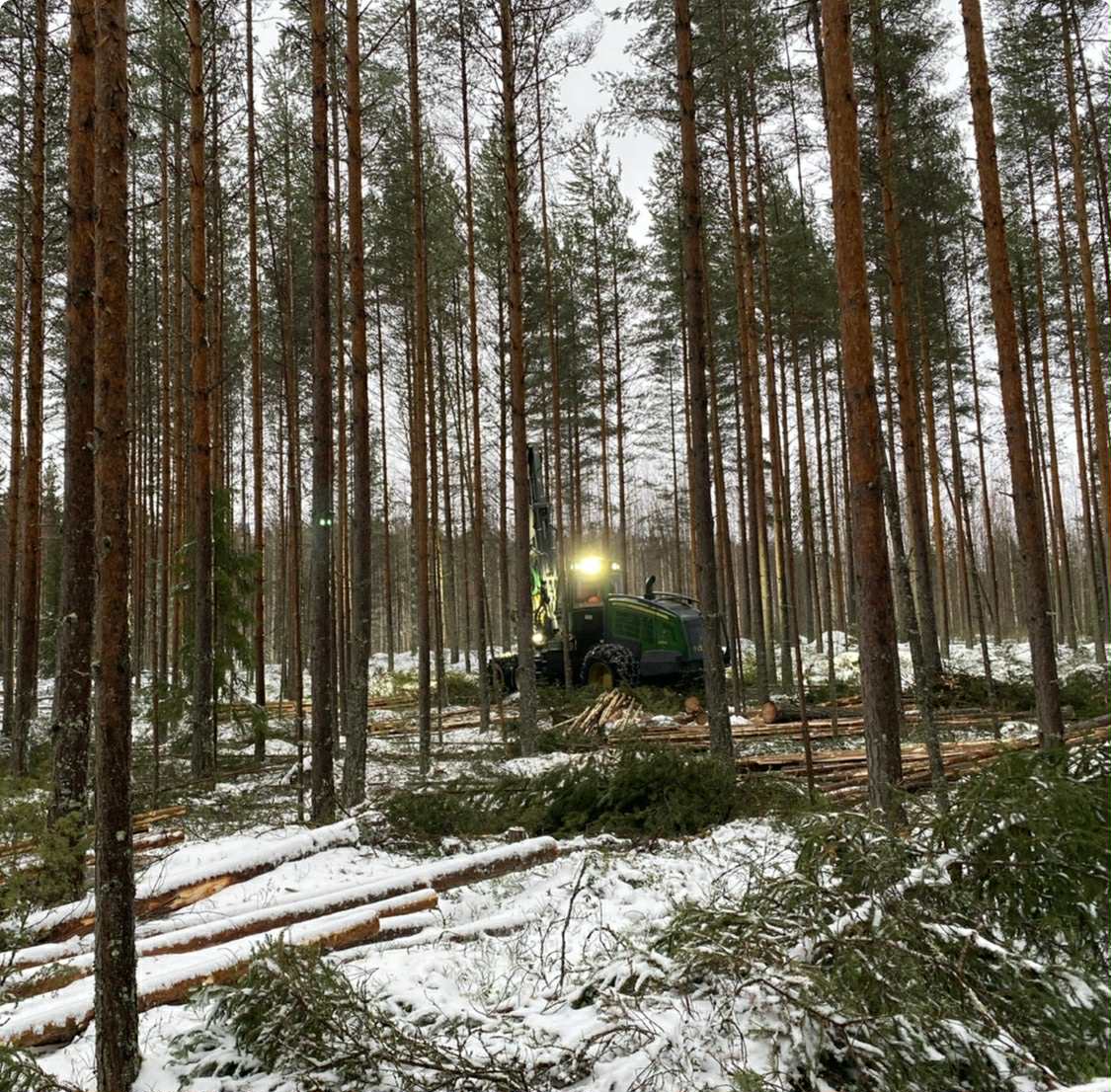
Finland’s timber trade saw a steep decline during the third quarter of the year.
Finland’s timber trade drops sharply as prices hold firm in Q3. According to the industry association Metsäteollisuus ry, member companies bought 4.8 million cubic metres of wood from privately owned forests between July and September. This represents a forty-two per cent decrease compared with the same period last year and stands roughly one-third below the five-year average.

-
That’s a remarkable amount of work hours for a single machine, the Norcar 600 owned by Erkki Rinne is taken well care of, it even has the original Diesel engine.
-
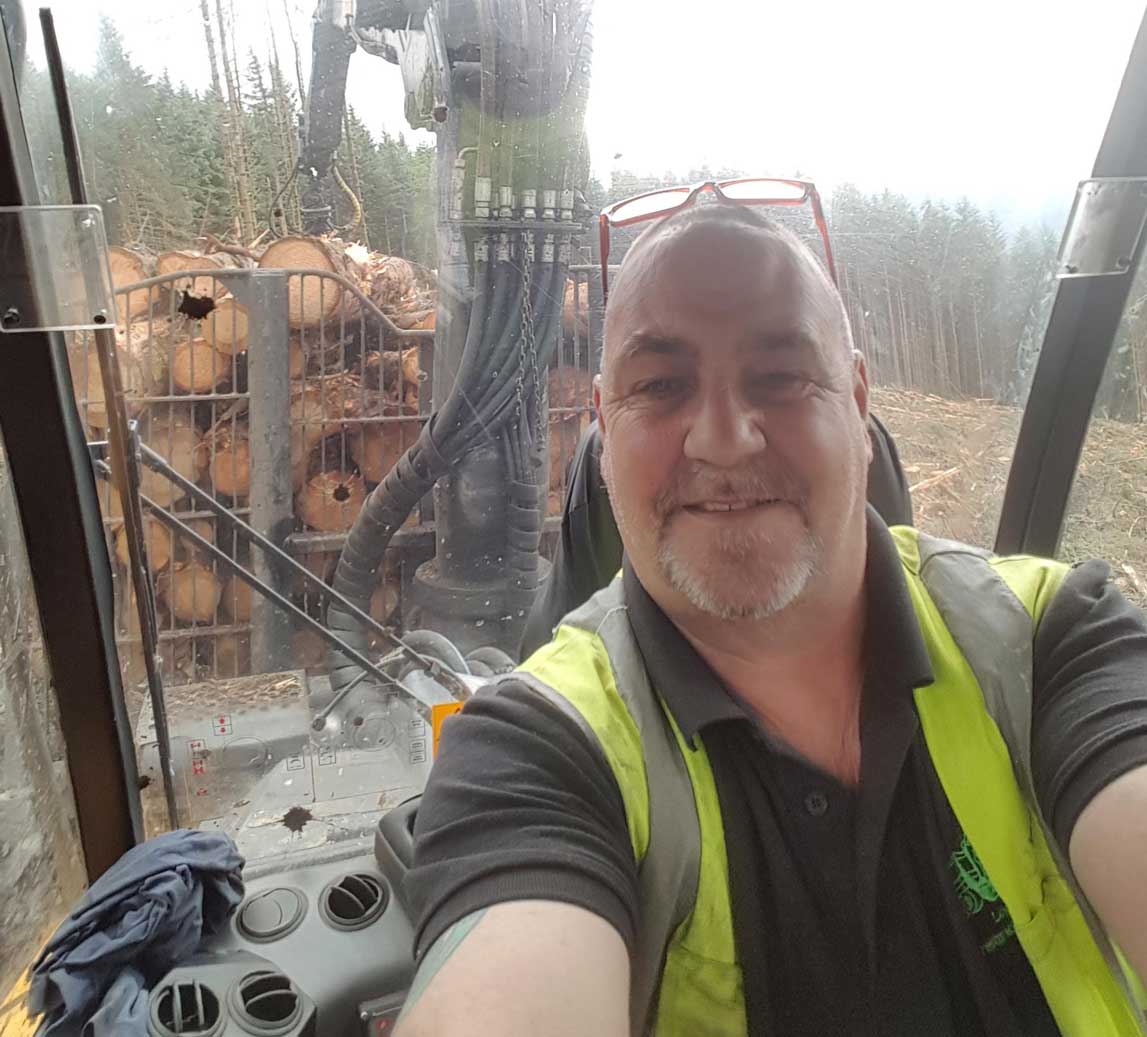
Kieran Anders is a forestry contractor working in the lake district. His work involves hand cutting and extracting timber using a skidder and tractor-trailer forwarder.
-
It is not possible to eliminate chain shot, but there are simple steps that can be taken to reduce the risk.
-
Arwel takes great pride in the fact that the mill has no waste whatsoever, “the peelings are used for children’s playgrounds, gardens and for farm animals in barns in the winter and the sawdust has multiple uses in gardens and farms as well.
-
Timber hauliers need to encourage young blood in, and also look after the hauliers we have, we need make the sector a safe and positive place to work.
FIND US ON
Purchases of pulpwood reached 2.3 million cubic metres, while log volumes amounted to 2.0 million cubic metres. Both categories remain well below normal levels. Pulpwood volumes are more than one-third under the long-term average, and log purchases are nearly forty per cent lower.
The sharp decline reflects a broader market uncertainty. Finland’s forest industry has in recent years faced rising production costs, weaker international demand and a more volatile global economic environment. Lower timber purchases risk intensifying the financial pressures already affecting the sector.
Stumpage prices remain unusually high despite lower demand
Although overall trade volumes have decreased, stumpage prices remain at historically high levels. Prices fell slightly from the record highs seen in the previous quarter. Stumpage prices for conifer logs decreased by four per cent and birch logs by five per cent. Pulpwood also fell by five per cent compared with the previous quarter.

Even with these reductions, prices remain significantly above 2022 levels. Conifer log prices are still twenty and fourteen per cent higher than the average for that year. Birch log prices have risen by approximately one-third since 2022. Pulpwood prices have increased even more sharply, with an average rise of fifty-five per cent over the same period.
Price differences can be substantial even between neighbouring forest plots. Factors such as tree quality, size, terrain, transport distances, harvesting techniques and seasonal conditions all influence the final price.
Industry calls for more active forest management amid uncertainty
According to Metsäteollisuus ry, the weakened timber market combined with high costs highlights a deeper structural challenge – increasing uncertainty in the operational environment. The organisation stresses the importance of long-term forest management to maintain growth potential, economic value and resilience to changing climate and market conditions.
– “Active forest ownership and management secure forest growth and vitality. At the same time, forests’ ability to adapt to climate change improves. This forms the basis for sustainable economic development and ensures the availability of raw materials in production forests,” said Maija Rantamäki, Head of International and EU Forest Affairs at Metsäteollisuus ry, in the original statement.
She also notes that government subsidies for forest management were exhausted already in 2024 and appear likely to run out again this year. According to the organisation, this should not prevent forest owners from carrying out essential measures, especially those in the
early stages of the forest cycle, which are crucial for future growth and economic returns.
Industry representatives warn that insufficient forest management could reduce future timber supply at a time when raw material costs are rising and demand conditions remain unstable.
Fact
– Timber purchases fell by forty-two per cent compared with Q3 2024
– Stumpage prices remain significantly above 2022 levels
– Government subsidies for forest management have run out early two years in a row
Source: Metsäteollisuus ry

Sign up for our free monthly newsletter here
Contact forestmachinemagazine@mail.com to get your products and services seen on the world’s largest professional forestry online news network.
#homeoflogging #writtenbyloggersforloggers #loggingallovertheworld
Written by loggers for loggers and dedicated solely to the equipment used in forestry operations.