The UK is Volvo Trucks Largest Market For Gas Powered Trucks
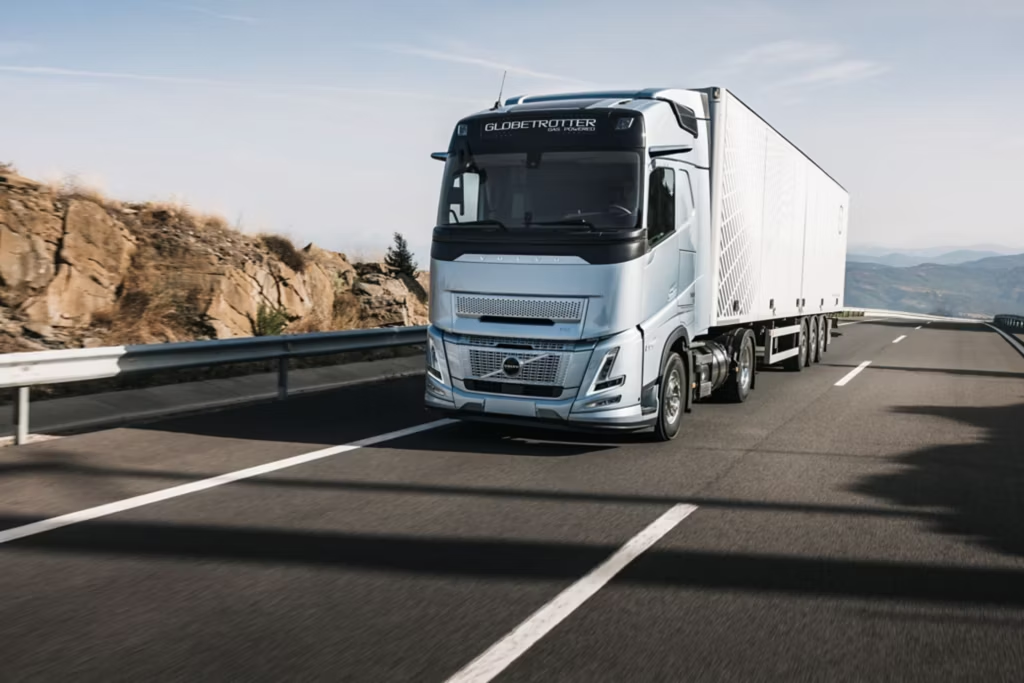
Volvo Trucks Milestone-Volvo’s gas-powered trucks are growing in volume as more markets are embracing alternative fuels that enable significant reduction of CO2 emissions. 2025 was Volvo’s best sales year ever for trucks powered by gas thanks to leading products and the favorable supply and cost of fuel.
Volvo Trucks has now delivered more than 10,000 gas-powered trucks globally since the company introduced this technology in 2018. So far, UK is Volvo’s leading market, followed by Germany, Sweden, the Netherlands, Norway, and France. New upcoming gas markets include India and Latin America, where volumes are growing steadily.

-
That’s a remarkable amount of work hours for a single machine, the Norcar 600 owned by Erkki Rinne is taken well care of, it even has the original Diesel engine.
-
Kieran Anders is a forestry contractor working in the lake district. His work involves hand cutting and extracting timber using a skidder and tractor-trailer forwarder.
-
It is not possible to eliminate chain shot, but there are simple steps that can be taken to reduce the risk.
-
Arwel takes great pride in the fact that the mill has no waste whatsoever, “the peelings are used for children’s playgrounds, gardens and for farm animals in barns in the winter and the sawdust has multiple uses in gardens and farms as well.
-
Timber hauliers need to encourage young blood in, and also look after the hauliers we have, we need make the sector a safe and positive place to work.
FIND US ON
Volvo offers gas-powered engines in its heavy-duty truck models, including the FM, FH, and FH Aero. These trucks can run on traditional liquefied natural gas (LNG) or bio-LNG, which is a renewable gas made from organic waste.
According to Jan Hjelmgren, the Head of Product Management at Volvo Trucks, “Volvo’s gas engine technology stands out for its power, smooth performance, and fuel efficiency. Our customers enjoy the strong performance and comfort of our gas trucks.” He emphasizes that gas-powered trucks are a significant step toward reducing emissions in transportation.
These trucks can travel up to 1,000 kilometers on a single tank, making them great for long-distance journeys, regional deliveries, and construction work. They offer a practical option for those looking for more environmentally friendly choices in transportation, especially as businesses seek sustainable solutions.
In several countries, there is already a well-developed network of gas filling stations and rapidly expanding access to bio-LNG. Some examples are Germany, Norway, Finland, and Sweden where all gas filling stations now offer the fuel. This enables many users to achieve CO2 reductions of up to 100% (Well to Wheel). In markets where tax incentives and public support for renewable fuels and low emissions are available, bio-LNG becomes a highly cost-effective alternative.
Volvo’s advanced gas engine technology is derived from its highly successful D13 powertrain, delivering diesel-like performance while substantially cutting CO2 emissions.
Volvo’s gas-powered trucks – facts:
- Volvo Trucks’ gas-powered trucks use the fuel-efficient HPDI (High Pressure Direct Injection) technology from supplier Cespira
- Volvo’s gas engine solution uses a small amount of diesel as ignition fuel, and when using HVO (Hydrogenated/ Hydrotreated Vegetable Oil) for ignition, CO₂ can be reduced up to 100% (Well to Wheel) versus a diesel-powered truck
- Biomethane is produced from organic waste liquified to bio-LNG
- Bio-LNG represents one of the fuel types for combustion engines which are a crucial part of Volvo Trucks’ powertrain strategy to reach net-zero tailpipe emissions by 2040
- Volvo Trucks’ three-path strategy to reach net-zero tailpipe emissions consists of battery-electric, fuel-cell electric, and combustion engines using renewable fuels

Sign up for our free monthly newsletter here
Contact forestmachinemagazine@mail.com to get your products and services seen on the world’s largest professional forestry online news network.
#homeoflogging #writtenbyloggersforloggers #loggingallovertheworld
Written by loggers for loggers and dedicated solely to the equipment used in forestry operations.