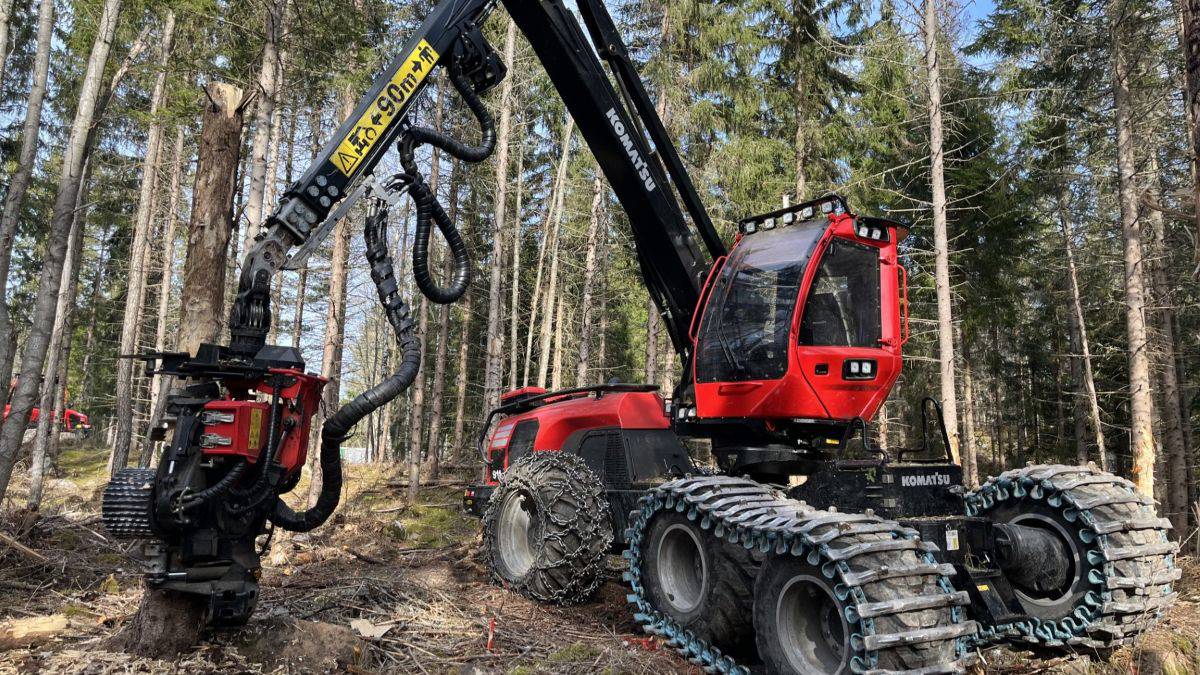
Crane tip control makes it easier to manoeuvre the harvester crane between remaining trees
Crane Tip Control Photo: Elias Mörnberg
“A standardized field experiment with novice drivers shows clear time savings. We therefore recommend that crane tip control is introduced as standard on new forest machines.” Skogsforsk
Driving harvesters in thinning places high demands on the operator. The operator must not only choose the right tree, but also manoeuvre the crane – and the trunk that the head may be holding – between the remaining trees without causing damage. According to existing literature, crane driving accounts for up to 90 percent of the total working time in thinning. That is why technical driver assistance that simplifies crane operation is particularly interesting.

-
That’s a remarkable amount of work hours for a single machine, the Norcar 600 owned by Erkki Rinne is taken well care of, it even has the original Diesel engine.
-
Kieran Anders is a forestry contractor working in the lake district. His work involves hand cutting and extracting timber using a skidder and tractor-trailer forwarder.
-
It is not possible to eliminate chain shot, but there are simple steps that can be taken to reduce the risk.
-
Arwel takes great pride in the fact that the mill has no waste whatsoever, “the peelings are used for children’s playgrounds, gardens and for farm animals in barns in the winter and the sawdust has multiple uses in gardens and farms as well.
-
Timber hauliers need to encourage young blood in, and also look after the hauliers we have, we need make the sector a safe and positive place to work.
FIND US ON
In this study, we investigated how crane tip control affects the time required to operate the crane in thinning-like conditions. With crane tip control, the operator controls the tip of the crane directly, instead of having to coordinate each individual crane joint.
Standardized field experiment with novice riders
We conducted a standardized field experiment that simulated the control of the harvester’s crane between remaining trees, similar to situations during thinning. The experiment was carried out with a medium-sized harvester (Komatsu 911) equipped with Smart Crane, Komatsu’s version of crane control.
A total of 18 students from Uppsala Vocational Upper Secondary School Jälla participated. All were beginners with limited experience of harvesting work. In each run, the operator (i.e. student), from a fixed machine position, would steer the crane to 13 standing trees and grab them with the head – without felling them. Since the trees were still standing, the exact same task could be repeated several times. Each operator completed the task three times with traditional crane control and three times with crane tip control, i.e. a total of six runs per operator.
Almost ten percent faster with crane tip control
The results show that operators solved the task on average 9.5 percent faster when using this. Most drivers benefited from the technology, although the size of the time gain varied between individuals. Overall, the results show that crane tip control works for a large majority, not just for individual operators.
Greatest benefit in thinning
Together with previous research, our results indicate that crane tip control for harvesters has greater time-saving potential in thinning than in final felling. When remaining trees limit the working space and the operator has to make decisions about tree selection at the same time, the cognitive load increases – and it is in these situations that crane tip control seems to have the greatest effect.
Our recommendation
We recommend that crane tip control be fully integrated into machine operator training. With the technology, students can spend less mental energy coordinating the crane’s joints and instead focus on tree selection, driving routes, nature considerations and correct bucking. In practice, crane tip control has few disadvantages, apart from a slightly higher purchase cost. Based on our results and previous studies, we therefore recommend that crane tip control be introduced as standard on new forest machines, both harvesters and forwarders.
At the same time, we note that despite many research projects on crane automation,
the effects of automation solutions other than crane tip control in practical forestry work are still relatively poorly documented. We therefore believe that future research should focus more on other forms of crane automation, preferably in studies conducted under real driving conditions.
Source, Skogsforsk
Sign up for our free monthly newsletter here
Contact forestmachinemagazine@mail.com to get your products and services seen on the world’s largest professional forestry online news network.
#homeoflogging #writtenbyloggersforloggers #loggingallovertheworld
Written by loggers for loggers and dedicated solely to the equipment used in forestry operations.