
A harvesting job can be priced, planned and machine-ready – then held up by one basic question: are you actually allowed to fell the timber? That is where the felling licence rules UK operators work under stop being paperwork in the background and start affecting production, haulage and contract risk.
Felling Licence-For contractors, woodland managers and timber buyers, this is not just a legal box to tick. It affects when you can start, how much can be taken, who carries the liability and what happens after the stand is cut. Get it wrong and you are not simply dealing with admin. You can be facing enforcement action, delays, restocking duties and an awkward conversation about who assumed what had already been sorted.

-
The WeighPro Wireless Weighing Link represents a precise and dependable weighing system designed specifically for round timber, eliminating the need for re-calibration. This system offers operators minimal maintenance requirements, boasting an impressive battery life of up to two years between recharges.
-
That’s a remarkable amount of work hours for a single machine, the Norcar 600 owned by Erkki Rinne is taken well care of, it even has the original Diesel engine.
-
It is not possible to eliminate chain shot, but there are simple steps that can be taken to reduce the risk.
-
Arwel takes great pride in the fact that the mill has no waste whatsoever, “the peelings are used for children’s playgrounds, gardens and for farm animals in barns in the winter and the sawdust has multiple uses in gardens and farms as well.
-
Timber hauliers need to encourage young blood in, and also look after the hauliers we have, we need make the sector a safe and positive place to work.
FIND US ON
Felling licence rules UK operators work under
In simple terms, a felling licence is permission to fell growing trees. In most cases across Great Britain, you need one unless a clear exemption applies. The rules sit slightly differently depending on whether you are working in England, Scotland or Wales, because the relevant forestry authority differs, but the practical point on site is much the same – do not assume commercial felling is lawful just because the crop is yours to buy or harvest.
That distinction catches people out. Ownership of the timber, or having a harvesting contract in place, does not automatically give authority to fell. The legal right to carry out the operation still has to line up with the licensing position.
A licence normally relates to a defined area, a stated volume or crop, and conditions around restocking or management. It is not a vague permission slip. If your work on the ground drifts away from what was approved, the problem starts there.
When a felling licence is usually required
If you are clearfelling, thinning at commercial scale, restructuring a plantation, removing broadleaf blocks, or carrying out work linked to woodland management plans, expect a licence to be required unless the operation falls inside a recognised exemption. For most professional forestry work, the safe starting point is to assume a licence is needed and then check whether an exemption genuinely applies.
That matters because the exemptions are narrower than some operators think. A bit of hearsay about what can be felled without permission has caused more than one avoidable enforcement issue.
The rules are aimed at growing trees, not just saleable timber. So if a stand is standing and rooted, the licensing question applies whether the eventual end market is sawlog, chipwood, biomass or site clearance.
The small volume exemption
The exemption most often discussed is the small volume threshold. Broadly, up to 5 cubic metres in a calendar quarter may be felled without a licence, provided no more than 2 cubic metres are sold. That sounds straightforward until it is tested against real operations.
For a domestic woodland owner taking a few stems for private use, that may be relevant. For a contractor with a machine on site, it usually is not. Volumes add up fast, and once saleable timber starts moving off site, the margin for getting the calculation wrong gets very thin.
It is also not a loophole for piecemeal commercial felling. Deliberately breaking a larger operation into smaller cuts to stay under the threshold is asking for trouble.
Other exemptions – useful, but not universal
There are exemptions for some orchard work, certain garden trees, trees posing an immediate danger, and felling directly required by other statutory permissions. There can also be situations involving planning consent where separate rules come into play. But this is where professional caution matters.
An exemption is not something to assume because a client says the trees are unsafe or the site is being developed. The basis for the exemption has to be real, defensible and correctly understood. If there is any doubt, it needs checking before the saws or heads start working.
The site reality – who should check what?
In practice, the woodland owner or manager often makes the application, but contractors should not treat that as the end of their concern. If you are mobilising harvesters, forwarders and haulage into a site, you need confidence that the legal basis for the felling is sound.
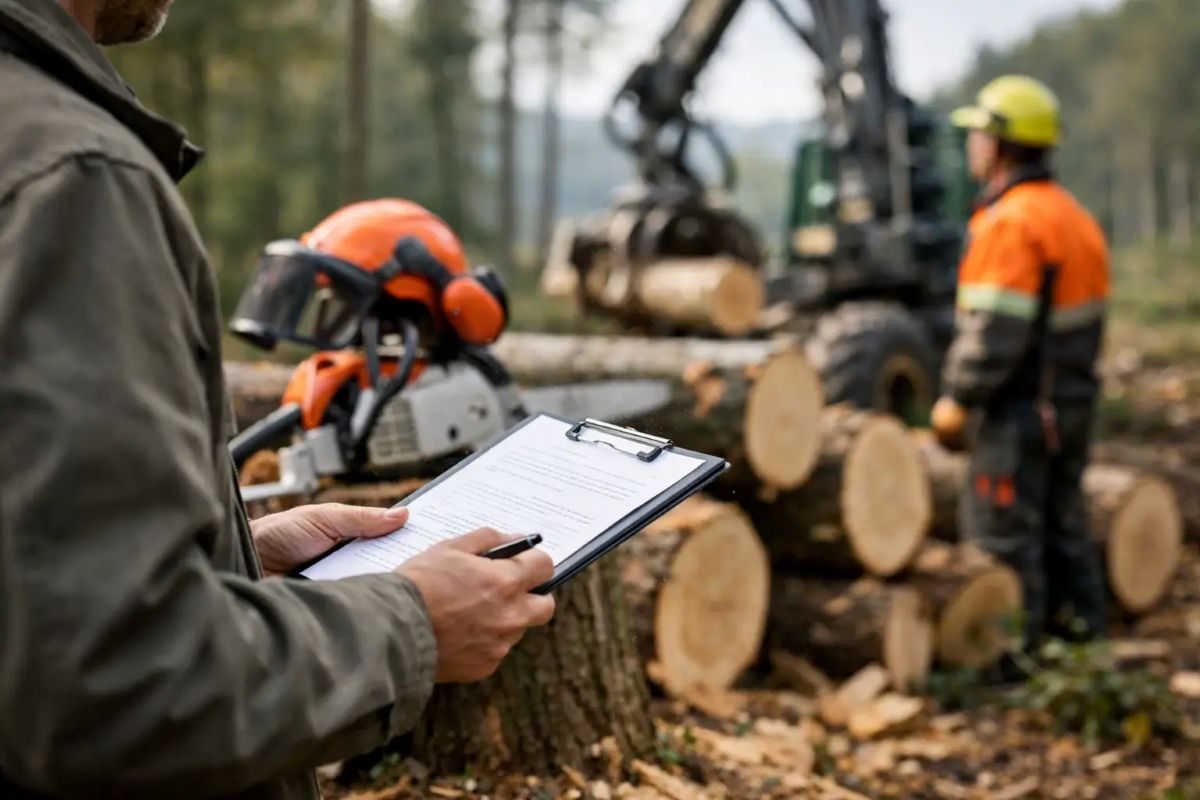
That does not mean the contractor carries all responsibility for the licence itself. It does mean asking sensible questions before work starts. Is there a valid felling licence in place? Does it cover the area being worked? Are there conditions attached? Is the restocking obligation understood? Has the approved boundary been marked clearly enough to keep the operation inside it?
Those are practical questions, not desk-based niceties. A line shown vaguely on a map can become a problem very quickly once a machine operator is working close to retained strips, water margins or neighbouring woodland compartments.
Restocking conditions matter more than some think
A felling licence often comes with a duty to restock. That is one of the most important parts of the approval and one that gets overlooked by people focused only on getting the crop out. In many cases, the licence will specify what must happen after felling, by when, and how successful regeneration is to be established.
For owners and managers, that is an obvious long-term obligation. For contractors, it still matters because the restocking condition can affect method, timing and site presentation. Ground damage, brash management, protection of retained trees and control of extraction routes can all influence what happens next.
If a site is left in a condition that makes replanting or natural regeneration harder, the commercial argument that the harvesting contract is finished will not do much to ease tensions. Good operators know the end of felling is not the end of the job’s consequences.
Common mistakes around felling licence rules UK sites still see
The first is assuming someone else has checked. A buyer assumes the manager sorted it. The contractor assumes the buyer sorted it. The operator assumes the marked area reflects the approval. That chain of assumption is where avoidable breaches begin.
The second is treating an old permission as if it still applies. If boundaries, species mix, volume, timing or management intent have changed, the original approval may no longer match the operation on the ground.
The third is poor mapping and poor communication. If the machine operator cannot clearly see what is in and what is out, the paperwork is only half doing its job.
The fourth is confusion between felling permission and other consents. A licence does not wipe away the need to consider protected sites, watercourse rules, wildlife legislation, planning issues or access constraints. Equally, having another consent in place does not always remove the need for a felling licence.
How enforcement risk shows up in the real world
Most forestry professionals are not trying to work outside the law. Problems usually come from complacency, outdated assumptions or poor handover between office and site. But intent does not remove the consequences.
Unauthorised felling can trigger enforcement action and compulsory restocking. It can also damage relationships with landowners, timber buyers, neighbours and regulators. On commercial jobs, that can mean delayed invoices, disputed liability and lost future work.
From a business point of view, it is a risk management issue as much as a legal one. A contractor who turns up with a six-figure machine train on site needs clarity before the first stem is taken. Waiting until a question is raised halfway through the job is too late.
What good practice looks like before machines move in
The sensible approach is straightforward. Check the licence status early, not the day before mobilisation. Read the actual permission rather than relying on a verbal assurance. Make sure the approved area and any exclusions are marked in a way that works for the operator in the cab. Confirm whether there are restocking conditions or timing constraints that affect the harvesting plan.
It is also worth matching the licence to the reality of the crop. If windblow, disease, access changes or revised silvicultural objectives have altered the job materially since consent was granted, pause and check whether the approved operation still fits.
That level of discipline is not overkill. It is the same kind of due diligence most operators already apply to haulage weights, machine transport, PUWER checks or site risk assessments. The licence position belongs in that same pre-start routine.
Why this is not just a woodland owner issue
There is sometimes a view that licensing is the owner’s problem and harvesting is the contractor’s problem. In the real trade, that division is too neat. Forestry jobs are collaborative, and regulatory failures tend to spread across everyone involved.
If you are managing a site, buying standing timber, organising harvesting or putting labour and machinery into the coupe, the felling licence position affects you. The closer you are to operational delivery, the less sensible it is to stay blind to it.
That is especially true on tight-margin contracts. One hold-up over a licensing query can knock machine utilisation, haulage scheduling and mill deliveries off course for days. The legal point and the commercial point are tied together.
For a trade title like Forest Machine Magazine, this is one of those subjects that sounds dry until it stops a job. Then it becomes very real very quickly.
The workable mindset is simple – treat the licence as part of the harvest plan, not an attachment to it. If the permission is clear, the boundaries are right and the conditions are understood, the job has a fair chance of running as it should. If any of that is vague, sort it before the first tree is on the deck.
Sign up for our free monthly newsletter here
Contact forestmachinemagazine@mail.com to get your products and services seen on the world’s largest professional forestry online news network.
#homeoflogging #writtenbyloggersforloggers #loggingallovertheworld
Written by loggers for loggers and dedicated solely to the equipment used in forestry operations.