Image Copyright: Scottish Forestry
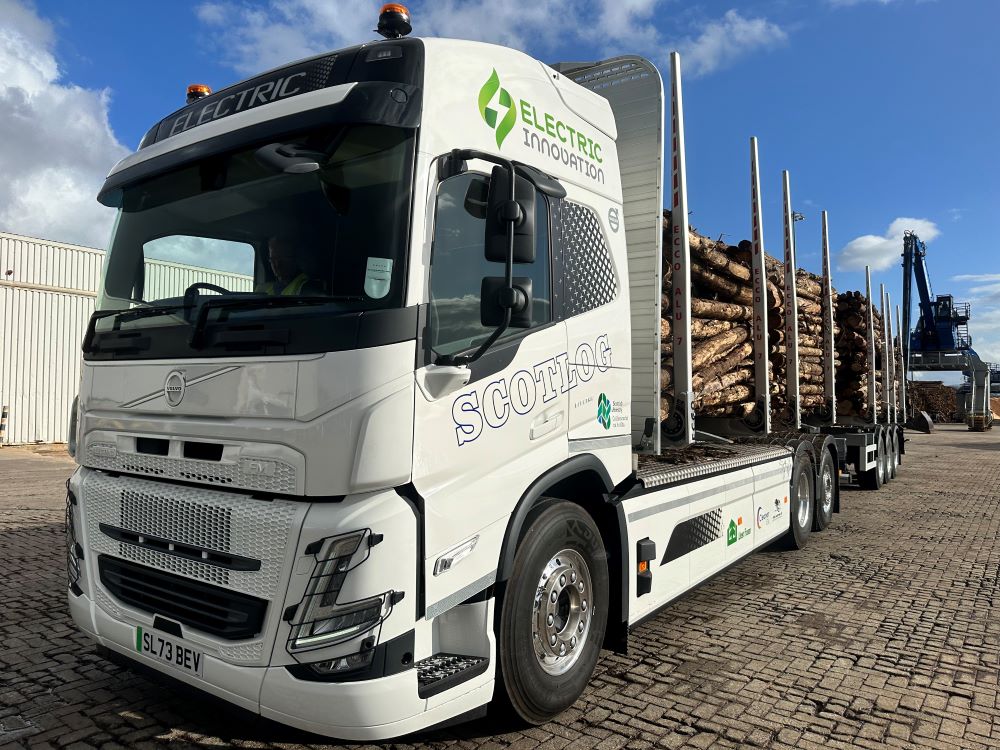
The Net Zero Timhaul pilot project which is testing how electric timber lorries stand up in forestry operations, is into the third year.. Already the trucks have transported around a quarter of a million tonnes of timber. Forestry Transport & Innovation Advisor, William Clarke, writes on the first two years.
Considering increasing fuel prices and effects on timber businesses, the upcoming ban on sales of ICE vehicles over 26 tonnes in 2040, and increasing eHGV focused support from Scottish Government, there has never been a better time for hauliers to “plug in to stand out”.
The Net Zero Timhaul (NZTH) pilot project was originally developed to explore how battery electric HGVs (eHGVs) can replace diesel vehicles in forestry operations as a practical step towards zero emission operations.

Now, at the end of year 2, the NZTH eHGVs have collectively completed 132,309 km (82,213 miles) avoiding 165 TCO₂eq total, comfortably saving just over 1 kgCO₂eq/km per lorry with operational ranges of 182 km (113 miles) on a full battery.
Overall, the second year of NZTH has delivered substantive technical and operational insights, building on the baseline performance, system reliability, and operational integration data. Findings to date include:
- Despite high capex, operational costs for eHGVs are much lower so the payoff distance where parity is reached with the diesel equivalent is c.131,000 miles or 5-years.
- The lorries reduce emissions by 1.186 kgCO2e/km (0.74 kgCO2e/mile) which, taking account of particulates etc, is a 91% reduction over the diesel equivalent.
- The Plug-In Truck Grant is now available providing operators with £120,000 grant support to reduce capex.
- 2025 saw a record 170% increase in eHGV registrations globally with more than 500 units ordered in the UK alone.
- Another 748 charging hubs were added nationally with a 41% increase in Ultra-rapid (>150 kW) chargers and 400 kW chargers becoming available.
- More than £200 million support is being invested in charging infrastructure
-
That’s a remarkable amount of work hours for a single machine, the Norcar 600 owned by Erkki Rinne is taken well care of, it even has the original Diesel engine.
-
Kieran Anders is a forestry contractor working in the lake district. His work involves hand cutting and extracting timber using a skidder and tractor-trailer forwarder.
-
It is not possible to eliminate chain shot, but there are simple steps that can be taken to reduce the risk.
-
Arwel takes great pride in the fact that the mill has no waste whatsoever, “the peelings are used for children’s playgrounds, gardens and for farm animals in barns in the winter and the sawdust has multiple uses in gardens and farms as well.
-
Timber hauliers need to encourage young blood in, and also look after the hauliers we have, we need make the sector a safe and positive place to work.
FIND US ON
Related Posts

You can read more in the 2025 Progress Report and the team have produced a short film.
This project is funded by Scottish Forestry through the Strategic Timber Transport Fund, with support from partners Creel Maritime, James Jones and Sons, and Scotlog.
Sign up for our free monthly newsletter here
Contact forestmachinemagazine@mail.com to get your products and services seen on the world’s largest professional forestry online news network.
#homeoflogging #writtenbyloggersforloggers #loggingallovertheworld
Written by loggers for loggers and dedicated solely to the equipment used in forestry operations.