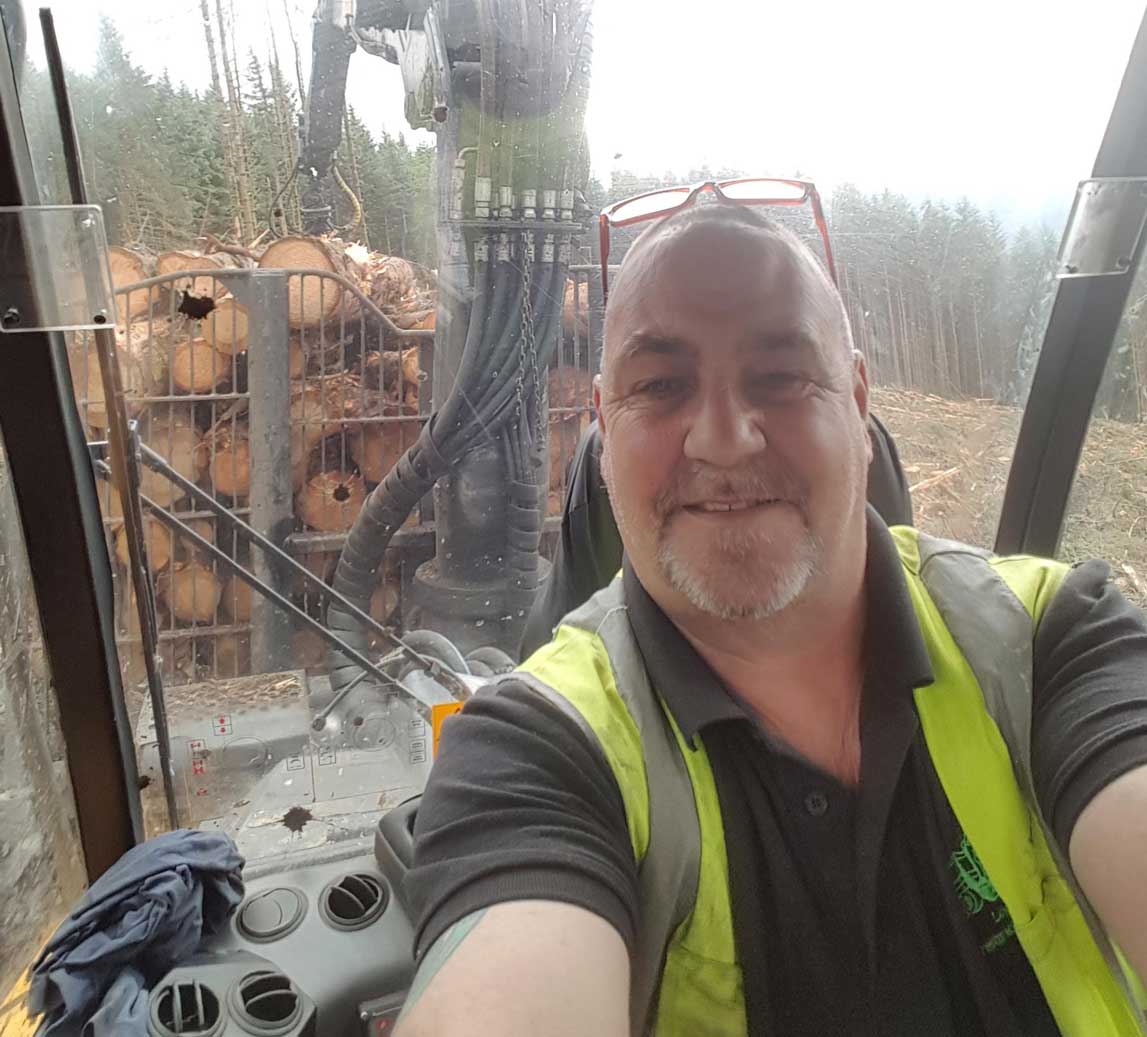

Forestry can be a very good investment, but only for buyers who understand that trees do not work to quarterly targets. In this trade, value is built over years through timber growth, land quality, access, species choice, management discipline and the market you expect to sell into.
Is forestry a good investment opportunity-Yes it is as it attracts a very mixed crowd. Some buyers want productive conifer blocks with haulage access and a clear harvest cycle. Others are looking at mixed woodland for long-term land holding, carbon potential or shelterbelt value alongside a wider farming business. The investment case changes a lot depending on what sits behind the purchase.

-
That’s a remarkable amount of work hours for a single machine, the Norcar 600 owned by Erkki Rinne is taken well care of, it even has the original Diesel engine.
-
Kieran Anders is a forestry contractor working in the lake district. His work involves hand cutting and extracting timber using a skidder and tractor-trailer forwarder.
-
It is not possible to eliminate chain shot, but there are simple steps that can be taken to reduce the risk.
-
Arwel takes great pride in the fact that the mill has no waste whatsoever, “the peelings are used for children’s playgrounds, gardens and for farm animals in barns in the winter and the sawdust has multiple uses in gardens and farms as well.
-
Timber hauliers need to encourage young blood in, and also look after the hauliers we have, we need make the sector a safe and positive place to work.
FIND US ON
In the UK, forestry has a few qualities that make it attractive on paper. It is a real asset, demand for timber remains tied to construction, packaging, panel products, biomass and fencing, and well-managed woodland can hold value beyond the standing crop alone. In the right location, the underlying land can be just as important as the timber.
That said, forestry is not a simple asset class. Returns are usually uneven. You may have long periods of management cost and limited income, followed by a major return at thinning or clearfell. If you need quick liquidity, forestry is often the wrong place to look. If you can think in rotations rather than months, it becomes more interesting.
For trade readers, the practical answer is that productive forestry can be a sound investment when four things line up – the crop is right, the ground is workable, extraction and haulage are realistic, and the buyer has a clear route to revenue. Miss one of those and the headline figures can start to look very soft.
What actually drives forestry returns?
The biggest driver is timber productivity. Yield class still matters because it tells you a great deal about how hard the site can work. A fast-growing conifer crop on suitable ground with proper management will always have a stronger commercial story than a poorly stocked woodland bought on optimism.
Species matters as well. Sitka spruce remains central to many commercial woodland purchases because the market understands it, processors understand it, and it performs reliably on the right site. Other species may suit specific soils, climates or policy aims, but they do not always give the same clarity when it comes to future harvesting and sale.
Then there is access. A woodland can look good in a sales brochure, but if extraction is difficult, road frontage is poor, stacking space is limited and lorry movements are constrained, your harvesting cost will rise quickly. That directly affects stumpage value. In commercial forestry, awkward access is not a side issue. It is often the difference between a decent return and a disappointing one.
Timber market timing also has a major effect. Prices move. Demand from sawmills, panel board plants, biomass operators and fencing manufacturers shifts with wider construction and energy conditions. If your crop matures into a weak market, returns can be under pressure. A good forest manager can help with timing, but no one controls the market.
The land value question
A lot of first-time buyers focus on trees and forget the ground beneath them. In practice, land value can be a large part of the investment case. Well-located forestry land in established timber-growing regions tends to attract stronger interest because buyers know there is an operational supply chain around it – contractors, hauliers, processors and forestry agents who know the patch.
That regional context matters. A productive block in a recognised forestry area with decent roading and local market access is usually easier to value than an isolated parcel where harvesting costs are likely to bite. The same volume of timber can mean very different money once machine access, brash management, roadside loading and haulage distance are properly costed.
For owner-operators and contractors, that point is even sharper. If the woodland can integrate into an existing operation, support machine utilisation or give a measure of supply security, the investment may stack up better than it would for a passive buyer.
Grants, tax and policy – helpful, but not a free ride
One reason forestry often comes up in investment discussions is the favourable tax treatment attached to commercial woodland in certain circumstances. That can improve the overall picture, particularly for long-term holders. Grants for woodland creation, restocking and environmental management can also support establishment and maintenance.
But none of that fixes a poor site or a weak commercial plan. Grant-backed planting still needs the right species, the right deer control, the right weed management and the right protection from weather exposure. Policy support can improve viability, yet operational forestry still wins or loses in the ground conditions.
There is also a regulatory angle. Felling permissions, environmental constraints, watercourse protections, public access issues and replanting obligations all need to be factored in. Anyone buying woodland as an investment needs to understand that forestry is not just land ownership. It is an ongoing management responsibility.
Where forestry can go wrong
The weakest forestry investments are often the ones bought on sentiment, not numbers. Buyers see mature trees and assume easy money. Then they discover windblow risk, poor internal roads, a crop past its best, or a harvesting operation that becomes expensive before the first stick reaches the weighbridge.
Small woodland parcels can also disappoint buyers who expect commercial-scale performance. There may be good reasons to own a small block, but if the objective is straightforward timber return, scale matters. Mobilising harvesters, forwarders and haulage into a difficult or fragmented site can eat into margins at speed.
Risk from storm damage is another serious point. Windblow can wipe out timing and market strategy overnight. Disease and pest pressure are not theoretical either. Species choice has to reflect site conditions and resilience, not just what looked strong in the last sales catalogue.
And then there is patience. Forestry returns are slow by comparison with many other investments. If cash flow is your first concern, woodland rarely behaves in a convenient way.
Is forestry a good investment compared with other assets?
That depends on what you want from it. Forestry does not behave like equities, and it does not produce the kind of regular income many property investors expect. What it can offer is a hard asset with biological growth, underlying land value and exposure to a sector that remains commercially useful.
For UK buyers with experience in land, agriculture, contracting or timber processing, that can be appealing because the risks are at least understandable. You can inspect a crop, measure access, assess drainage, price the haulage and speak to the local market. It is a trade-facing asset, not just a line on a platform.
For those outside the sector, forestry can still work, but it usually works best with proper management support and realistic expectations. Buying woodland because it sounds steady is not enough. Buying because the crop, site, road access and market line up is a different proposition altogether.
Who is forestry best suited to?
Commercial forestry tends to suit patient capital. It suits buyers who understand land-based businesses, who can tolerate long holding periods, and who are comfortable with uneven cash flow. It also suits operators who gain practical value from ownership – securing timber supply, supporting contracting activity, diversifying a rural business or balancing other land use.
It is less suited to anyone looking for fast turnover or low-touch ownership. Woodland needs management. Harvest planning, restocking, pest control, boundary work, insurance and compliance all need attention. If you treat forestry as a passive purchase, the asset can drift.
The practical answer
So, is forestry a good investment? Yes, it can be – especially where the woodland is productive, access is workable, the management is competent and the buyer understands the market they are buying into. No, it is not if the plan relies on vague future value, ignores harvesting cost, or assumes every woodland behaves like a prime commercial crop.
In this trade, the best forestry investments are usually the least romantic ones. Good ground. Good access. A species mix with a market. Sensible management. Clear figures. That is the part that matters.
If you are weighing up a purchase, look at the woodland like a contractor would look at a job – can it be worked efficiently, can the timber be moved profitably, and what is likely to be left once the real costs are stripped back? Ask that honestly, and the investment case becomes much clearer.
A forest is not a magic asset. It is a working one. Treat it that way, and it has every chance of paying its keep over the long haul.
Sign up for our free monthly newsletter here
Contact forestmachinemagazine@mail.com to get your products and services seen on the world’s largest professional forestry online news network.
#homeoflogging #writtenbyloggersforloggers #loggingallovertheworld
Written by loggers for loggers and dedicated solely to the equipment used in forestry operations.