
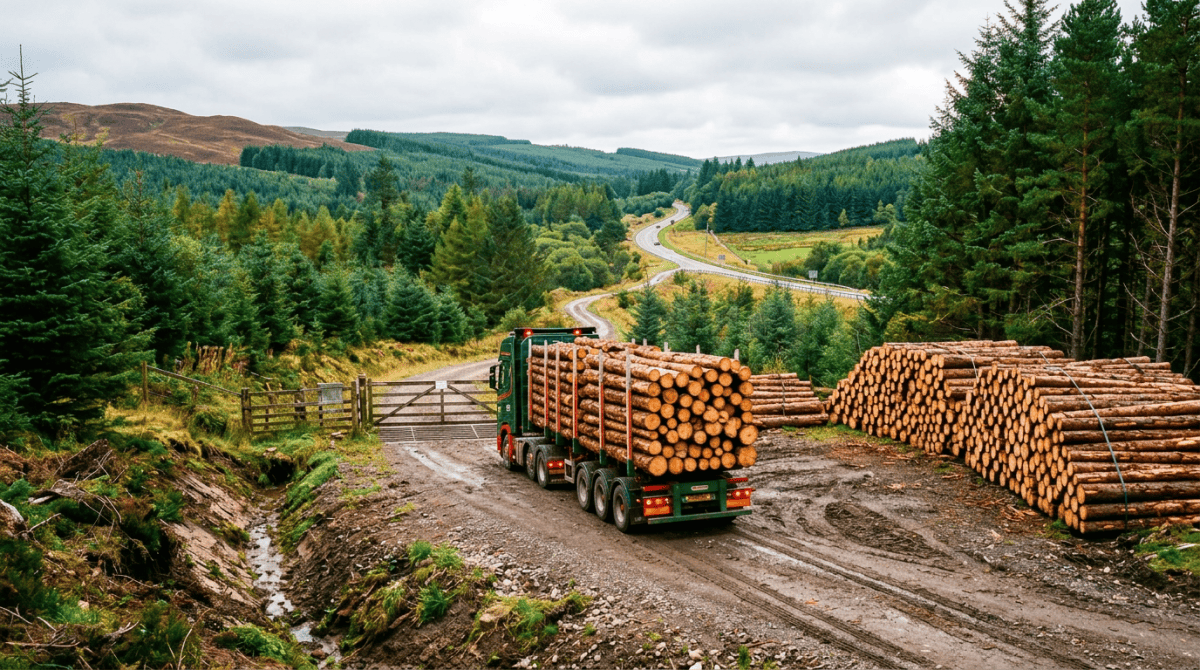
A gate wide enough for a pickup tells you little about whether a timber lorry can collect a load. Between the standing crop and the public road, a forwarder needs a workable extraction route, the timber needs somewhere to be stacked, and the lorry needs room to load and leave. A weakness at any one of those points can change the cost, timing or viability of a harvest. Walk the route before you value the timber.
By Randy Levine
Timber Access-Trace the route from the crop to the road
Mark the likely harvest compartments, extraction routes, roadside stacking areas and exit on one map. Then walk the route with a forestry contractor and ask a timber haulier to review the lorry approach. A contractor may see a workable route out of the crop while the haulier spots a bend or weak crossing that prevents collection. Ask both to identify the point that would stop the job.

-
The WeighPro Wireless Weighing Link represents a precise and dependable weighing system designed specifically for round timber, eliminating the need for re-calibration. This system offers operators minimal maintenance requirements, boasting an impressive battery life of up to two years between recharges.
-
That’s a remarkable amount of work hours for a single machine, the Norcar 600 owned by Erkki Rinne is taken well care of, it even has the original Diesel engine.
-
It is not possible to eliminate chain shot, but there are simple steps that can be taken to reduce the risk.
-
Arwel takes great pride in the fact that the mill has no waste whatsoever, “the peelings are used for children’s playgrounds, gardens and for farm animals in barns in the winter and the sawdust has multiple uses in gardens and farms as well.
-
Timber hauliers need to encourage young blood in, and also look after the hauliers we have, we need make the sector a safe and positive place to work.
FIND US ON
On the extraction leg, look for side slopes, soft hollows, old drains and places where repeated passes could rut the ground or carry sediment towards a watercourse. Ask how the route would work in the intended harvest season. A short route that depends on one unreliable crossing may cost more to use than a longer route on firmer ground. The UK Forestry Standard calls for minimising stream and drain crossings where alternatives are practical and protecting crossing points and waterside areas from machinery damage. [1]
Check the stacking area with the haulier
Stand where the lorry would load and look at the space left once the timber is stacked. Can the lorry approach and leave without the stack occupying its turning area? Can the operator load from a suitable position while keeping other vehicles and people clear? Look for overhead lines, soft verges, steep crossfalls, ditches and any shared access that needs to stay open. Ask the contractor and haulier to mark out the proposed stacking, loading and turning areas on the same plan.
Work through a collection delay as well. If lorries are held up while extraction continues, where will the next loads go? A plan that works only when every pickup arrives on time can leave a forwarder waiting or force timber into space needed for turning. Ask how much timber the site can hold and how the harvest would be phased if storage is tight.
Follow the lorry beyond the gate
Drive the proposed route to the main road. Flag narrow bends, weak bridges, pinch points and places where an approaching vehicle would have nowhere to pass. In areas covered by an Agreed Routes Map, check the classification of the roads serving the woodland. The Timber Transport Forum advises owners or their agents to consult the local authority where the map calls for it and to tell prospective timber buyers about route restrictions or requirements. [2]
Check the private sections separately. Ask your solicitor to review the rights relied on for machinery access and timber haulage, including any limits and responsibility for repairs. A track visible on a map, or a neighbour who allowed the seller through, is a lead to investigate. Ask for the documents behind it and confirm whether any proposed road or crossing works need consent before treating them as part of the plan.
Put a price on the bottleneck
Consider two hypothetical woods with similar standing timber. One has a firm roadside stacking area and a confirmed haulage route. The other has a shorter forwarder run but needs an assessed crossing and a built turning area before lorries can collect. The shorter run may save machine time. That saving must cover the extra work and the possibility of a delayed harvest.

Ask for separate estimates for extraction, road or crossing work, stacking and turning improvements, haulage and reinstatement. Record which figures are firm and which depend on permissions, ground conditions or an inspection. If a bridge is unassessed or a shared route remains unresolved, carry that uncertainty into the offer and harvest timetable. A timber valuation is more useful when it shows how the timber will reach the road and what it will cost to get it there.
Questions to take on the first visit
- Which compartments feed each extraction route, and which sections are likely to fail in wet conditions?
- Where will the timber be stacked, where will the lorry load, and where will it turn?
- Which private access rights and public-road conditions apply to the proposed route?
- What needs inspection, consent or improvement before the first load leaves, and who will pay for it?
Sources
[1] Forestry Commission. The UK Forestry Standard, fifth edition, sections on forest roads and mechanised operations. https://www.gov.uk/government/publications/the-uk-forestry-standard
[2] Timber Transport Forum. Agreed Routes Map consultations. https://timbertransportforum.org.uk/agreed-routes-map/consultations/
Randy Levine runs StrategicLandPurchases.com, which publishes practical guidance for land buyers. https://strategiclandpurchases.com
Contact forestmachinemagazine@mail.com to get your products and services in front of the world’s largest professional forestry online news network.
#homeoflogging #writtenbyloggersforloggers #loggingallovertheworld
Written by loggers for loggers and dedicated to bringing you the latest forestry news