

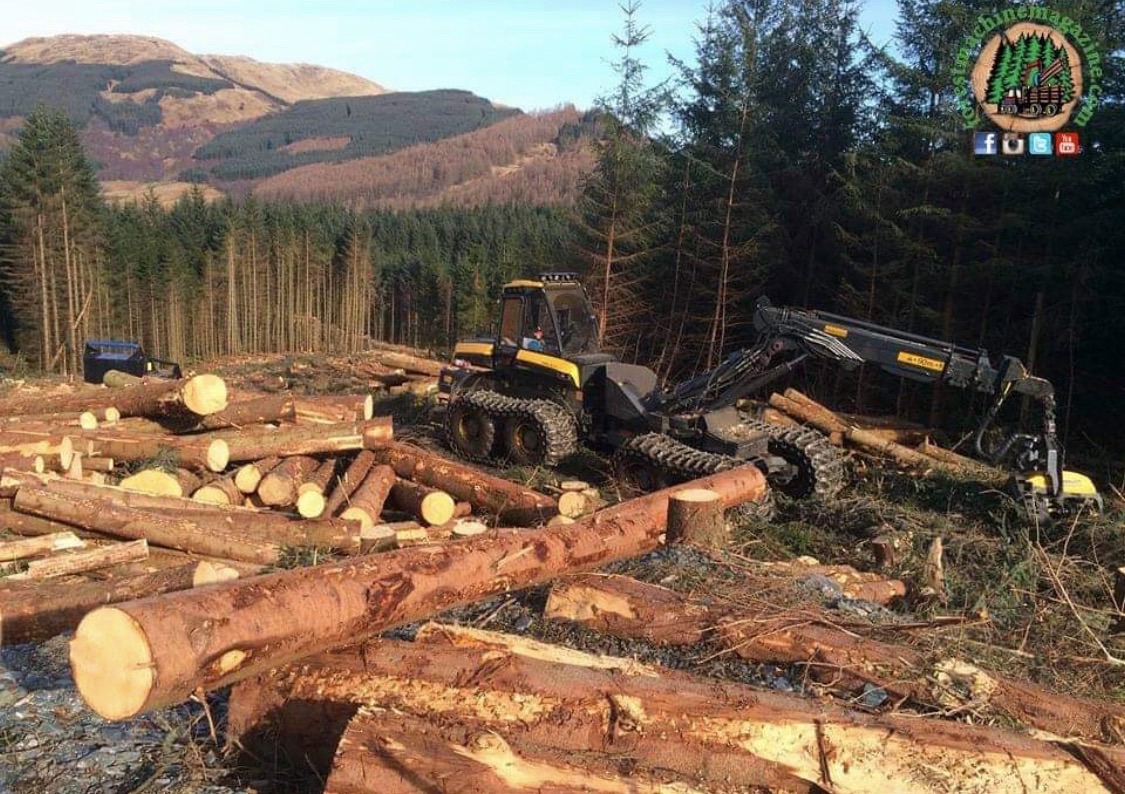
White diesel has just crossed the £2 per litre threshold, while red diesel prices have soared to astonishing levels. Petrol is not far behind, with reports indicating a serious risk of further price hikes, potentially reaching £3 per litre. What implications will this have for the forestry sector?
Fuel Price Crisis-As fuel prices continue to climb, the forestry and timber harvesting sectors are likely to face significant challenges. Fuel is a major operating expense for equipment such as harvesters, forwarders, skidders, chippers, and timber lorries. The rising costs will have serious implications for an industry already navigating one of its most turbulent periods in history.
This will have serious repercussions for an industry going through one of its most turbulent periods in history.

-
The WeighPro Wireless Weighing Link represents a precise and dependable weighing system designed specifically for round timber, eliminating the need for re-calibration. This system offers operators minimal maintenance requirements, boasting an impressive battery life of up to two years between recharges.
-
That’s a remarkable amount of work hours for a single machine, the Norcar 600 owned by Erkki Rinne is taken well care of, it even has the original Diesel engine.
-
It is not possible to eliminate chain shot, but there are simple steps that can be taken to reduce the risk.
-
Arwel takes great pride in the fact that the mill has no waste whatsoever, “the peelings are used for children’s playgrounds, gardens and for farm animals in barns in the winter and the sawdust has multiple uses in gardens and farms as well.
-
Timber hauliers need to encourage young blood in, and also look after the hauliers we have, we need make the sector a safe and positive place to work.
FIND US ON
This will create;
Higher harvesting costs– contractors will need much higher rates just to keep afloat
Marginal sites become unviable-steep, wet, low-volume or long extraction jobs will have to be postponed
Pressure on contractors-smaller contractors with older, less fuel efficient equipment will be hit the hardest.
Timber haulage– long-distance transport of wood would be difficult to justify
Pressure on sawmills and wood processors-timber prices will escalate, which will have a further impact on house building and construction.
Reduced machine utilisation — contractors may stop taking low-margin work rather than operate machines simply to keep them busy.
Mechanisation could change — there could be renewed interest in simpler machines, excavator-based systems, cable extraction, and other systems that reduce total cost on particular sites. Automation and productivity become more valuable — getting more tonnes per litre and per machine-hour becomes critical
The Bigger Danger
The real problem isn’t simply expensive diesel. It’s the combination of diesel + machinery costs + wages + finance + insurance + repairs + haulage + weak timber prices.
For example, if a harvesting contractor’s fuel bill rose by £20,000 a year, but timber prices didn’t rise, that £20,000 comes directly out of the contractor’s margin unless productivity or rates change.
That could accelerate contractors leaving the industry. If enough contractors disappear, forest owners may end up with timber they want harvested but don’t have enough suitable harvesting capacity to remove it.
Expect rising diesel prices to push UK forestry towards fewer contractors, higher harvesting rates, greater productivity per machine, shorter timber supply chains and much more careful selection of which forests are economically viable to harvest.
For a representative UK mechanised Sitka spruce operation, if you use 1.8 litres of diesel per tonne for harvester + forwarder. That’s just an illustrative figure—actual consumption can vary considerably with terrain, extraction distance, machine size and utilisation.
Fuel cost per tonne harvested
£1.50/L = £2.70/t
£2.00/L=£3.60/t
£2.50/L = £4.50/t
£3.00/L = £5.40/t
£3.50/L = £6.30/t
So going from £1.50 to £3.00/L doubles the harvesting fuel cost, adding about £2.70/t before considering haulage.
Haulage is where it gets interesting
Suppose a timber lorry carries 28 tonnes and averages around 2.5 km/L loaded. A 100-km delivery can consume a substantial amount of fuel, particularly when the empty return journey is included.
At £3/L, a long-distance timber delivery could therefore add several pounds per tonne more than it would at £1.50/L.

That means a forest producing relatively low-value pulpwood or small-diameter roundwood could become particularly vulnerable.
What happens at £3/L diesel?
Imagine a harvesting operation currently costing:
£20/t harvesting + £10/t haulage = £30/t
If fuel increases sufficiently to add:
* +£2.70/t to harvesting
* +£3–5/t to haulage
the total could become roughly £36–38/t.
If the roadside value of the timber hasn’t increased correspondingly, someone’s margin gets squeezed.
And this is why I think high diesel prices could accelerate the restructuring of UK forestry contracting.
The operations most exposed would be:
Long extraction distance → steep/wet ground → low timber volume → small/poor-quality timber → long haul to mill
Whereas high-volume, productive sites close to a mill are much better positioned.
There is also an important knock-on effect: if diesel reached £3/L and stayed there, machine productivity would become almost as important as machine purchase price. A harvester that produces 25 tonnes/hour rather than 18 tonnes/hour could have a significant advantage even if it costs more to buy.
Contact forestmachinemagazine@mail.com to get your products and services in front of the world’s largest professional forestry online news network.
#homeoflogging #writtenbyloggersforloggers #loggingallovertheworld
Written by loggers for loggers and dedicated to bringing you the latest forestry news