I asked Can-Am what makes their ATVs especially well-suited for forestry and land management tasks.
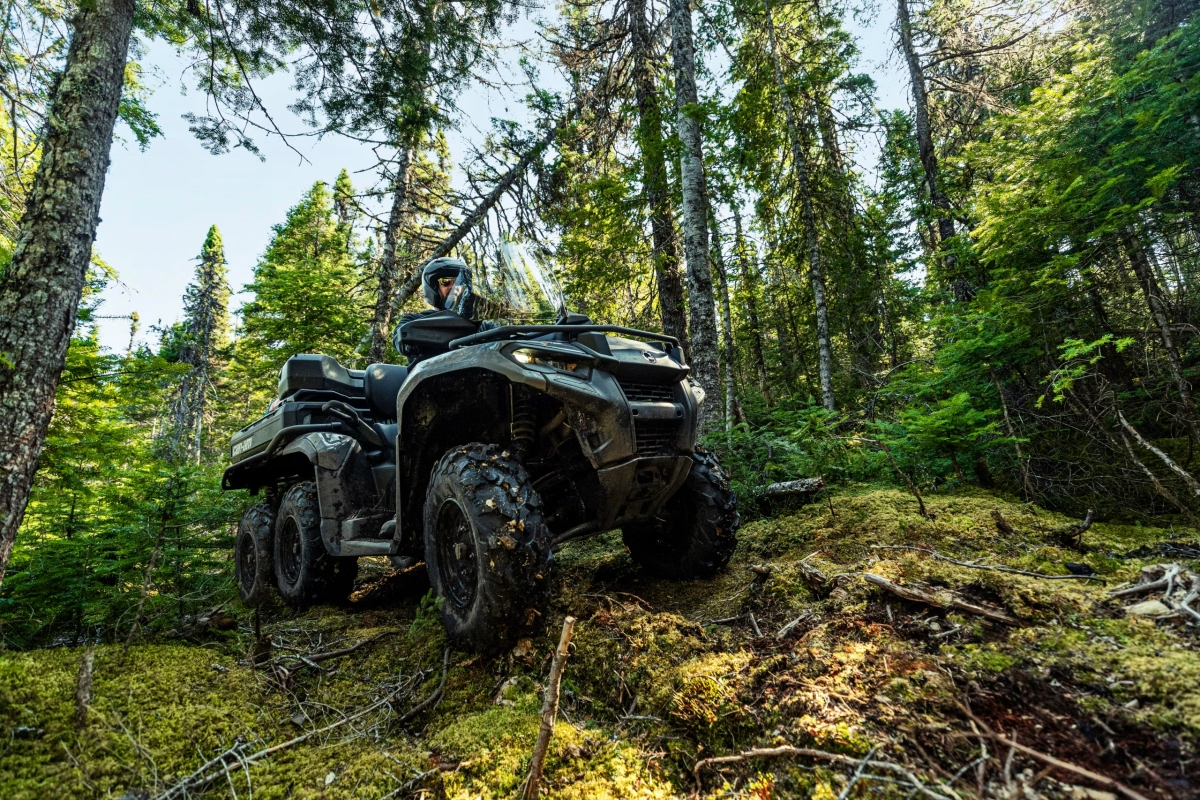
Photo credit; can-am.brp.com Outlander 6×6
Can-Am ATVs (All-Terrain Vehicles) are versatile tools used in forestry for woodland inspection, fire patrols and response, fence inspection, planting and plantation maintenance, surveying, gamekeeping, timber extraction, harvesting support, and emergency rescues.
They provide access to difficult areas that other equipment would find almost impossible to reach, while offering low ground disturbance and operating costs.
-
The WeighPro Wireless Weighing Link represents a precise and dependable weighing system designed specifically for round timber, eliminating the need for re-calibration. This system offers operators minimal maintenance requirements, boasting an impressive battery life of up to two years between recharges.
-
That’s a remarkable amount of work hours for a single machine, the Norcar 600 owned by Erkki Rinne is taken well care of, it even has the original Diesel engine.
-
It is not possible to eliminate chain shot, but there are simple steps that can be taken to reduce the risk.
-
Arwel takes great pride in the fact that the mill has no waste whatsoever, “the peelings are used for children’s playgrounds, gardens and for farm animals in barns in the winter and the sawdust has multiple uses in gardens and farms as well.
-
Timber hauliers need to encourage young blood in, and also look after the hauliers we have, we need make the sector a safe and positive place to work.
FIND US ON
I have seen many of these vehicles in use and at forestry exhibitions with an assortment of attachments, and some are best described as a Swiss Army Knife for forestry, especially for estate work where each day brings different tasks.
I wanted to learn more, so I contacted Can-Am, a pioneering company founded by Canadian inventor Joseph-Armand Bombardier, who created the world’s first tracked snow vehicle, the 1937 B7 snowmobile. In 2003, Can-Am Off-Road launched its first modern, dedicated off-road vehicle.
I started with the Can-Am Outlander 6×6 and asked why it is particularly suited for work in the forestry and land management sectors?
“The Can-Am Outlander 6×6 is particularly suited to forestry and land management work thanks to its six-wheel-drive system, which delivers exceptional traction and stability on a range of challenging terrains, including muddy bogs, steep slopes and woodland tracks, to name but a few. In addition, its industry-leading 1000lb. (453kg) payload capacity, strong towing capability and large cargo bed mean it can easily transport tools, materials and equipment to remote locations. It can also be fitted with various LinQ accessories, meaning it can be customised for a multitude of jobs, and there is less downtime as users don’t have to switch vehicles from job to job.”
How is vehicle demand changing within the forestry and land management sectors?
“The demand is changing because the jobs are evolving, and what we are seeing is that users want to have access to ATVs that are versatile, agile, have a large payload capacity and can tackle any terrain without compromise.”
What makes the Can-Am Outlander 6×6 particularly suited to forestry and land management work?
The Can-Am Outlander 6×6 was developed in some of the world’s harshest terrains and environments (such as with Reindeer farmers in Scandinavia), with the mindset that if it exceeded requirements there, it would suit anyone else.
The extensive development process means the 6×6 lineup is industry-leading in every spec possible when it comes to power, capability, capacities and maintenance intervals.
This makes it especially suited to the jobs that come with forestry and land management work, thanks to its combination of payload capacity, traction, and all-terrain capability.
The selectable four- and six-wheel-drive system provides exceptional grip on challenging ground, including mud, ruts, steep inclines, and uneven surfaces such as woodland and muddy terrain. The extended chassis and large cargo bed with dumping capacity and (toolless) removable sides let users transport tools, fencing materials, feed, equipment, and supplies efficiently. In contrast, its high towing capacity makes it ideal for pulling trailers loaded with timber, machinery, or maintenance equipment.
Service intervals of 100 hours or 3000 km and easy access to all service components mean there is less time spent maintaining the vehicle and more time working.”
What inspired the development of the Can-Am Outlander 6×6?
“The 6×6 was developed for our most hardworking customers in the hardest terrain, with specific attention to the vehicle’s ruggedness and capabilities. No matter the terrain, conditions, or job, the 6×6 is designed to do it all. There was an opportunity to maximise what the vehicle offers for these customers.”

Outlander Electric
Another interesting Can-Am I saw at exhibitions was the Outlander Electric, the world’s first mass-produced ATV.
What are the main benefits of the Can-Am Outlander Electric for forestry operators?
“The Electric has all the capabilities and features of Can-Am’s ICE ATVs: towing capacity 1830 lbs (industry-leading), rack capacity (360 lbs Front and rear- industry-leading), 12 in. ground clearance and 10 in. suspension travel. The vehicle also has a Visco-Lok QE front differential and High and low gears, which also allow maximum traction in tricky conditions. It also needs little maintenance, with no engine oil or filter changes needed.
And of course, wherever silence is a benefit, the Outlander Electric is the only choice!”

What misconceptions exist around electric off-road vehicles?
“EV isn’t up to the tasks that I do with my ATV” is something those unfamiliar with the Outlander Electric say. However, the Outlander Electric has been engineered to meet all the same specs of an equivalent ICE Outlander. Whether it’s towing capacity, rack capacity, or off-road capability, the Electric matches it all. The best way to show this is to get users to ride the vehicle.
The range is something we know many will question. The Outlander Electric has 31 miles of utility range (includes towing, hauling, riding up and down hills, driving through different terrains such as mud and sand) or 50 miles in optimal conditions. It can also charge from 20% to 80% in 50 minutes.”
What are the biggest differences operators will notice when driving the Outlander Electric?
“There are a couple of key differences the user will notice. The first is how consistently the electric motor delivers power on the trail. The second is the silence: there is no engine noise and very few mechanical sounds, and this is most noticeable at low speed, when all you can hear are the tyres on the ground.”
What inspired the development of the Can-Am Outlander Electric?
“Everything we develop is a result of talking to our customers and matching their requirements to the latest technological possibilities – so an electric ATV was just a matter of time! But as a brand, we would never launch anything that feels like a prototype or isn’t quite ready for the job. That’s why the Outlander Electric has the same capabilities as its ICE counterparts, with the same build quality and parts availability you’d expect from anything from Can-Am.”
In what ways does the Can-Am Outlander Electric differ from ‘traditional’ ATVs?
“The main difference between the Outlander Electric and the petrol-powered ATVs is simple. An electric motor powers it; however, it still has the DNA of the class-leading Outlander range: power, performance, and the versatility to handle a multitude of jobs with ease. In addition, the Outlander Electric has been thoroughly tested to ensure it can handle whatever jobs or terrain it faces.”
Would you be able to carry a deer’s carcass (90 -190kg) on the Outlander itself, or would you need a trailer?
“The Outlander EV has the same load and towing capacities as all our utility- focused ATVs. While it depends on the size of the animal, in most cases you would need a trailer for a deer carcass. The Outlander has a rear load capacity of 109kg and front load capacity of 54kg (total 163kg). The maximum towing weight is 830kg.”
When carrying the maximum load or pulling a trailer, roughly how many hours of work could you expect to get from the battery?
“It really depends on the type of terrain, the weather, loads, type of rider, hill or flat terrain, mud vs grass vs hardpack.
Our stated ‘Utility’ range of 31 miles (50km) accounts for towing a trailer at times. It is a real-world figure based on hours of research in the field, and not an idealised figure given perfect conditions”
On reasonable ground conditions, what is the maximum safe angle of ascent and descent when loaded or with a trailer (many forests are planted on steep hillsides/mountains)?
“There are too many variables to give a single answer. The Outlander Electric has the same stability as our ICE ATV’s.”
What is the expected lifespan of the battery and the cost of a replacement?
“5-year battery warranty, and the battery is a high-quality integrated lithium-ion battery and was extensively tested in a variety of conditions.”
These Can-Am ATVs appear to be a valuable asset for forestry work, and I’m looking forward to putting one to the test later this year.
Contact forestmachinemagazine@mail.com to get your products and services in front of the world’s largest professional forestry online news network.
#homeoflogging #writtenbyloggersforloggers #loggingallovertheworld
Written by loggers for loggers and dedicated to bringing you the latest forestry news