
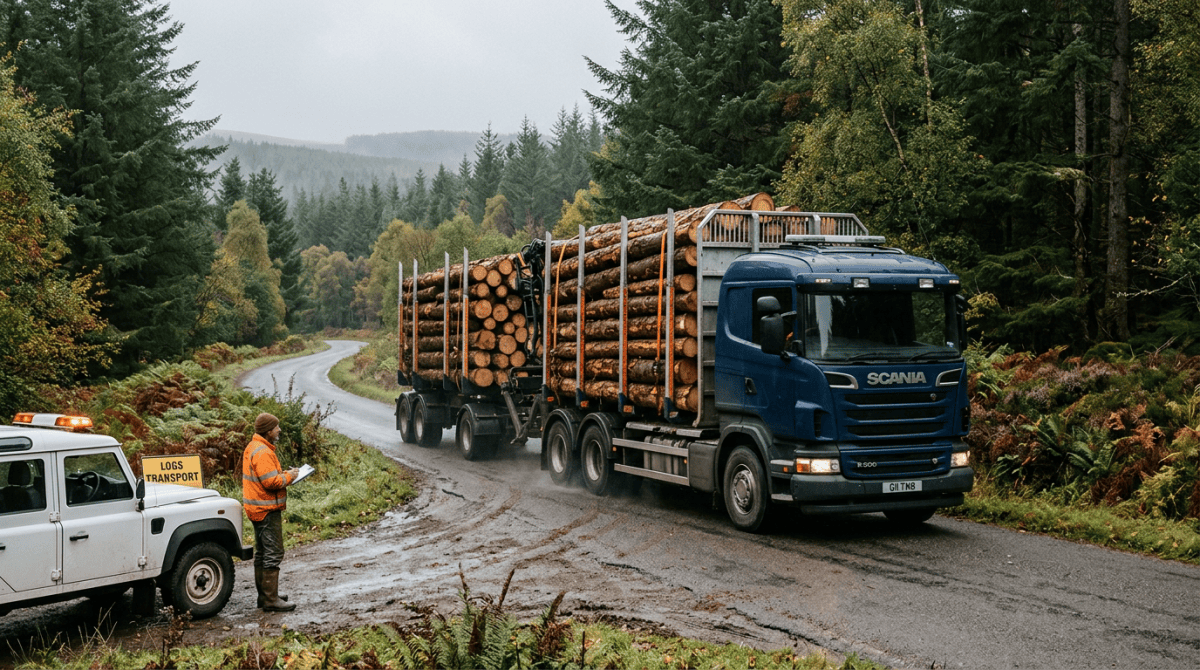
There is no single document called a “timber transport licence” in the UK. In practice, the phrase usually covers the operator’s licence, the driver’s entitlement and professional qualification, tachograph and drivers’ hours compliance, and any permissions needed for an unusual load or route.
Who needs timber transport licences?
As a rule, a business using a goods vehicle with a maximum authorised mass above 3.5 tonnes for commercial timber transport on public roads will need an operator’s licence. This applies whether the load is roundwood, chip, biomass fuel, sawlogs or fencing material. A conventional artic, rigid timber lorry, or drawbar outfit collecting from a roadside stack and delivering to a mill will almost certainly fall under operator licensing.
-
The WeighPro Wireless Weighing Link represents a precise and dependable weighing system designed specifically for round timber, eliminating the need for re-calibration. This system offers operators minimal maintenance requirements, boasting an impressive battery life of up to two years between recharges.
-
That’s a remarkable amount of work hours for a single machine, the Norcar 600 owned by Erkki Rinne is taken well care of, it even has the original Diesel engine.
-
It is not possible to eliminate chain shot, but there are simple steps that can be taken to reduce the risk.
-
Arwel takes great pride in the fact that the mill has no waste whatsoever, “the peelings are used for children’s playgrounds, gardens and for farm animals in barns in the winter and the sawdust has multiple uses in gardens and farms as well.
-
Timber hauliers need to encourage young blood in, and also look after the hauliers we have, we need make the sector a safe and positive place to work.
FIND US ON
The key point is that an operator’s licence attaches to the business responsible for using the vehicle, not simply to the person behind the wheel. If a harvesting contractor runs its own lorry to move its own timber, it can still require an O-licence. Carrying your own goods does not remove the obligation.
A genuine third-party haulier carrying timber for payment also needs the right authority, normally a standard national operator’s licence for UK work. If the business carries goods for others outside Great Britain, it may need a standard international licence. A restricted licence is generally for own-account work only, such as a sawmill moving its own raw material or finished product. It does not permit carrying another firm’s timber for hire or reward.
This is where informal arrangements can create trouble. A contractor may describe a load as a favour for a neighbouring estate, but if money changes hands or the job forms part of a commercial arrangement, it can be treated as hire or reward. The Traffic Commissioner will look at the reality of the operation rather than the wording on an invoice.
Forestry work is not a blanket exemption
Forestry has particular exemptions and concessions in some transport rules, especially around drivers’ hours. They are often misunderstood as a general exemption from operator licensing. They are not.
Certain specialist vehicles and narrowly defined forestry operations may fall outside parts of the normal regime. Agricultural tractors used for forestry work, purpose-built off-road machinery moving locally, and specific own-account operations can all raise different questions. But putting a loaded timber trailer or lorry onto public roads between forest, weighbridge and mill is a different proposition from moving equipment around a worksite.
The practical test is straightforward: if it looks and operates like commercial road haulage, plan on it being regulated like commercial road haulage. Don’t assume a forestry logo on the door changes that position. If you’re relying on an exemption, get advice on the exact vehicle, journey pattern, and business arrangement before treating it as settled.
The operator’s licence: choosing the right one
An O-licence is more than a formality. The licence holder must have a suitable operating centre, proper maintenance arrangements, financial standing, and systems that keep vehicles legal and roadworthy. For timber work, that means more than a six-weekly inspection sheet filed in the office.
The operator must be able to show control over defects, brake testing, tyre condition, crane maintenance, load restraint equipment and daily walk-round checks. Forestry roads are hard on kit. Mud, sharp stone, overloaded trailers, and repeated off-road running can quickly expose weak maintenance systems. A wagon that looks tidy on the tarmac may have taken a beating before it gets there.
Standard licence holders also need a professionally competent transport manager with genuine and continuous control of the transport operation. Lending a transport manager’s name to an operator without involving them in the work is a poor gamble. Traffic Commissioners take a dim view of paper compliance, particularly where prohibitions, drivers’ hours issues, or overloaded timber loads appear on the record.
For smaller forestry firms, a restricted licence can be the correct route when carrying only their own goods. It still brings obligations around maintenance, operating centres and financial standing. Restricted does not mean lightly regulated.

Drivers, tachographs and hours rules
The lorry driver needs the correct vocational entitlement. For most timber artics and drawbar combinations, that means Category C+E. A rigid lorry requires the appropriate Category C entitlement. Drivers working commercially will usually also need a valid Driver Certificate of Professional Competence, unless a specific exemption applies.
Tachographs and drivers’ hours rules are another area where forestry businesses need to separate fact from folklore. Most goods vehicles over 3.5 tonnes used for commercial carriage fall under the retained EU rules on drivers’ hours and tachographs. This includes driving limits, break requirements, daily and weekly rest rules, correct mode switching, and proper record retention.
A forestry-related exemption is available in limited circumstances, including certain vehicles used by forestry undertakings to carry goods as part of their own business within 100 kilometres of the undertaking’s base. The conditions matter. The vehicle use, ownership or hiring arrangement, nature of the journey, and distance must all fit. A contracted timber haulier working from forest to mill cannot simply claim the exemption because the load came from woodland.
Even where an exemption from the retained EU rules applies, domestic drivers’ hours rules may still apply. Operators should have a written decision on which regime covers each type of work, rather than leaving the call to a driver at the gate.
Loads, weights and roadside reality
A timber transport licence will not protect an overloaded or insecure load. Enforcement officers can deal with the vehicle in front of them, and an O-licence holder may then have to explain why their systems didn’t prevent the issue.
Timber must be loaded within legal gross, axle, and individual axle-group limits. That is not always easy when timber density varies, the stack is wet, and a loader is working in poor visibility. A payload estimate from the forest is useful, but it is not a substitute for a reliable weighbridge process. Build in clear instructions for what happens when a wagon is overweight: where it returns, who pays, and who has the authority to decide.
Load security deserves the same attention. Stanchions, bolsters, bunks, chains, straps and tensioners must suit the load and be inspected. The load must remain secure through cambers, roundabouts, braking and uneven exits from forest roads. Drivers also need safe access to carry out checks without climbing over unstable timber or working beside live traffic.
Long or abnormal timber, abnormal indivisible loads, restricted structures and route-specific constraints can bring further permissions into play. That may include notifications, movement orders or special route planning. Do not leave this until the wagon is loaded and the mill is expecting it.
Paperwork that should travel with the operation
A well-run timber haulage job should stand up to a roadside inspection without a scramble through gloveboxes and phones. The exact documents vary, but the operator should have clear control of at least the following:
- vehicle maintenance and daily defect reporting records;
- tachograph records and drivers’ hours evidence where required;
- delivery, weighbridge and load information that identifies the consignment;
- evidence of the operator’s licence authority, insurance and driver entitlement.
For timber coming from regulated woodland, transport paperwork may also support traceability back to the harvesting site and felling permission. A felling licence is not a transport licence, but poor traceability can create awkward questions for everyone in the supply chain. If the load is waste wood rather than a timber product, waste carrier controls may also apply.
When to check before the wheels turn
The most common compliance mistake is waiting until the business has bought the wagon or won the contract. Check the licence position before adding a vehicle, expanding the operating centre, taking on a new haulage lane or changing from own-account work to carrying for customers.
The same applies when subcontracting. A harvesting business that hires a haulier should verify that the haulier is properly licensed and insured, and make sure the booking instructions are realistic. Tight turnaround times, unclear loading responsibility, and pressure to leave with a marginal load can put good operators in bad positions.
Timber transport is demanding work, not a paperwork exercise. But the paperwork reflects the controls that keep a loaded wagon legal, roadworthy and moving. Get the licence route right before the first load leaves the stack, and the rest of the operation has a far firmer footing.
Contact forestmachinemagazine@mail.com to get your products and services in front of the world’s largest professional forestry online news network.
#homeoflogging #writtenbyloggersforloggers #loggingallovertheworld
Written by loggers for loggers and dedicated to bringing you the latest forestry news