
For contractors, the cost of getting transport wrong rarely stops at a late start. It can mean a prohibition, damage to a bridge or roadside furniture, a machine exceeding weight limits, or an avoidable incident during loading.
Transporting Forestry Machinery-The machine brochure weight is a starting point, not the figure to plan a move around. A harvester fitted with wider tracks or tyres, chains, a harvesting head, extra guarding, fuel and a full tool locker may be substantially heavier than the bare-machine specification. The same applies to forwarders carrying bogie tracks, blade options, cranes, grapples and fuel.
Get the proper operating transport weight for each machine in the fleet, and record its width, height, and overall length in travelling configuration. Do not assume a similar model will weigh the same. Head choice alone can change the figures enough to affect axle loads and the required transport category
.
-
The WeighPro Wireless Weighing Link represents a precise and dependable weighing system designed specifically for round timber, eliminating the need for re-calibration. This system offers operators minimal maintenance requirements, boasting an impressive battery life of up to two years between recharges.
-
That’s a remarkable amount of work hours for a single machine, the Norcar 600 owned by Erkki Rinne is taken well care of, it even has the original Diesel engine.
-
It is not possible to eliminate chain shot, but there are simple steps that can be taken to reduce the risk.
-
Arwel takes great pride in the fact that the mill has no waste whatsoever, “the peelings are used for children’s playgrounds, gardens and for farm animals in barns in the winter and the sawdust has multiple uses in gardens and farms as well.
-
Timber hauliers need to encourage young blood in, and also look after the hauliers we have, we need make the sector a safe and positive place to work.
FIND US ON
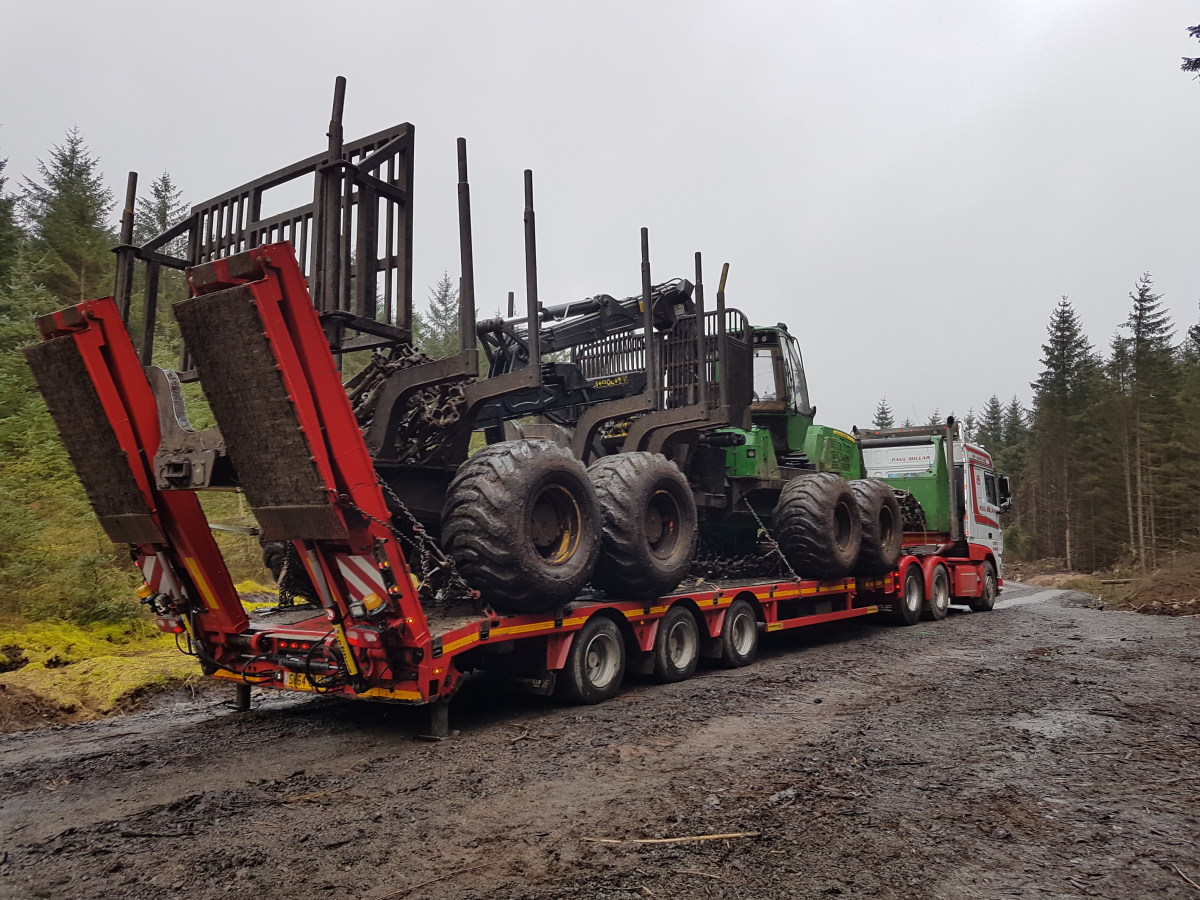
The lorry and trailer matter just as much. A low-loader with ramps, neck, widening deck and ramps strong enough for a 20-tonne-plus machine has its own significant unladen weight. Add the tractor unit, fuel, chains, timbers and driver, then calculate the gross train weight and the loading on each axle group. A combination can be legal at gross weight while still overloading an individual axle.
A public weighbridge is cheap insurance after a change of machine, trailer or loading position. It also gives the operator evidence, not a guess, if there is a roadside stop.
Match the trailer to the machine and the work
There is no universal forestry low-loader. A short two-axle plant trailer may suit a compact excavator or small thinning machine, but it will not be the right answer for every forwarder or wheeled harvester. The trailer needs enough deck length to position the machine correctly, enough width for the running gear, and rated lashing points where they are needed.
Low deck height helps keep overall height under control, particularly on high-cab harvesters and machines with fixed cranes. It can also make loading less severe. The trade-off is ground clearance on rough access roads, steep ferry ramps and uneven loading areas. A detachable gooseneck or extending trailer may solve one problem while adding operating cost, complexity and extra weight.
Consider the whole job, not only the machine. If every site involves narrow lanes, tight junctions and soft roadside verges, a shorter combination may be worth more than a few extra tonnes of capacity. If the business regularly shifts a large forwarder, harvester and attachments between distant contracts, a purpose-built heavy-haulage arrangement may be the safer commercial choice.
Keep attachments in the plan
Heads, grapples, mulchers and buckets are not loose extras. They alter the centre of gravity, overall length and restraint requirement. Carrying a head separately can reduce height or improve axle distribution, but it creates another item that must be restrained and accounted for. A head sitting on the deck needs suitable packing, clear hose protection, and secure restraint against movement in every direction.
Loading is where most shortcuts show
Before a machine climbs the ramps, inspect the ground. A level, firm loading area is not a luxury. Soft forest entrances, sloping lay-bys and wet timber yards can put the trailer out of line, reduce ramp grip and leave insufficient room to straighten up. If the ground is wrong, find a better place or make the area safe before proceeding.
Clean mud, brash, snow and diesel from tracks, tyres, ramps and deck. The driver needs clear communication with the machine operator, especially where sightlines are poor. One person should be directing the manoeuvre. A collection of shouted instructions from the roadside is how routine loads become expensive incidents.
Once on deck, lower attachments and booms into the manufacturer-approved transport position. Engage slew locks, articulation locks and travel locks where fitted. Shut down safely, isolate as required and remove ignition access. Hydraulic pressure alone is not a restraint system.
Use rated chains, binders and lashing points appropriate to the machine and trailer. The working load limit must be clear, and the gear must be inspected, not merely assumed sound because it was used last week. Damaged hooks, stretched chains, bent deck rings, and worn ratchets need to be taken out of service. Chocks and packing can prevent local movement, but they do not replace proper tie-down.
The restraint arrangement must control forward, rearward and sideways movement. Track machines and wheeled machines behave differently under braking and cornering, so follow the machine and restraint equipment guidance rather than relying on a favourite chain pattern. Recheck tension after the first few miles, particularly after leaving a rough site road where the load and trailer have settled.

Transporting Forestry Machinery: know the legal route
The legal basis for a move depends on the dimensions, weights and configuration involved. Standard Construction and Use limits may cover some combinations. Larger or heavier indivisible loads may require operation under the Special Types General Order, with notifications, route conditions and possibly an escort arrangement.
This is not paperwork to sort out after the machine is loaded. Establish the category before you make the booking. Check the combination’s gross weight, axle weights, width, length and height, then confirm what notice is required and who must receive it. Requirements can vary by movement and the authorities involved, so use current official guidance and keep a clear movement record in the cab.
A familiar timber route is not automatically suitable for a low-loader. Railway bridges, weak bridges, low wires, restricted village streets, tight roundabouts and parked cars can all defeat an otherwise sensible plan. Height needs particular care. Measure the loaded machine rather than trusting the trailer specification, and allow for tyre pressure, suspension movement and uneven road surfaces.
Route planning should include practical stopping places. The driver may need room to check chains, deal with a closure or wait safely before entering a constrained section. A sat-nav is useful, but it does not understand your axle loads, overhang, trailer swing or the state of a minor road after heavy rain.
Do not forget the working-time side
Forestry transport often starts early and finishes late because the machine has to be off the road before a shift can begin. That does not remove driver hours, working-time and tachograph obligations where they apply. Plan the collection, loading, travel, unloading and return journey as one shift. A rushed final leg after a difficult extraction is a poor time to discover the driver has no legal time left.
Roadside safety starts before the gate
The loading team should have suitable PPE, but high-vis clothing is not a control measure on its own. Consider traffic management when loading or unloading is close to the public highway. Keep people out of the ramp line and away from pinch points around chains, wheels and machine articulation joints.
At the destination, assess whether the machine can come off safely before opening a binder. A timber yard entrance may be busy with timber lorries, loaders and site visitors. A forest entrance may be blind, narrow, and carry public traffic, cyclists, or walkers. If you can’t unload without creating a roadside hazard, hold the load and change the arrangement.
It is also worth agreeing who owns each part of the job. On a contract move, the haulier may be responsible for vehicle compliance and load restraint, while the machine owner provides correct weights, dimensions and transport instructions. In reality, both sides need to challenge bad information. A driver should not be handed a machine and told that it is ‘about 20 tonnes’ when no one has checked it.
Build a repeatable transport routine
The best transport operations are dull because the checks are built into the work. Keep a current sheet for every machine with its transport weight, dimensions, approved tie-down points and any special instructions. Keep certificates, inspection records and notification details available. Review near misses, damaged ramps and recurring route problems while they are still fresh.
Forestry work changes week to week: different machines, different sites, weather, and access conditions. That is exactly why the basics need to stay fixed. A properly weighed machine, suitable trailer, disciplined loading method and route checked for the load will protect the driver, the kit and the margin on the job long after the machine has reached the next block.
Contact forestmachinemagazine@mail.com to get your products and services in front of the world’s largest professional forestry online news network.
#homeoflogging #writtenbyloggersforloggers #loggingallovertheworld
Written by loggers for loggers and dedicated to bringing you the latest forestry news