
A new type of CT scanning could detect root rot earlier and more accurately, improving both timber measurement and sorting.
Butt-Rot; Multi-energy CT scanning can make it possible to detect early rot damage in spruce, which today’s automated measurement systems have difficulty identifying. In the experiment, researchers scanned five segments from the same decay-damaged spruce stump with a photon-counting CT scanner. The dual-energy images showed structures that became more apparent in segments with more extensive rot damage. This suggests that the technology can capture signals from rot that are difficult to detect with traditional CT.

-
The WeighPro Wireless Weighing Link represents a precise and dependable weighing system designed specifically for round timber, eliminating the need for re-calibration. This system offers operators minimal maintenance requirements, boasting an impressive battery life of up to two years between recharges.
-
That’s a remarkable amount of work hours for a single machine, the Norcar 600 owned by Erkki Rinne is taken well care of, it even has the original Diesel engine.
-
It is not possible to eliminate chain shot, but there are simple steps that can be taken to reduce the risk.
-
Arwel takes great pride in the fact that the mill has no waste whatsoever, “the peelings are used for children’s playgrounds, gardens and for farm animals in barns in the winter and the sawdust has multiple uses in gardens and farms as well.
-
Timber hauliers need to encourage young blood in, and also look after the hauliers we have, we need make the sector a safe and positive place to work.
FIND US ON
- Photocount CT: Unlike traditional CT scanners, the new technology records individual X-ray photons instead of measuring them as a combined signal. This lets you categorise photons by energy level.
- Dual energy provides more information: By dividing photons into two energy classes, the scanner can create images that show more wood properties than a traditional CT image.
- Two types of images: The study used both virtual single-energy images and double-energy images. The latter showed distinct, curved structures that appeared to be linked to the rot damage.
- High resolution: The scan had a spatial resolution of approximately 0.7 × 0.7 × 1.0 millimetres.
- Next steps: More logs need to be scanned and analysed to confirm the results and understand which substances in the wood are causing the signals.
Currently, no automated technology can detect solid root rot in spruce logs and spruce stacks. This complicates sorting and posting in industry, increases transport costs, reduces sustainable timber utilisation, and hinders progress toward automated log measurement.
In a preliminary study, Skogforsk X-rayed a rot-damaged log with the most advanced form of medical CT scanner: a photon-counting scanner that can measure with multiple energies. The study, conducted with Örebro University Hospital and equipment manufacturer Siemens Healthineers, showed that this type of CT scanner may be able to detect root rot. The results have recently been published in the journal Wood Material Science and Engineering.
Root rot is a billion-dollar problem, but difficult to detect
Root rot, caused by the fungus genus Heterobasidion spp., is one of the most significant challenges in Swedish forestry. It affects about 14% of all spruces in Sweden and up to 20% of spruce trees. A recent study from Skogforsk shows that economic losses from root rot in spruce amount to over one billion kronor annually. These losses arise from unnecessary log failure, downgrading, and scrapping of spruce sawlogs.
Today, harvester operators primarily detect rot visually during logging or with timber meters. Visible rot is often long-lasting, so-called soft rot. The early, firm rot is harder to detect. Skogforsk has shown that harvester drivers cut about 3% more spruce with faulty logs than the control meter estimates, and that 85% of these log-fault cases are due to rot. Because the most common defect in spruce cannot be measured automatically, developing a fully automatic classification system for measuring spruce sawlogs is hindered.
Many quality characteristics can be measured in sawmill measurement frames. The most advanced measuring frames are CT scanners (Computed Tomography), which X-ray the logs in 3D and create a density image. These measuring frames can detect advanced rot, but they are not sufficient to replace manual classification in timber measurement. This is because changes in wood density and structure in the early stages of decomposition are too small.
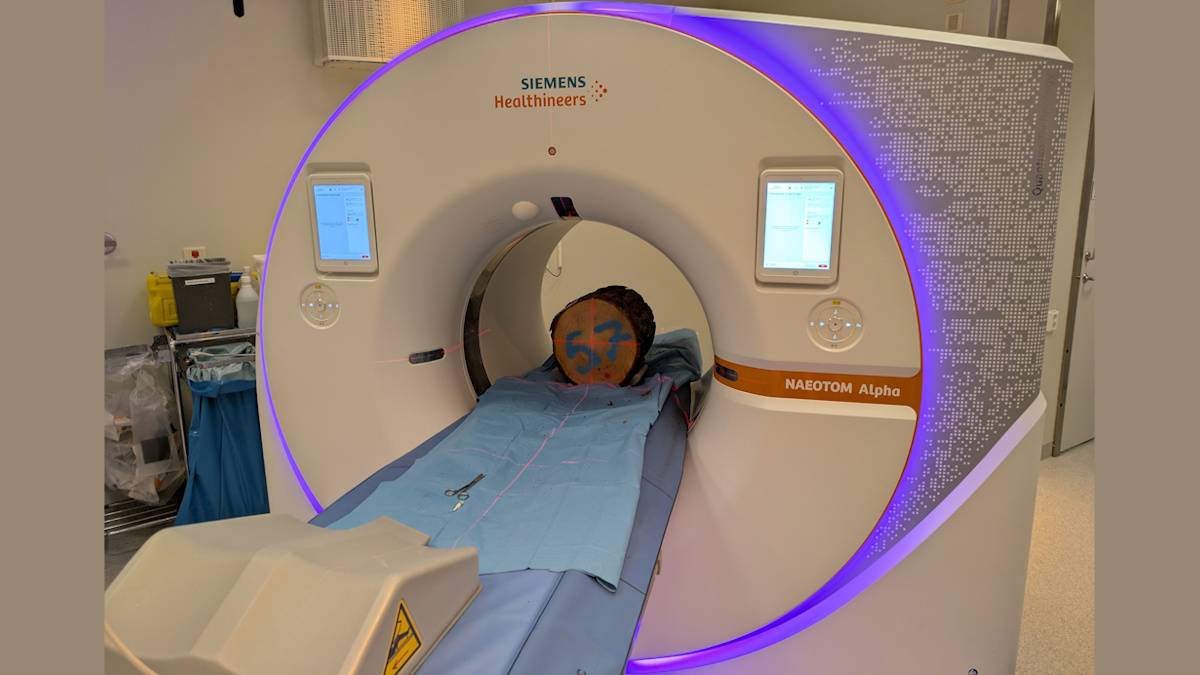
A piece of stock is scanned with a photon-counting CT scanner at Örebro University Hospital.

A new generation of CT scanners
The measurement frames record how X-ray photons move through an object. The sawmills’ measurement frames detect photons in groups. The very latest medical measurement frames are photon counting (Photon Counting Computed Tomography, PCCT), which detect photons one by one. This allows photons to be grouped into different classes based on their energy. This also increases sensitivity and can capture subtle signal differences. In this feasibility study, the Siemens NAEOTOM Alpha CT scanner was used, and the photons were grouped into two classes (Dual Energy Computed Tomography DECT). The spatial resolution was approximately 0.7 mm (width) x 0.7 mm (height) x 1.0 mm (length).
This is not the first time medical CT scanners have been used to measure timber. This was first done in the 1980s, and then between the 1990s and 2010s, when the Department of Wood Technology at Luleå University of Technology played an important role. The research led to the first dedicated CT scanner for roundwood, CT-Log from Microtec, which is now installed at four Swedish sawmills.

How the test sample was selected
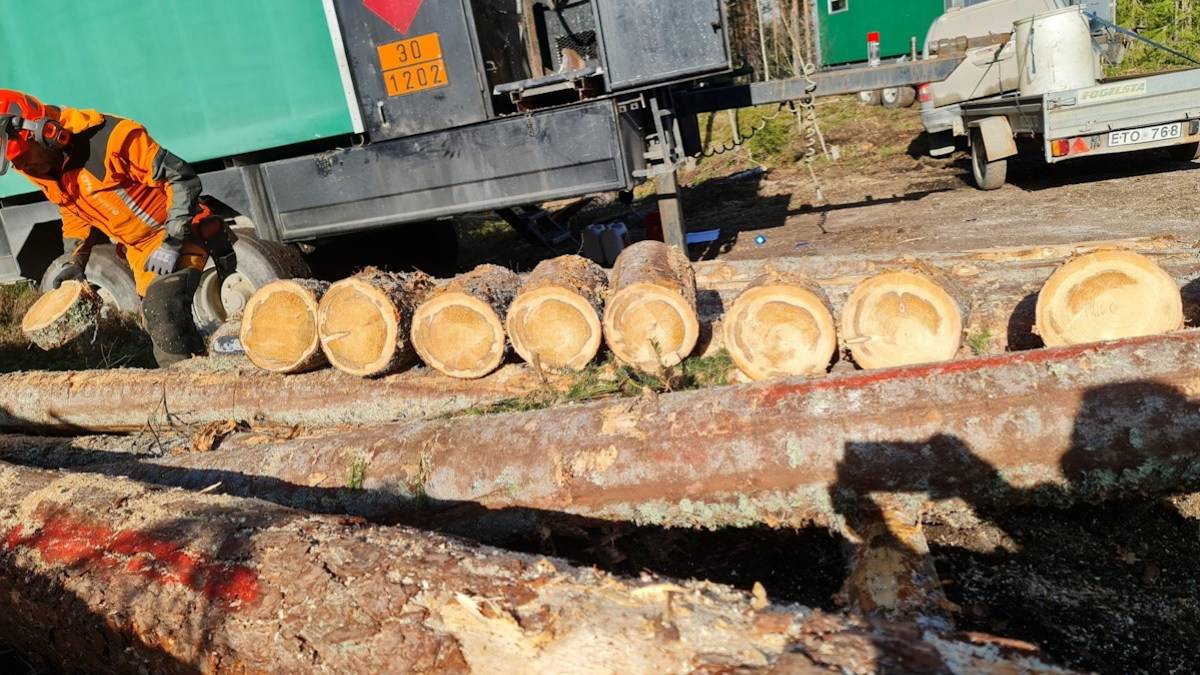
Two project participants participated in one of Sveaskog’s logging operations outside Finspång, where the harvester operator helped identify logs with visible root rot. The logs were then cut into three-decimeter segments with a chainsaw. The goal was to find a log with a gradual transition in rot, from strong in the root cut to invisible in the top cut. The best log that met the criteria was selected. From that log, a pulley was also cut at the root and one at the top; both were sent to SLU for analysis, which confirmed the presence of Heterobasidion spp. in the root segment, while the top segment showed no signs of infection. Five of the segments (a, b, c, d, e) were sent to Örebro University Hospital to be scanned using the NAEOTOM Alpha scanner.
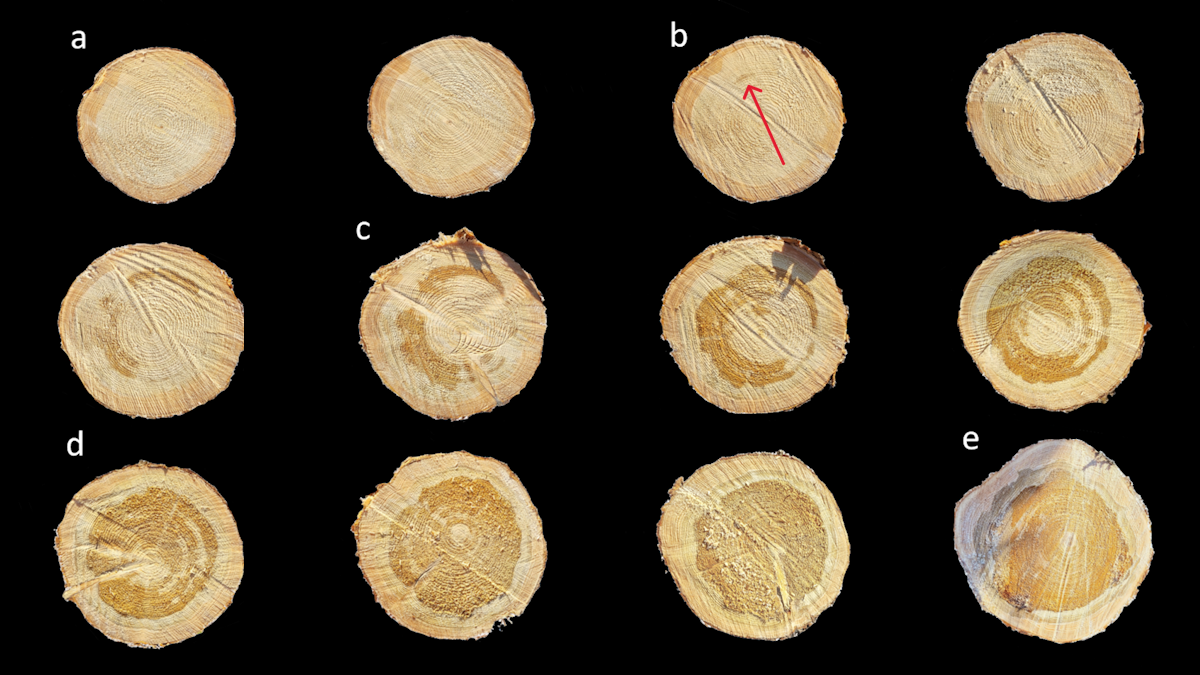
Segments sawn from the test stock. Segments a-e were sent for CT scanning. A red arrow marks the slightly damaged rot area in segment b. In the lower row, aniline wood appears as a greenish-grey area around the heartwood.
Double-energy CT scanning: Two image types provide different information
The CT scanner measurements are converted into images in a process called reconstruction. To aid reconstruction, measurements of known substances, such as water and air, are often used. For dual-energy images, a third substance is required with chemical properties different from water and air. In this case, calcium was chosen based on the hypothesis that the digestion process enriches the wood in calcium. Based on this, two types of images were reconstructed: virtual single-energy images, which somewhat resemble classic CT images, and double-energy images.
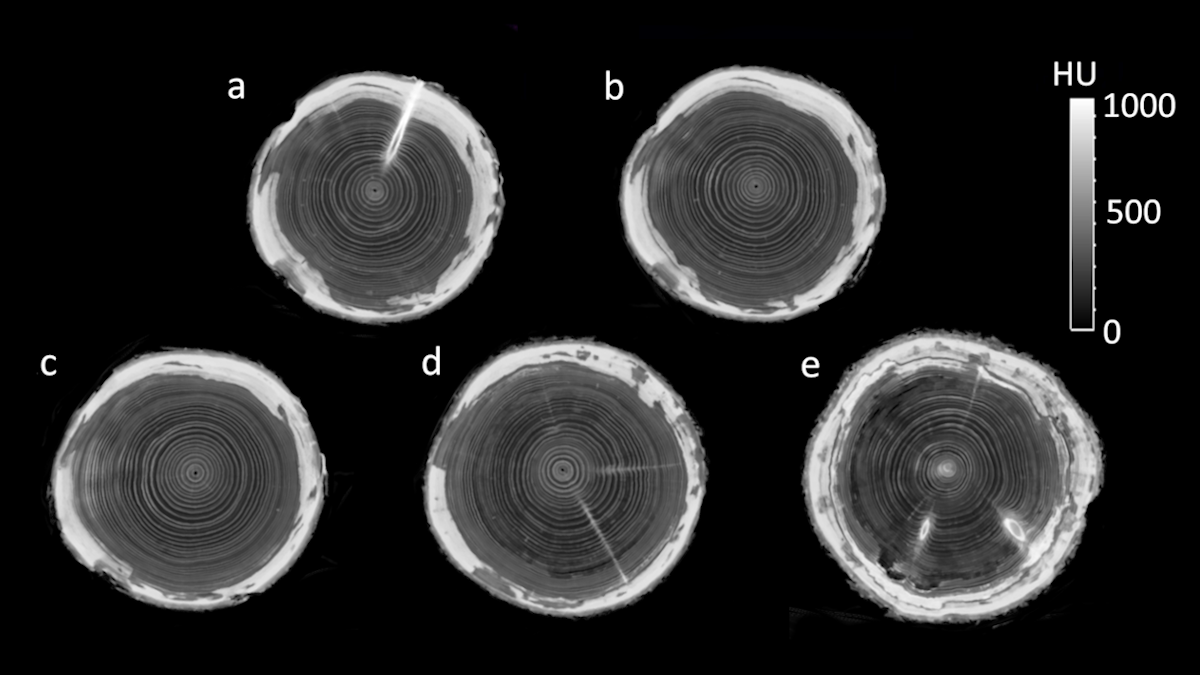
Single energy images (virtual) of the five scanned segments from the rot-damaged log.
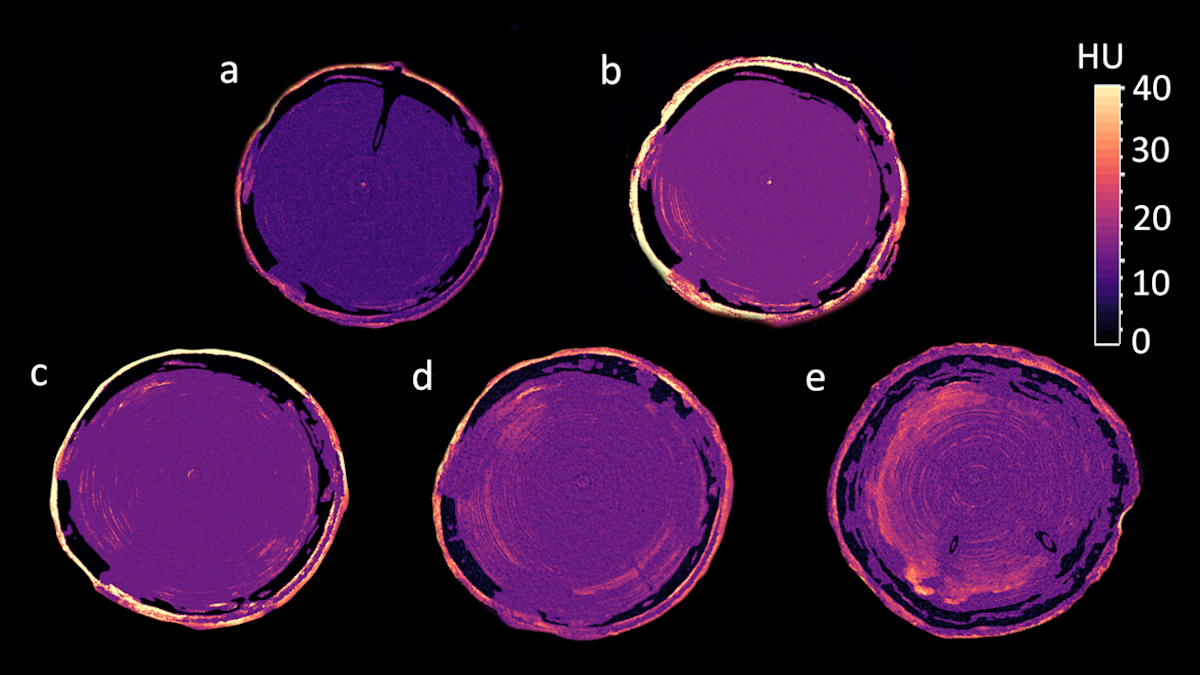
Double-energy images of the five scanned segments from the rot-damaged log.
Dual-energy images capture signals of rot that might otherwise be missed
With the human eye, rot damage is visible in segments b, c, d, and e. In the virtual single-energy images, rot damage appears in segments d and e as dark streaks, indicating decreased density. Compared to the degree of discolouration in the visual photos, it is striking that the structure of the wood is not affected nearly as much by rot – the growth rings are still distinct.
In the dual-energy images, you can see curved, bright structures in segments b, c, d, and e. They become more intense and larger as the rot appears more severe in the corresponding visual photos. It seems that the studded energy images pick up some kind of signal related to the rot.
Next step: More logs and deeper analyses
The results are exciting, but we can’t draw scientific conclusions from a single log. Therefore, Skogforsk wants to carry out a follow-up project in which we both scan more logs and perform chemical measurements to understand what substance creates the patterns we see in the dual-energy images. We also want to investigate whether it would be sufficient to measure in fewer directions, as so-called discrete X-ray measuring frames do.
Perhaps the sawmill surveyors of the future will use dual energy?
Contact forestmachinemagazine@mail.com to get your products and services in front of the world’s largest professional forestry online news network.
#homeoflogging #writtenbyloggersforloggers #loggingallovertheworld
Written by loggers for loggers and dedicated to bringing you the latest forestry news