
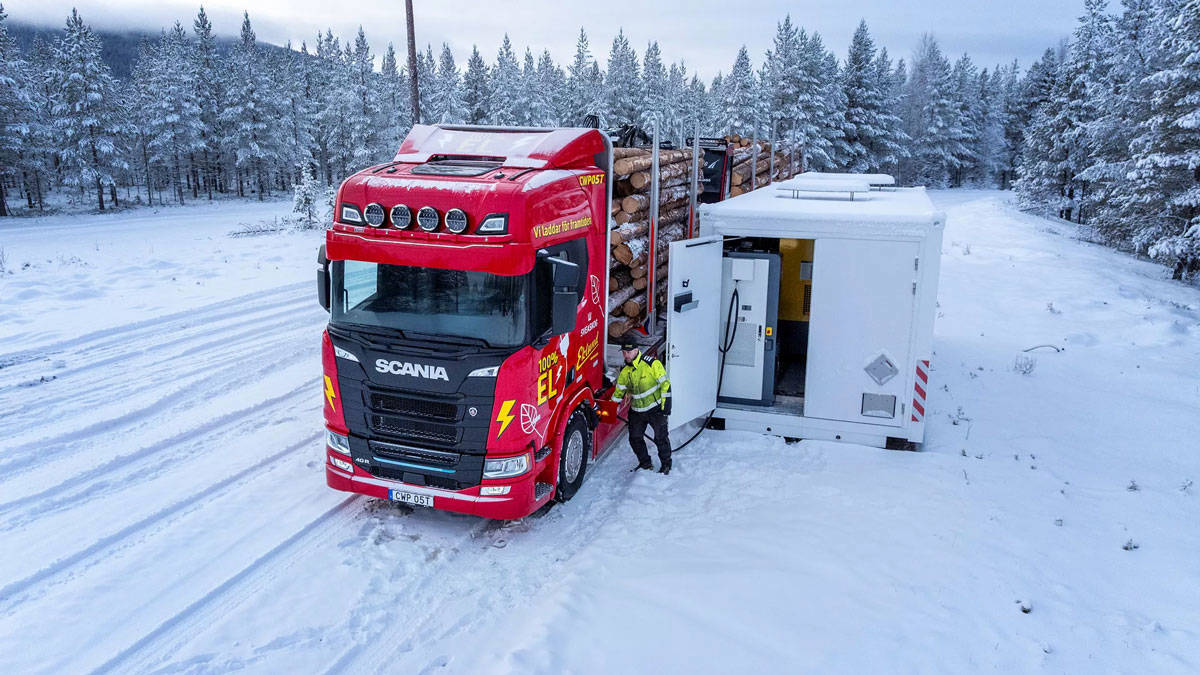
Mobile charging stations make it possible to charge even where conventional charging infrastructure is lacking. Here, a battery-electric timber truck is being charged. Image: Sveaskog
Electric Charging Stations-When forestry machines and tractors are electrified, the power grid is not always sufficient. Mobile electricity logistics can store, transport, and make electricity available where the work is performed.

-
The WeighPro Wireless Weighing Link represents a precise and dependable weighing system designed specifically for round timber, eliminating the need for re-calibration. This system offers operators minimal maintenance requirements, boasting an impressive battery life of up to two years between recharges.
-
That’s a remarkable amount of work hours for a single machine, the Norcar 600 owned by Erkki Rinne is taken well care of, it even has the original Diesel engine.
-
It is not possible to eliminate chain shot, but there are simple steps that can be taken to reduce the risk.
-
Arwel takes great pride in the fact that the mill has no waste whatsoever, “the peelings are used for children’s playgrounds, gardens and for farm animals in barns in the winter and the sawdust has multiple uses in gardens and farms as well.
-
Timber hauliers need to encourage young blood in, and also look after the hauliers we have, we need make the sector a safe and positive place to work.
FIND US ON
Results & Advice | Electricity for machines far from the grid
Electrifying forestry and agricultural machinery requires new solutions for energy supply. Mobile electricity logistics means supplying electricity where the work is carried out through storage, transport, or local production. It can complement the fixed power grid and enable electrification even in locations far from charging infrastructure.
Here are some things to keep in mind:
Think systems rather than individual machines: Plan vehicles, energy storage, charging, transport, and local energy production together.
Combine fixed and mobile solutions: Mobile solutions can complement the fixed power grid and enable electrification where permanent charging infrastructure isn’t practical. They can handle longer assignments, temporary power peaks, and workplaces with no grid connection.
Adapt the energy solution to your business: Electricity can be delivered via battery transport or by transporting fuels to the workplace and converting them into electricity where needed. The most suitable solution depends, among other things, on energy needs, transport distance, usage patterns, and access to infrastructure.
Use local electricity production: Farms, forest industries, and wind and solar parks can serve as energy nodes from which electricity is distributed to machines and vehicles. Electricity can be produced at many scales and close to its intended use, providing flexibility and creating alternatives to long, centralised supply chains.
Coordinate energy and transport logistics: Leverage existing transport and logistics chains. Energy can often be distributed via the same flows already used for machinery, raw materials, and inputs.
Plan for seasonal variations: In agriculture, energy demand varies greatly throughout the year. By sharing batteries and energy storage across applications, resources can be used more efficiently.
Weigh more benefits than just energy costs: Mobile energy storage can reduce the need for costly grid expansion, improve electricity-system flexibility, and provide backup power during outages.
The electrification of forestry machines, tractors, and heavy transport is already underway. But how do you charge large machines that operate far from the power grid? That is one of the major challenges in the transition. Several research projects and companies are developing solutions to bring electricity where the work actually takes place. Building power grids for every machine or temporary workplace is neither possible nor economically reasonable. Therefore, new system solutions are needed.

Within the TREE, ZEFO, and AgroDrive projects, machine manufacturers, transport operators, forestry companies, and researchers jointly develop solutions for electrification outside the power grid. Together, the projects bring together some of the leading players in developing the electrified work machines and transportation of the future.
Experience shows that how electricity is made available can become a crucial piece of the puzzle. In northern Sweden, mobile charging is being tested for electrified timber transport. Battery-electric tractors with battery exchange systems have been developed and put into operation, while several players are developing the next generation of electric forestry machines. It is also in these operations, with long transport distances and energy-intensive work machines, that the potential to reduce fossil emissions is often greatest.
When the electricity is available – but not where it is needed
Sweden is facing extensive electrification of transport, industry, and agriculture. We have a significant annual electricity surplus, and the share of weather-dependent electricity production from solar and wind is increasing, creating greater variation in both production and electricity prices. Power grids will continue to be the backbone of the power system, but production and demand do not always coincide in time and place. Therefore, the value of flexibility, inventory, and solutions that can help match consumption with production increases.
This becomes particularly clear in agriculture and forestry. The business is geographically dispersed, seasonal, and mobile, while the electricity infrastructure is stationary. Forest transport often takes place on smaller forest roads where public charging infrastructure is limited. At the same time, workplaces and energy needs shift between stands, fields, and farms, while the power grid and charging stations remain in place. The challenge is therefore not just about how much electricity is needed, but about producing sufficient power where and when the work is to be done.
Not all needs can be met through permanent infrastructure either. In some cases, it is rational to expand the power grid to the user; in others, it may be more efficient to use mobile off-grid solutions. Energy storage can then bridge production and use. They can store electricity when it is available and deliver high power where and when it is needed. Mobile electricity logistics is about making electrical energy available where and when it is needed, even beyond the fixed power grid’s reach, through storage, transport, or local electricity production.
In the agriculture and forestry sector, local electricity production already exists, for example through forest industries, farms, or their own wind farms. This creates opportunities not only to supply machines with energy but also to take greater control over their own energy supply.
Energy has always been transported
Transferring energy to the user is nothing new. Firewood, coal, oil, and fuel have long been transported where they are needed. What makes electricity special is that the energy is mainly distributed through fixed grids, making it possible to transfer energy directly to where it is needed.
When large industrial machines are electrified, new challenges arise. It is no longer about supplying smaller electric tools outside the grid, but about delivering large amounts of electricity to machines that are mobile, geographically dispersed, and, in some cases, rarely come into contact with fixed electrical infrastructure.
The future electrification of the real industries will therefore likely combine fixed power grids with various forms of mobile electricity logistics. The question then becomes how to make electricity available when distances are large, workplaces are relocated, and permanent infrastructure is not always a reasonable option.
From grid expansion to energy logistics
As electricity usage becomes more mobile, energy supply also needs to become more flexible. Several approaches can deliver electricity to locations outside the power grid, and the main difference is how the energy is transported.
Transporting stored electricity in batteries
Electricity can be stored in batteries where grid capacity or local electricity production is available and then transported to the workplace. The battery can be used for mobile energy storage to charge the machine during breaks and between shifts, or swapped directly for a discharged battery in the machine. In this way, existing electricity production and grid capacity can be utilised even when work is carried out far away.
Transporting fuels and producing electricity locally off-grid
Energy can also be transported as fuel, for example as biogas, hydrogen, e-fuels, or other renewable fuels. At the workplace or nearby, the energy can be used directly in the machine or converted into electricity through, for example, a generator or fuel cell. This makes it possible to deliver large amounts of energy even to places where battery transport becomes impractical.
The two main principles have different strengths and limitations. Battery-based solutions are highly efficient but involve weight challenges and capital costs, while fuels have higher energy density and are therefore easier to store and transport over longer distances. The right solution depends on energy needs, distance, usage patterns, and access to infrastructure. In practice, several solutions can be combined into a flexible energy system.
Electricity logistics can also be connected to existing energy and transport flows. Local electricity production on farms and in industries, solar and wind farms, charging stations, and fuel depots can serve as energy nodes, while existing transport can move batteries or fuels to workplaces.

Mobile charging as an enabler
Mobile charging should not be seen as a competitor to fixed charging but as a complement.
A vehicle can be charged mainly via fixed connections, but can be supplemented with mobile auxiliary charging to handle longer assignments, periods of higher energy demand, or more demanding driving patterns. Mobile energy storage can also serve as a backup solution when regular infrastructure is unavailable.
Discussions about mobile electricity logistics often focus on cost per kilowatt-hour. But for many businesses, the relevant comparison is more complex.
Alternatives include building grid capacity that is only used during parts of the year, establishing charging infrastructure with low utilisation rates, or accepting delayed electrification. In other cases, the alternative may be production downtime, idle machines, or long detours for charging.
The question is therefore not only what mobile electricity costs, but also what costs can be avoided by moving, storing, or generating electricity where it is needed.
For businesses that move between locations, the same mobile energy resource can be shared and used across multiple workplaces over time, creating value for more actors.
Why not just go with HVO?
A natural objection is why machines in the real industries should be electrified at all if it requires new solutions for electricity supply. Why not continue using combustion engines and replace fossil fuels with HVO or other biofuels?
For certain applications, HVO and other renewable fuels will remain important for a long time. In some cases, they can also be a long-term relevant solution.
But biofuels are not an unlimited resource. When road transport, aviation, and industry demand the same raw materials, the question arises of how to use these limited sustainable bioresources where they are most effective.
Electricity can be produced locally in several different ways, although electricity is not an infinite resource either. Electrification can simultaneously provide significantly higher energy efficiency from the energy source to the work performed and reduce dependence on fuel supplies. Electrification can also improve the working environment by reducing noise and local emissions.
Regardless of the energy carrier, the challenge remains to make energy available where the work is performed.
Forestry presents various challenges
Forestry clearly shows that electrification is not just about vehicles and machines, but also about making electricity available where the work is done.
The electrification of heavy forest transport is underway. Within the TREE project, electric timber and wood chip trucks are already in operation while the project works on charging infrastructure, route planning, vehicle technology innovation, and business models.
Experience shows that electrification is a systemic issue. It’s not enough to just replace the diesel engine with an electric motor. Vehicles, charging, power grids, and logistics must work together.
For heavy transport, electricity and grid connections are usually relatively close to the business. The challenge, instead, is that charging at sufficiently high power isn’t always in the right place. Forest transport often takes place in areas where public charging infrastructure is sparse or poorly adapted to transport flows. Building fast chargers that are used only periodically can also be economically difficult.
TREE is therefore also testing mobile assisted charging. An electric timber truck in northern Sweden is charged at a mobile charging station in an area with long transport distances and limited charging infrastructure. Mobile charging will become a range extender, allowing electrification to go further today.
For forestry machines, the situation is more challenging. Harvesters and forwarders operate far from both charging stations and grid connections, regularly moving between different locations. A harvester can work entire shifts without leaving the stand, while the forwarder regularly returns at least to the roadside. The challenge here is not to complement existing infrastructure, but to make energy available where the work is carried out. Some form of mobile electricity logistics will therefore be a prerequisite for electrification.
That is the question the ZEFFO project is investigating. The project compares different energy carriers, energy systems, and logistics chains for future emission-free forest workplaces and develops solutions for how energy can follow the work.
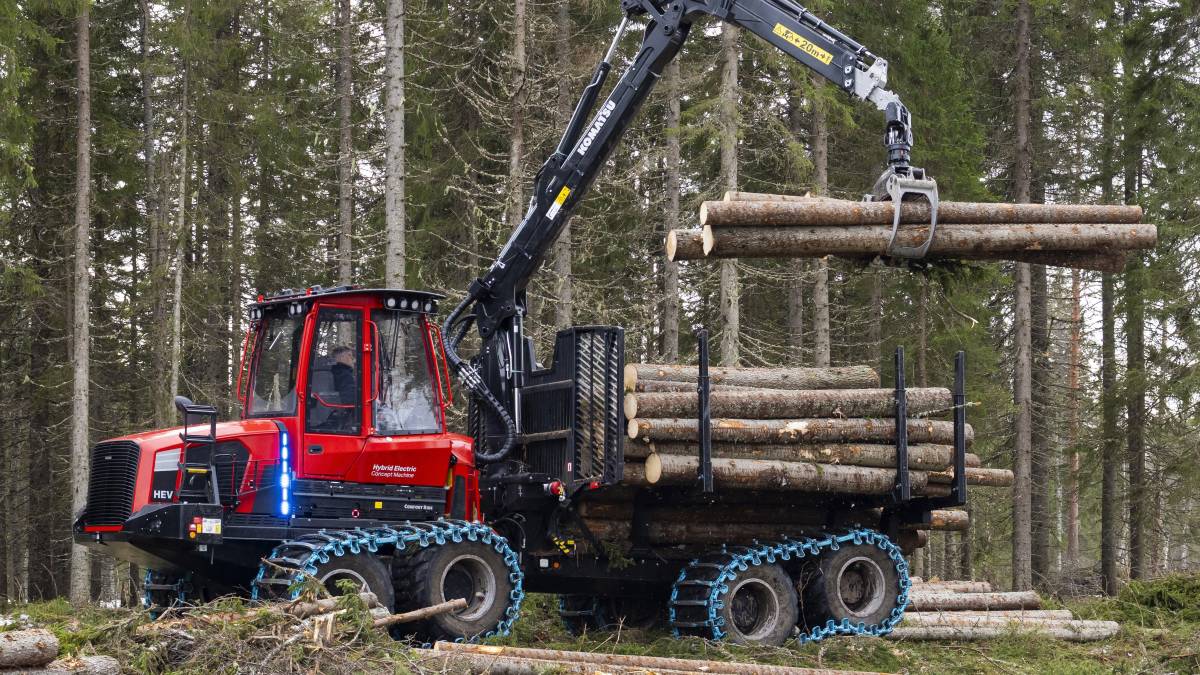
Hybrid electric concept machine from Komatsu.
The major challenge for agriculture is seasonal variations
Many of these challenges also apply to agriculture. Agricultural machinery works over large areas, and energy needs vary greatly by time of year and by the type of work performed.
Farmers with solar panels on their farm buildings can take control of their electricity supply. With batteries, you can store your own electricity and use it to power your machines. On a farm, you can charge a battery via solar panels or the grid while the tractor is out in the field and then swap an empty battery for a full one. Traktorarvid has demonstrated the concept of replacement batteries and electric logistics with its autonomous electric tractor, Drever120.
Because agriculture is highly seasonal, the need for battery storage and energy carriers varies greatly throughout the year. Grid capacity for charging is also a limiting factor and can become costly to expand based on seasonal demand. When the periods of greatest energy demand occur depends on the production orientation, but naturally occurs during spring and autumn crops as well as during summer. For the rest of the year, batteries and other system resources can be used either on-farm or off-farm for energy storage. In one project, a modular battery system has been built which, like a screwdriver battery, can be used for various applications. For example, it could be used in agricultural machinery for half the year and in piste machines for the second half.
To manage seasonal variations, it is necessary to develop ways to share batteries and other resources across different applications. This can help increase the electrification of agricultural machinery, which otherwise struggles with the large capital tied up in machines and systems that remain unused for much of the year.
AgroDrive, led by RISE and a national centre for fossil-free energy in agriculture and food, has shown that the transition will likely rely on a combination of electrification, biofuels, local energy production, and electricity logistics rather than a single technology.
Similar challenges also exist in the construction sector, where workplaces move over time and fixed electrical infrastructure often arrives late in the process.
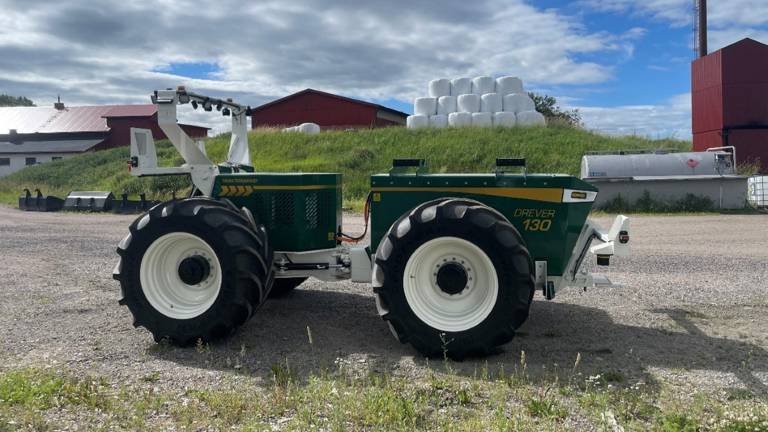
The autonomous and battery-electric agricultural tractor Drever 130, developed by Traktorarvid AB.
Electrification across the country
If charging infrastructure relies solely on strong grid connections and high public demand, investments will naturally concentrate where conditions are already favourable. Many of the businesses that are hardest to electrify are found in rural areas where distances are large, and energy needs vary over time. This risks leading to uneven electrification across the country.
Mobile electric solutions can therefore help ensure that electrification is not limited to places where the infrastructure is already strongest. In this way, mobile electricity logistics becomes not only a technical solution but also a way to create more equal conditions for transition throughout the country.
Moreover, the challenge is far from unique to Sweden. Similar conditions exist in many countries with large distances and natural resource-based industries, for example in the Nordic countries, Canada, and Australia.
From charging to flexibility, energy services, and readiness
When electricity can be stored, transported, or produced locally, new opportunities arise to utilise both electricity production and grid capacity more efficiently. Mobile battery storage can be charged where capacity is available and used where the need for electricity or power is greatest. The same resource can power machines and vehicles, store locally produced electricity, cut peak power, and provide backup power.
The value therefore lies not only in the energy delivered but also in the flexibility and energy services that the warehouse can provide. As technology develops, new business models may emerge where electricity is made available as a service.
Moreover, the development is about more than electrification. Battery storage and mobile charging systems commonly used in agriculture, forestry, or construction can be used as backup power for essential societal functions when needed. One example is the municipalities’ safety points during longer power outages, where residents can get information, communication, heating, and the opportunity to charge equipment. In this way, the same investment can support electrification, flexibility, energy security, preparedness, and greater societal resilience.
Electrification in the tough corners of society
The power grids will be the backbone of the energy system of the future. But the spine is not always enough to reach the hands and feet that will perform the work. When electrification moves into forests, fields, and temporary workplaces, solutions are also needed to make electricity available where it is needed. Therefore, the next step in the transition is not just about building more networks, but also about developing smart and efficient mobile electricity logistics. Only then can electrification reach even those parts of society where the transition is most challenging.
Source; Skogsforsk
Contact forestmachinemagazine@mail.com to get your products and services in front of the world’s largest professional forestry online news network.
#homeoflogging #writtenbyloggersforloggers #loggingallovertheworld
Written by loggers for loggers and dedicated to bringing you the latest forestry news