


About half of the timber transports in the studied system could be electrified under today’s conditions. Wood-processing charging points can be as important as battery size and range.
Electric timber transport. The overall goal of the TREE project is to help 50 per cent of all new trucks in the forestry industry be electric by 2030. For forest transport, the road to get there is more complex than for many other types of transport. Driving distances vary, and many routes have limited access to charging infrastructure.

-
The WeighPro Wireless Weighing Link represents a precise and dependable weighing system designed specifically for round timber, eliminating the need for re-calibration. This system offers operators minimal maintenance requirements, boasting an impressive battery life of up to two years between recharges.
-
That’s a remarkable amount of work hours for a single machine, the Norcar 600 owned by Erkki Rinne is taken well care of, it even has the original Diesel engine.
-
It is not possible to eliminate chain shot, but there are simple steps that can be taken to reduce the risk.
-
Arwel takes great pride in the fact that the mill has no waste whatsoever, “the peelings are used for children’s playgrounds, gardens and for farm animals in barns in the winter and the sawdust has multiple uses in gardens and farms as well.
-
Timber hauliers need to encourage young blood in, and also look after the hauliers we have, we need make the sector a safe and positive place to work.
FIND US ON
Results from a simulation-based study of timber transport in Värmland, carried out using the tool ElRutt, show that the goal of 50 per cent electrification may be achievable with today’s vehicle technology, if charging at industry is possible. At the same time, the results show that the outcome depends on how the transport system as a whole is designed. Vehicles, charging infrastructure and transport planning need to work together to achieve a higher degree of electrification.
Industry: a strategic place for charging
When a timber truck delivers timber to an industry, it stops for unloading. If the truck can also charge at the industrial level, the work shift can be streamlined with less need for separate charging stops. The results indicate that charging at industry can significantly affect the possible degree of electrification.
In the study, the possible degree of electrification increased from about 40 to 50 per cent when charging was available at the industry, compared with a scenario where vehicles used only the public charging network during shift hours. The improvement was achieved without changing the technical characteristics of the vehicles. Without the option to charge at the industry, transport becomes more dependent on expensive public charging. This quickly worsens the economic case, limits which routes are possible for electric trucks, and creates inefficiencies through extra driving or special charging stops.
The results show that the location of charging infrastructure can be at least as important as the number of chargers in the transition of forest transport.
More powerful chargers increase the potential
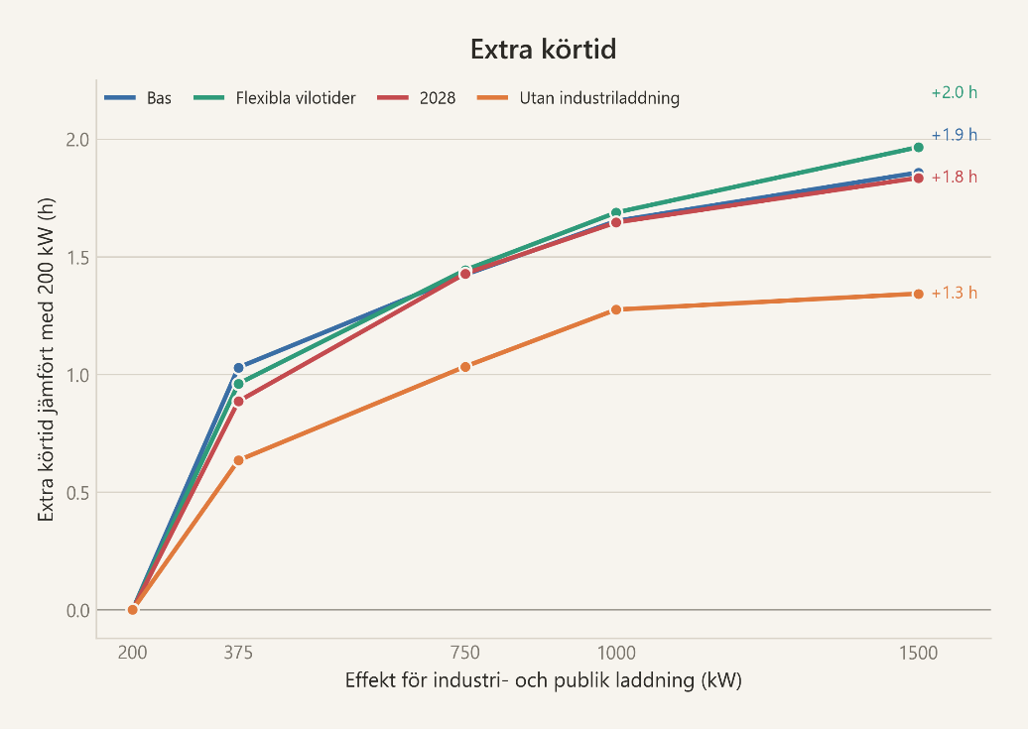
Figure 1. Extra driving time compared to a 200 kW reference vehicle for different charging scenarios and charging powers.
The study also shows that the charging power has a major impact on how efficiently electric timber trucks can be used.
When the charging power increased from 200 kW to 750-1,500 kW, corresponding to future MCS charging, the average driving time could increase by up to 2 hours per shift for a two-shift timber truck. At the same time, the simulations showed that a large part of the transport system could be electrified. Shorter charging times mean vehicles can spend more time transporting and less time charging. The results therefore indicate that not only charging availability, but also charger performance, affects how far the transition can go. At the same time, higher charging effects require investments in both charging points and electricity grids. It is therefore important to dimension the charging infrastructure where it provides the greatest benefit.
Rest time can become charging time
Transport planning can also affect the ability to use electric trucks efficiently. Today’s rules for breaks and rest were designed for diesel-powered trucks, but for electric vehicles, a rest stop can also act as a charging stop. When the model allowed greater flexibility in when breaks could be taken, so rest time could be coordinated with charging, the possible electrification rate increased from around 50 to 63 per cent. This was also true in scenarios with lower battery capacity and available charging power.
The results show that the transition is not just about vehicle technology. How transport is planned can also strongly affect how well electric trucks can be used.

A transport system must work as a whole
The study shows that about 50 per cent of transport in the analysed system can be electrified. At the same time, the results indicate that charging at the industry plays an important role in achieving this. Higher charging power and more flexible transport planning could further increase the potential.
At the same time, challenges remain for the most demanding transport, where long distances and limited access to charging can still limit the potential to replace diesel power. For the forest industry, this means the transition must be seen as a systemic issue in which vehicles, charging infrastructure, electricity grids, and transport planning are developed together.
The results show that the electric timber truck of the future doesn’t depend solely on battery size. Access to the right charging in the right place can be at least as crucial.
Source;Skogsforsk
Contact forestmachinemagazine@mail.com to get your products and services in front of the world’s largest professional forestry online news network.
#homeoflogging #writtenbyloggersforloggers #loggingallovertheworld
Written by loggers for loggers and dedicated to bringing you the latest forestry news