
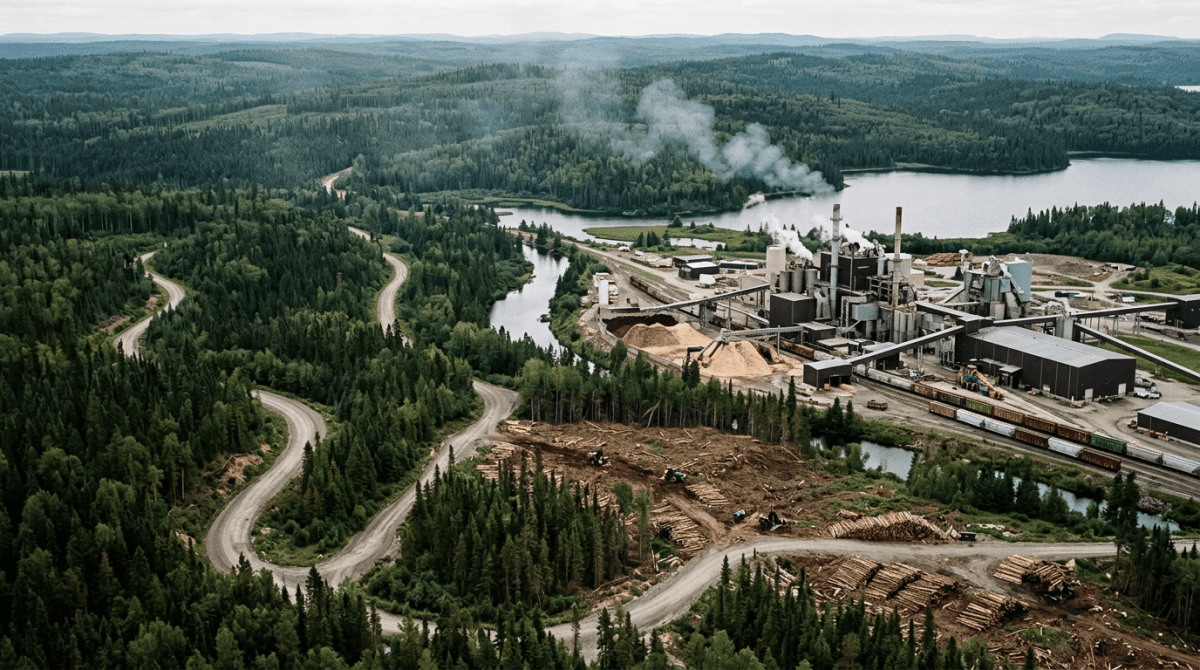
The Federal Government will roll out the $6.5B over six years to help modernise ageing sawmills, boost productivity and develop new products.
Forestry industry leaders say Ottawa’s $6.5-billion funding package will give the sector a much-needed boost but won’t save struggling mills overnight.
The federal government’s spending plan, announced last week, proposes rolling out funding over six years to help modernise ageing mills, boost productivity and develop new products
.
-
The WeighPro Wireless Weighing Link represents a precise and dependable weighing system designed specifically for round timber, eliminating the need for re-calibration. This system offers operators minimal maintenance requirements, boasting an impressive battery life of up to two years between recharges.
-
That’s a remarkable amount of work hours for a single machine, the Norcar 600 owned by Erkki Rinne is taken well care of, it even has the original Diesel engine.
-
It is not possible to eliminate chain shot, but there are simple steps that can be taken to reduce the risk.
-
Arwel takes great pride in the fact that the mill has no waste whatsoever, “the peelings are used for children’s playgrounds, gardens and for farm animals in barns in the winter and the sawdust has multiple uses in gardens and farms as well.
-
Timber hauliers need to encourage young blood in, and also look after the hauliers we have, we need make the sector a safe and positive place to work.
FIND US ON
But the money isn’t expected to start flowing until 2027-28, even as U.S. tariffs, weak markets and rising costs continue to threaten jobs and operations across the country.
Derek Nighbor, president and chief executive of the Forest Products Association of Canada, called the $6.5-billion commitment “precedent-setting.”
But he warned that 2027 will likely be another difficult year for the industry as housing starts remain weak and U.S. tariffs persist.
“The $6.5 billion over six years in the budget is for longer-term transformation, upgrading equipment, getting into new product lines,” he said. “That’s all very welcome for the long term.”
Nighbor said the immediate challenge is helping the industry weather the current downturn.
“There’s no magic moment or magic bullet for the federal government just to turn this thing on a dime, and everything is fine,” he said.
The forestry sector has been battered by years of mill closures and layoffs.
Those struggles have intensified over the past several months, with pulp and paper mills across the country shutting down or suspending operations citing a range of market pressures.
In recent weeks, AV Group NB Inc. temporarily idled its Nackawic pulp mill in New Brunswick, affecting about 350 workers, while Rayonier Advanced Materials halted production at its Témiscaming, Que., facility, affecting more than 300 jobs.
Domtar also announced in August that it would indefinitely idle its Bayview Fibre chipping facility and Howe Sound pulp mill in Port Mellon, B.C., affecting about 400 employees.
Ken Farr, president of the Canadian Institute of Forestry, said he worries the funding may come too late to help some struggling mills.
“The issue is now and the problem is now,” he said.
Farr said the industry is facing a “perfect storm” of U.S. tariffs, ageing facilities and increasingly limited access to affordable timber supplies.
“I don’t think any kind of funding can be sent too soon,” he said. “It will help companies upgrade their equipment, raise productivity and transition to higher-value wood and paper products.”

The forest sector is a key driver for Canada’s economy, particularly in rural, remote and Indigenous communities.
The 2026 budget said the industry employed nearly 200,000 workers and contributed $29.7 billion to the country’s GDP in 2025.
The new federal funding includes $500 million to strengthen wood fibre supply chains and forest management, $2 billion to help companies modernise mills, boost productivity and develop higher-value products, and $4 billion in financing through Export Development Canada to support major investments in forestry facilities.
Unifor national president Lana Payne said in a statement the funding will provide “urgently needed stability for the sector and its workers, while also supporting the necessary long-term transformation of the overall sector.”
But the industry needs a broad strategy to address the ongoing challenges, she said.
The federal government is developing a forest sector strategy it says will improve the industry’s long-term competitiveness.
Based on recommendations from an industry task force, the plan is expected to be released before the end of the year.
“Unifor hopes this strategy includes more detailed measures supporting workers and communities through transition,” Payne said.
Nighbor said greater regulatory certainty is one of the industry’s top priorities for the federal strategy.
He said companies can spend years developing harvesting plans and obtaining provincial approvals, only to face additional federal restrictions that could disrupt operations.
The industry wants more co-ordination between Ottawa and the provinces to give companies more certainty about access to timber supply, Nighbor said.
“If you’re investing in a mill, you need to know that you’re going to have certainty or access to that working land base for at least the next 20 to 30 years.”
Source: ctvnews.ca
Contact forestmachinemagazine@mail.com to get your products and services in front of the world’s largest professional forestry online news network.
#homeoflogging #writtenbyloggersforloggers #loggingallovertheworld
Written by loggers for loggers and dedicated to bringing you the latest forestry news