
Forestry operators must halt work if the public breaches a risk or exclusion zone, according to new FISA safety guidance.
The Forest Industry Safety Accord (FISA) has released an important update to its guidance on public access around forest operations and tree work. This update clarifies the specific responsibilities of landowners, Forestry Works Managers, contractors, and operators, with more detail to support safety and compliance.

-
The WeighPro Wireless Weighing Link represents a precise and dependable weighing system designed specifically for round timber, eliminating the need for re-calibration. This system offers operators minimal maintenance requirements, boasting an impressive battery life of up to two years between recharges.
-
That’s a remarkable amount of work hours for a single machine, the Norcar 600 owned by Erkki Rinne is taken well care of, it even has the original Diesel engine.
-
It is not possible to eliminate chain shot, but there are simple steps that can be taken to reduce the risk.
-
Arwel takes great pride in the fact that the mill has no waste whatsoever, “the peelings are used for children’s playgrounds, gardens and for farm animals in barns in the winter and the sawdust has multiple uses in gardens and farms as well.
-
Timber hauliers need to encourage young blood in, and also look after the hauliers we have, we need make the sector a safe and positive place to work.
FIND US ON
The updated guide encompasses all forestry operations while adhering to the principle that controls must align with the level of risks involved. It also offers much more detailed guidance on implementing these controls effectively in real-world situations.
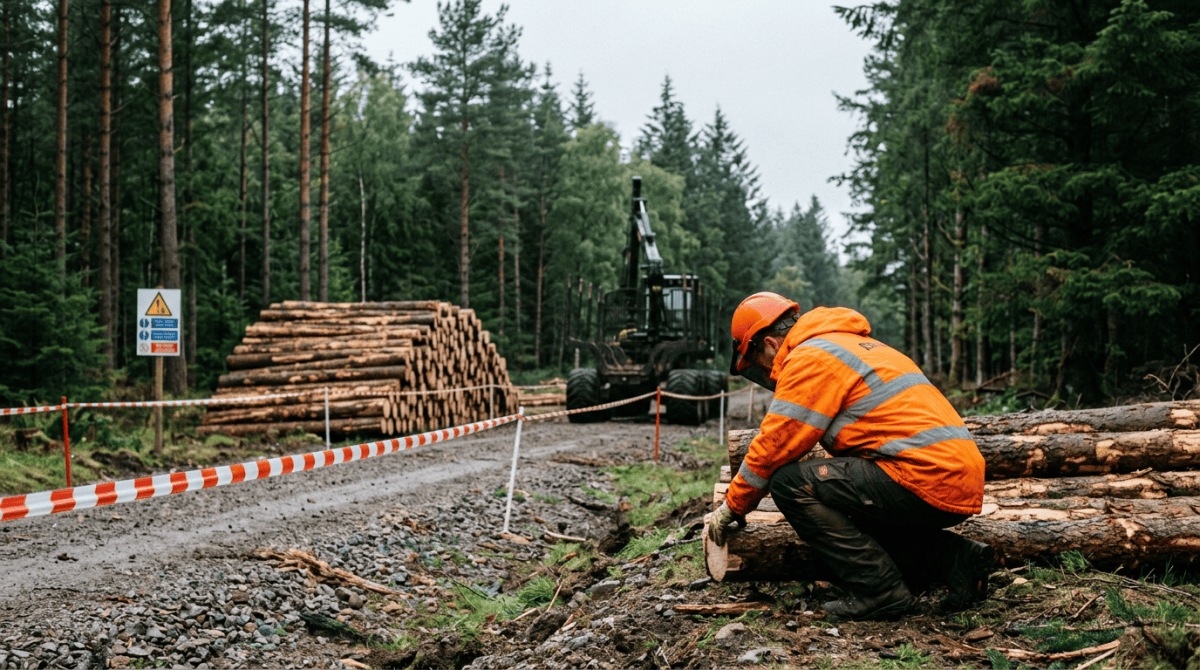
Operators are required to remain vigilant and attentive to members of the public who may be present at or nearing worksite areas. If there is any indication that a person has entered or is approaching an established exclusion zone, they must immediately halt all operations. Work should only recommence once it has been confirmed that the area is safe and clear of any unauthorised individuals. Also, promptly report any breaches of safety protocols or other hazardous situations encountered during these operations to the Forestry Works Manager to ensure ongoing safety and compliance.
Greater emphasis is also placed on banks persons. FISA says they may be required at key access points where signs and temporary barriers do not provide adequate controls, particularly where public access is foreseeable or at high levels.
Significantly, decisions not to use a banks person should be clear and justified, with robust alternative measures identified and implemented.
Statutory safety signs should be no smaller than A3, with larger versions considered depending on the location and level of visitor activity. Erect threshold signs at all known access points to a risk zone.
FISA also gives substantially more consideration to physical barriers. Consider semi-permanent measures such as Heras fencing where reasonably practicable, while plastic netting, barrier tape, and natural obstacles can be appropriate in other circumstances.
However, the guide warns that barrier tape alone will not be sufficient in areas with high levels of public access.
The updated document puts greater emphasis on communicating with visitors before they reach a working site. Landowners and Forestry Works Managers are encouraged to consider the full visitor journey, providing information before people set out, while travelling to the site, on arrival, and while using woodland facilities.
It also gives operators more flexibility to manage public access according to individual circumstances.
At moderately used woodland with informal access, for example, signage may be concentrated at the main or obvious entry points rather than every possible route, with banks persons deployed only where higher-risk activities justify them.

For timber uplift after harvesting, the new guidelines emphasise the importance of establishing an exclusion zone for loading operations. This zone is primarily determined by the reach of the machinery used and the length of the timber being handled, with a minimum requirement set at 50 meters to ensure safety.
Additionally, the updated guidance incorporates a revised definition of the mechanical harvesting risk zone. This zone is meant to enhance safety measures and should be defined as the maximum of three criteria: a distance of 90 meters, the specific risk zone specified by the equipment manufacturer, or a measurement that combines two tree lengths with the length of the machinery boom. This thorough approach aims to mitigate risks associated with timber harvesting operations.
This guidance highlights the roles and responsibilities for managing public safety under FISA GMHSF, ensuring activities in and around worksites are coordinated, and the right tasks are carried out by the right people. It also provides advice on suitable control measures that reflect a balanced, risk-based approach, with examples of operational scenarios.
This FISA guide is new to the forestry industry, and we welcome your feedback. If you have feedback, please email admin@ukfisa.com. We will share your comments with the FISA Worksite Working Group, and we will review the guide in six months.
Contact forestmachinemagazine@mail.com to get your products and services in front of the world’s largest professional forestry online news network.
#homeoflogging #writtenbyloggersforloggers #loggingallovertheworld
Written by loggers for loggers and dedicated to bringing you the latest forestry news