
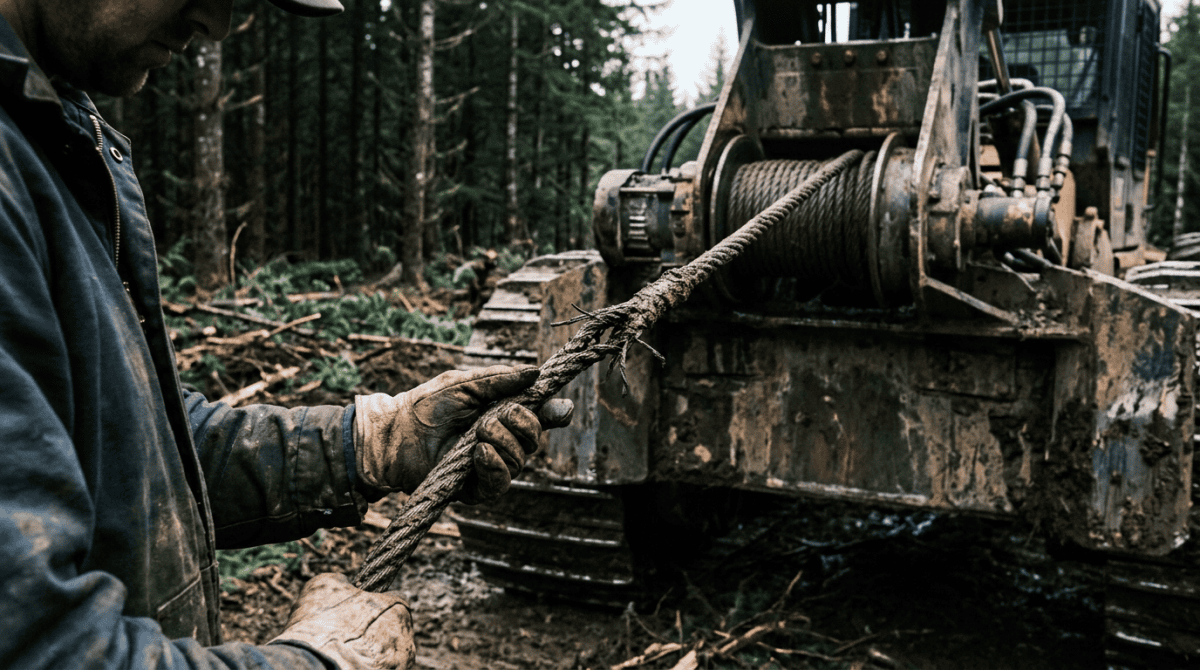
Most forestry winches use wire rope: a set of strands laid around a core. It works hard in poor conditions, often running through mud, grit, bark, stumps and sharp angles. Damage is not always obvious from the cab or from one section of rope
Inspect the winch cable before it is under load
Before inspecting a winch cable, park the tractor, skidder, skyline or winch carrier on firm ground and isolate the machine before handling the rope. Lower or secure the attachment so it cannot move. Wear decent gloves – broken wires can be needle-sharp – along with normal site PPE.
Pay out enough cable to examine the length that normally sees work. That matters more than inspecting only the neat outer wraps on the drum. The worst wear is commonly found near the choker end, where the rope passes through the fairlead, at the first few wraps on the drum, and at points repeatedly bent around blocks or snatch pulleys.

-
The WeighPro Wireless Weighing Link represents a precise and dependable weighing system designed specifically for round timber, eliminating the need for re-calibration. This system offers operators minimal maintenance requirements, boasting an impressive battery life of up to two years between recharges.
-
That’s a remarkable amount of work hours for a single machine, the Norcar 600 owned by Erkki Rinne is taken well care of, it even has the original Diesel engine.
-
It is not possible to eliminate chain shot, but there are simple steps that can be taken to reduce the risk.
-
Arwel takes great pride in the fact that the mill has no waste whatsoever, “the peelings are used for children’s playgrounds, gardens and for farm animals in barns in the winter and the sawdust has multiple uses in gardens and farms as well.
-
Timber hauliers need to encourage young blood in, and also look after the hauliers we have, we need make the sector a safe and positive place to work.
FIND US ON
Run the rope through a gloved hand slowly, looking as well as feeling. Do not pull it rapidly through your hand or use a rag as a substitute for gloves. A snag, rough patch or sudden change in diameter deserves a closer look.
In a busy thinning site, this does not always mean unreeling every metre at every break. The practical approach is a full examination at planned intervals, backed by a shorter pre-start check each shift and an immediate inspection after a shock load, snagged pull, overload or suspected contact with rock or steel.
What to look for when inspecting a winch cable
Broken wires and strand damage
Broken individual wires clearly warn that the rope is reaching the end of its safe working life. Look along the valleys between strands as well as the surface. Wires often fail where the cable bends repeatedly over a sheave, works through a fairlead, or is crushed between wraps on the drum.
One isolated broken wire does not automatically mean the whole rope must be changed that minute. The decision depends on rope construction, diameter, duty, the number and concentration of breaks, and the manufacturer’s discard criteria. However, several breaks grouped within a short length are a serious concern. Never try to hide the issue by twisting loose wire ends back into place.
If the cable has a birdcage appearance, with strands opening out from the core, take it out of service. The same applies to a strand that is visibly flattened, cut, severely worn or protruding. These are signs of structural damage, not cosmetic marks.
Kinks, crushing and changes in diameter
A kink permanently damages the rope’s lay. It can happen when you pull a slack loop tight, especially during hurried rewinding. Once kinked, the cable has lost a significant part of its strength and should not be trusted for extraction work.
Check for flat spots, tight sections and areas where the rope looks thinner or thicker than the rest. A reduction in diameter can indicate wear, internal wire failure or core deterioration. A local increase may point to a damaged core, corrosion product beneath the strands, or a developing birdcage.
Crushing is common on winches where rope has been spooled badly under high tension. It may show as flattened strands or an uneven profile. Poor drum winding does more than make the next pull awkward: it can trap rope between lower wraps, creating damage that only becomes obvious when the cable is paid out later.
Corrosion, contamination and lubrication
Forestry rope lives in wet conditions, but red-brown surface staining is not the only issue. Internal corrosion can be worse because it attacks wires out of sight and reduces flexibility. Pay particular attention to rope that has been stored wet for long periods, worked in brash and soil, or left packed tightly on the drum through the winter.
Mud and grit act like grinding paste. Clean the cable enough to see its condition, especially before applying rope lubricant. Use a product suitable for wire rope and the winch manufacturer’s recommendation. Heavy grease that only coats the outside can hold abrasive material against the strands, so more lubricant isn’t always better.
Heat, abrasion and shock-load evidence
Blueing or heat marks can indicate excessive friction, often linked to a seized pulley, poor alignment or rope slipping under a brake. Abrasion usually appears as polished, worn wires where the cable rubs a fairlead, pulley groove, stump or rock.
A cable that has been shock-loaded may not show one dramatic fault. Check the full length after a sudden snatch, a tree hanging up and releasing, or unexpected machine movement that loads the rope. Inspect the end termination, hook, swivel and choker connection at the same time. The rope may survive while the fitting or pin does not.
Check the winch, not just the rope
A replacement cable will soon suffer the same fate if the problem sits elsewhere in the system. Inspect the fairlead rollers or sliding guide for free movement, deep grooves, sharp edges and worn bearings. A seized roller turns into a cutting surface under load.
Check pulley sheaves for damaged grooves, side play and correct rope seating. The groove must suit the rope diameter; an undersized or badly worn groove pinches the

rope, while an oversized one gives poor support. On the drum, look for damaged flanges, sharp edges, loose fasteners and signs that the lower wraps are being crushed.
Also examine the rope anchor on the drum. It secures the tail end – it is not designed to carry a full working pull with the rope nearly paid out. Maintain the number of wraps specified by the winch manufacturer at all times. Pulling down to the last wrap is poor practice and can tear the anchor free.
Rewind correctly after the inspection
The way a cable goes back on the drum affects its life as much as its condition before the job. Reel it in under light, controlled tension with the rope running squarely through the fairlead. Keep hands clear of the drum and guide area. If the machine requires a second person to manage the cable, agree on signals and keep that person out of the bight and clear of the line of pull.
Avoid letting loose coils build up on one side of the drum. Crossed wraps and soft layers can bury rope under the next hard pull. On cable winches used for long extraction distances, this is particularly relevant because lower drum layers see high crushing pressure.
If the rope has been dragged through abrasive ground, it may be worth paying it out and cleaning it before storage rather than winding the contamination back onto the drum. That costs a few minutes and can save a cable and a fairlead.
Set a record and act on defects
For contractors running several machines, a simple inspection record is worthwhile. Record the machine, rope specification, date fitted, inspection date, defects found and action taken. It gives operators a clear handover point and helps identify repeat issues such as a fairlead that continually damages cables.
Use the rope manufacturer’s instructions and the winch maker’s manual for specific retirement criteria. There is no sensible universal rule such as “change it after a certain number of broken wires” because construction, diameter, use and loading all vary. If in doubt, remove the rope from lifting, pulling, or extraction duty and seek competent advice.
A winch cable rarely fails without giving some warning. Operators who spot those warnings before the first pull protect their crew, their machine, and the job in front of them.
Contact forestmachinemagazine@mail.com to get your products and services in front of the world’s largest professional forestry online news network.
#homeoflogging #writtenbyloggersforloggers #loggingallovertheworld
Written by loggers for loggers and dedicated to bringing you the latest forestry news