
Electric forestry machinery has advanced but hasn’t replaced diesel on harvesting sites. Contractors should focus on which jobs can benefit from quieter operation, lower emissions, and reduced fuel handling without compromising production or recovery capability.
Electric Forestry Machinery-That distinction matters. A battery-powered chainsaw on thinning and clearance work is one thing. A 20-tonne harvester climbing wet ground for a long shift, with a forwarder behind it and no dependable grid connection, is another proposition entirely. Forestry work is hard on machines, hard on batteries, and rarely done beside a convenient charger.
-
The WeighPro Wireless Weighing Link represents a precise and dependable weighing system designed specifically for round timber, eliminating the need for re-calibration. This system offers operators minimal maintenance requirements, boasting an impressive battery life of up to two years between recharges.
-
That’s a remarkable amount of work hours for a single machine, the Norcar 600 owned by Erkki Rinne is taken well care of, it even has the original Diesel engine.
-
It is not possible to eliminate chain shot, but there are simple steps that can be taken to reduce the risk.
-
Arwel takes great pride in the fact that the mill has no waste whatsoever, “the peelings are used for children’s playgrounds, gardens and for farm animals in barns in the winter and the sawdust has multiple uses in gardens and farms as well.
-
Timber hauliers need to encourage young blood in, and also look after the hauliers we have, we need make the sector a safe and positive place to work.
FIND US ON
Where electric forestry machinery is earning its place
The strongest case for electric forestry machinery is currently in work where machines return to a base, operate close to power, or have defined duty cycles. Arb and utility crews, estates, local authorities, sawmills, firewood yards and urban woodland contractors are the natural early adopters.
Battery chainsaws, hedge cutters, clearing saws, and blowers are already established tools, not experimental kit. Their appeal is practical: less noise around houses, schools, and public footpaths; no two-stroke fuel mixing; instant starting; and lower operator vibration. With a well-organised crew, charged battery packs can keep a day moving with little disruption.
The catch is that battery tools require discipline. Packs need protection from damage, charging needs planning, and a wet, cold day will quickly expose optimistic runtime claims. A professional operator also needs enough batteries to work at a proper pace, not one tool and a promise. That raises the initial outlay, although reduced fuel and servicing can narrow the gap over time.
Compact electric loaders, mini excavators, and site carriers also make sense in yards and controlled woodland environments. They are particularly useful where timber handling takes place under cover, in public-facing locations or where noise restrictions limit working hours. For sawmill handling, biomass loading and firewood processing, electric drive can suit repetitive work remarkably well.
The grid connection is part of the machine
A machine’s electrical supply deserves the same scrutiny as its engine specification. Before ordering electric equipment, a business needs to know what power is available at the depot or yard, whether the existing connection can support charging, and what charging will cost at the times it is needed.
A standard overnight charge may work for one compact machine. It may not support a fleet returning late, needing to be ready before first light, and sharing capacity with workshops, processing lines, and site lighting. Three-phase supply, load management and charge scheduling can become part of the operating plan.
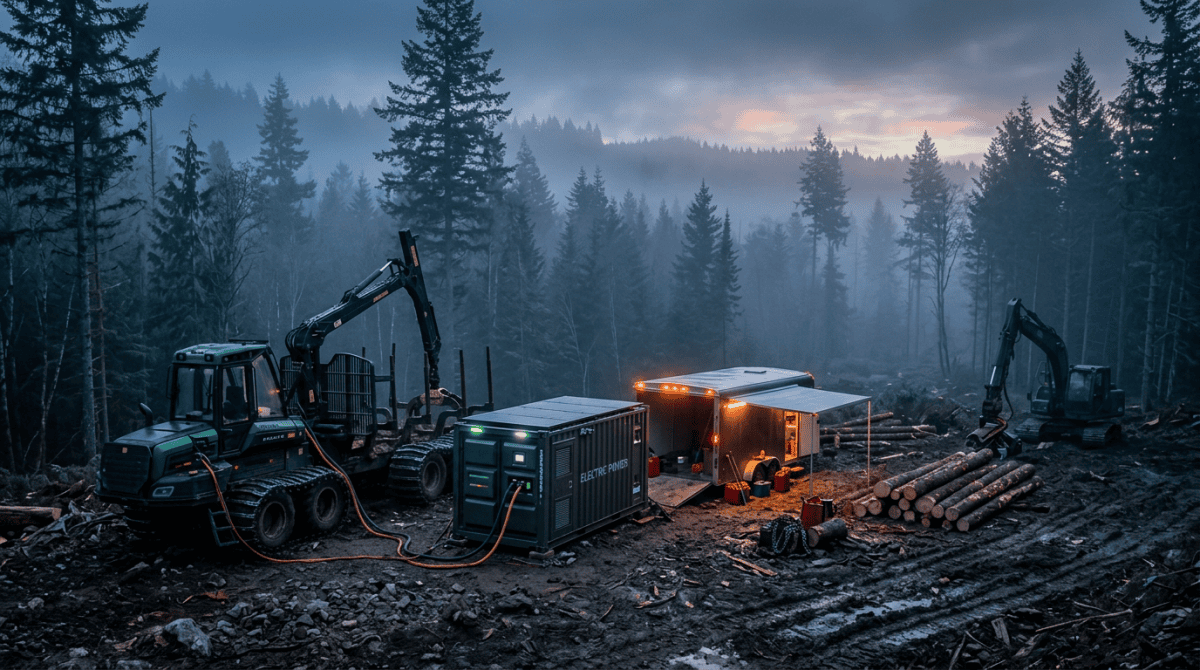
For remote sites, mobile charging units and battery storage are beginning to appear, but they do not make energy free or magically available. If you haul a diesel generator into the woods solely to charge machinery, the emissions and cost case needs careful examination. It may still reduce noise at the point of work, but it doesn’t equate to genuinely low-carbon operation.
Why full-scale electric harvesting remains difficult
Purpose-built electric harvesters and forwarders are being developed, while some manufacturers are testing hybrid systems, cable connections and alternative powertrains. The direction of travel is clear. However, the commercial fit remains narrow for most UK harvesting contractors.
A productive cut-to-length operation needs sustained power, machine weight in the right place, reliable traction and a working day that can stretch when weather, haulage or timber flow demands it. Harvesters draw heavily on hydraulic systems, particularly when processing larger stems. Forwarders need energy not only to travel but to crane, load and climb under variable ground conditions.
Battery packs capable of supporting that work add weight, cost and packaging challenges. Weight can help traction up to a point, but it can also increase ground pressure, transport complexity and the consequences of getting a machine stuck. A forestry machine can’t be treated like an electric car with tracks.
Charging time is another operational issue. Contractors earn on output, and a machine standing still at the wrong point in a shift is expensive. Shift changes, planned refuelling windows and roadside landings could provide opportunities for charging in certain operations. Yet those arrangements need to work through winter, across scattered contracts and with the realities of access, cable protection and site security.
That does not rule out electrification. It means the first viable large-machine applications are likely to be predictable: fixed processing sites, short extraction distances, timber yards, cable-assisted operations with an available power source, or fleets working from a well-equipped depot. For conventional harvesting across remote, steep or soft sites, diesel still offers the energy density and rapid refuelling that keep production moving.
Measure the job, not the brochure
Assess an electric machine against the work it will actually perform. Manufacturers’ runtime figures are useful starting points, but they rarely account for operator style, slope, timber size, ambient temperature, attachment use, travel distance and stop-start working.
For a battery tool fleet, track battery changes over several weeks. Record the work type, weather, number of packs used, charge times and any waiting time. For a loader or yard machine, measure hours under load, peak demand, charging windows and electricity cost. That information is more valuable than a headline range figure.
Total cost of ownership also matters. Electric equipment can have fewer routine service items: no engine oil, fuel filters, exhaust after-treatment or idling losses. But you need to ask about battery replacement terms, dealer response, software support, charger repairs, and residual value before signing an order.
A contractor should also consider the cost of downtime honestly. Diesel fuel is available almost everywhere and a bowser can be sent out quickly. A failed charger, damaged high-voltage cable or battery fault may require specialist attention. Good dealer backup is not a nice extra when the machine is booked into a tight programme.
Safety and site practice still come first
High-voltage systems introduce different risks, not fewer risks. Operators and fitters need clear instructions on isolation, charging, damaged batteries, water ingress and incident response. Handle a battery damaged by impact, crushing, or fire according to the manufacturer’s procedure, not as ordinary scrap or left in a workshop corner.
Charging areas need sensible housekeeping. Keep leads protected from vehicle movement, avoid improvised extension arrangements, and ensure battery packs are not charged beside fuels, waste timber, or other combustible materials. The usual forestry standards for inspection, maintenance, and competent use still apply, with an added electrical layer.
The workforce benefits are worth taking seriously. Lower noise can improve communication and reduce fatigue, especially in repetitive clearance and processing work. It can also make operations more acceptable near neighbours. But quieter equipment can create its own hazard around pedestrians and other site users, so exclusion zones and awareness remain essential.
The buying decision is becoming more strategic
Pressure to reduce emissions is coming from several directions: client procurement, local authority contracts, landowner requirements and the wider cost of carbon reporting. Some work will increasingly favour contractors who can demonstrate lower-emission methods, particularly around public spaces and processing sites.
That should not push businesses into buying machinery to satisfy a fashionable specification. The best investment may be a battery tool package, an electric loader in a busy yard, better depot charging and a cleaner diesel fleet for the work that still demands it. Hybrid fleets are likely to be the practical answer for some time.
For buyers, the useful questions are straightforward: what does the machine produce in a real shift, where will it charge, what happens when it faults, and does the contract reward the change? If the answers stack up, electric forestry machinery can be a sound commercial tool rather than a marketing exercise.
The technology will improve, but forestry should not wait for a perfect all-electric harvester before acting. Start where the work is repeatable, the power supply is dependable and the machine can prove its worth one shift at a time.
Contact forestmachinemagazine@mail.com to get your products and services in front of the world’s largest professional forestry online news network.
#homeoflogging #writtenbyloggersforloggers #loggingallovertheworld
Written by loggers for loggers and dedicated to bringing you the latest forestry news