
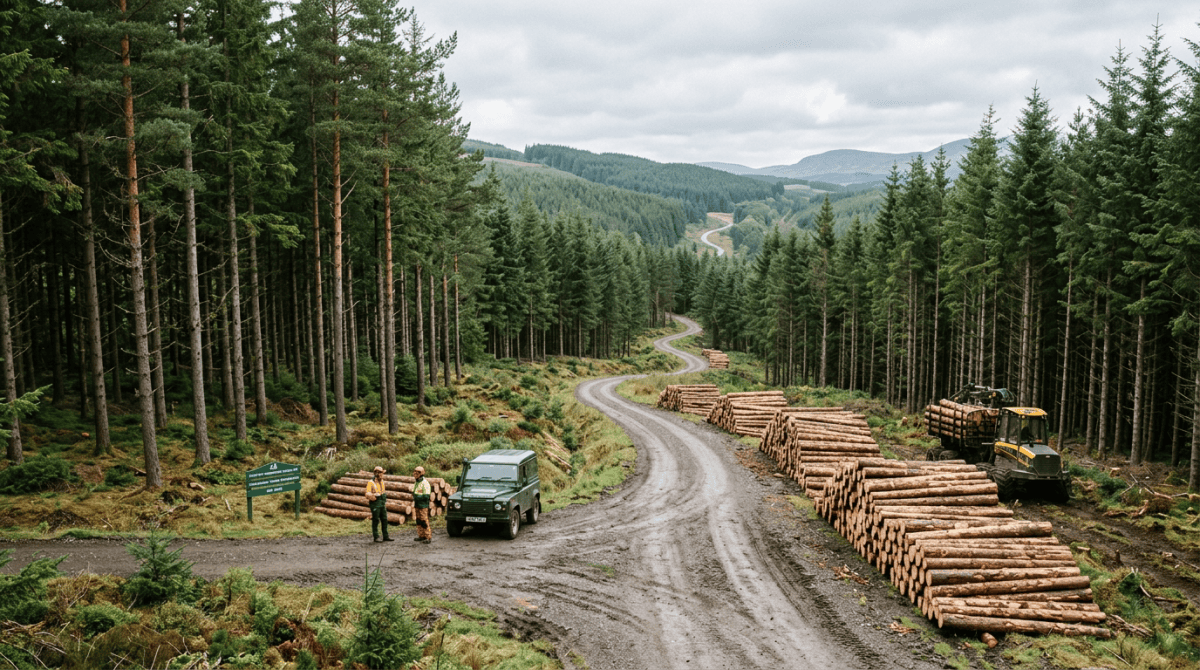
A productive conifer crop can now offer two potential income streams: the timber it yields and the carbon it may retain or generate.
Forest carbon market trends are therefore no longer confined to investors and consultants. They are beginning to affect the work available to contractors, harvest timing, and the figures behind woodland acquisitions across Great Britain.
For working forestry businesses, the useful question is not whether carbon is good or bad. It is whether a proposed carbon project stacks up once the commitments, access requirements, lost timber opportunities and operational risk are properly costed.

-
The WeighPro Wireless Weighing Link represents a precise and dependable weighing system designed specifically for round timber, eliminating the need for re-calibration. This system offers operators minimal maintenance requirements, boasting an impressive battery life of up to two years between recharges.
-
That’s a remarkable amount of work hours for a single machine, the Norcar 600 owned by Erkki Rinne is taken well care of, it even has the original Diesel engine.
-
It is not possible to eliminate chain shot, but there are simple steps that can be taken to reduce the risk.
-
Arwel takes great pride in the fact that the mill has no waste whatsoever, “the peelings are used for children’s playgrounds, gardens and for farm animals in barns in the winter and the sawdust has multiple uses in gardens and farms as well.
-
Timber hauliers need to encourage young blood in, and also look after the hauliers we have, we need make the sector a safe and positive place to work.
FIND US ON
Related Posts
Forest carbon market trends shaping woodland decisions
The voluntary carbon market remains the main route for woodland carbon in the UK. Landowners establish or manage woodland under a recognised framework, quantify expected carbon sequestration, and may sell verified units to organisations seeking to compensate for part of their emissions. In practice, the UK Woodland Carbon Code remains the reference point for new woodland projects, while the Peatland Code serves a different purpose when restoration, rather than tree planting, is the proposition.
The key change is that buyers are becoming more demanding. The early market could reward a broad promise of trees in the ground. Buyers now want clearer evidence of additionality, long-term protection, sensible species selection, transparent ownership of carbon rights and credible monitoring. They also want to avoid reputational trouble from buying credits tied to poor planting, failed establishment or woodland that was likely to be created anyway.
That scrutiny is healthy, but it adds cost and complexity. A woodland owner may need baseline surveys, project design work, validation, ongoing monitoring and verification. Credits are not simply produced when planting is complete. Projected units and independently verified units carry different levels of confidence, and their value can differ accordingly. Read any contract with the same care as a long-term timber supply agreement.
There is also a clear split opening up between high-quality, well-documented projects and low-confidence supply. A site with secure tenure, sensible establishment plans, realistic yield assumptions and good records is easier to sell than a speculative scheme built around optimistic stocking and a weak maintenance budget. The market is moving towards proof, not presentation.
Timber still sets the operational baseline
Carbon does not remove the need to manage a forest as a working asset. In many commercial blocks, timber revenue remains the most tangible cash flow, particularly where there is established road access, a reliable market outlet and a crop approaching thinning or clearfell age. Carbon income may improve a marginal planting case, support longer-term management or help fund establishment, but it does not make poor ground, inaccessible sites or weak silviculture disappear.
For harvesting contractors, the issue is more immediate. A carbon-led management plan can alter coupe size, intervention dates and extraction specifications. It may favour continuous cover forestry, wider riparian buffers, retaining more habitat trees, or delaying harvesting. Those choices can be right for the site, but they can reduce machine productivity and increase cost per tonne if they aren’t planned properly.
A harvester and forwarder team cannot price work on a neat map alone. Ground bearing capacity, slope, timber size, forwarding distance, turning areas, public access, overhead services and road condition still determine whether a job pays. Where carbon conditions require lower-impact extraction or seasonal restrictions, the tender should say so from the outset. Contractors should not be expected to absorb extra risk because a woodland manager has marketed the project as low impact.
The same applies to haulage. Longer retention, selective removal and smaller roadside stacks can change load building and lorry turnaround. If a site is designed around carbon claims but lacks serviceable forest roads and loading areas, the operational consequences will soon show up in haulage costs.
Carbon contracts need proper due diligence
Carbon rights may sit with the freeholder, leaseholder or another party under a management agreement. That point needs settling before planting, sale or harvesting work begins. A buyer purchasing a forest for its timber potential can find that future management is already constrained by a carbon contract. Equally, a landowner might assume carbon income is theirs while a previous agreement has assigned those rights elsewhere.
Before signing, woodland owners and managers should establish the project duration, who carries liability if the crop fails, what happens after storm damage, disease or fire, and whether insurance or a buffer system covers the shortfall. They should also clarify exit provisions. A commitment extending for decades may survive a change in ownership and can affect the property’s saleability and valuation.
Additionality deserves particular attention. Put plainly, the project must show that the claimed carbon benefit would not have happened in the same form without carbon finance. Where planting is already required by a condition, fully funded by another scheme, or clearly profitable from timber alone, the argument can become harder. This is not merely paperwork. If a project is challenged later, its credibility and commercial value can suffer.
For contractors, the practical protection is to ask for the relevant site constraints before quoting. Is there a carbon project plan? Are there restrictions on brash handling, ground disturbance, felling dates, retained timber or machinery movements? Is there a requirement for georeferenced work records or photographic evidence? Those details belong in the work specification, not in a last-minute conversation at the gate.

The planting boom has limits
Government support, corporate net-zero commitments and pressure to increase woodland cover have all driven interest in afforestation. But available land is not an unlimited resource, and neither is planting capacity. Good planting ground often has competing claims from food production, habitat restoration, sporting interests, landscape concerns and development pressure.
The supply chain is another constraint. Tree nurseries need confidence to grow the right stock several years ahead. Fencing crews, ground-preparation contractors, planters, and beat-up teams are already stretched in busy areas. A project that looks attractive on a spreadsheet can fall behind if plants, labour, or deer control aren’t secured.
Species choice is also receiving closer attention. Carbon models may favour fast growth, but a single-species prescription can create exposure to pests, disease, drought and windthrow. Sitka spruce will remain central to British timber production on suitable ground, yet the direction of travel is towards better site matching, more diversity where appropriate and management plans that can withstand a rougher climate. That can mean slower early carbon accumulation, but a more durable crop over the full commitment period.
Better data will raise the bar
Remote sensing, digital inventories and improved forest mapping are making it easier to monitor woodland condition. Satellite imagery can flag canopy change, while drone surveys and field measurements can provide more detailed evidence where required. These tools will not replace competent ground assessment, especially in mixed stands or difficult terrain, but they are changing what buyers and auditors expect to see.
For professional operators, this may create extra admin, but it can also reward good practice. Accurate machine records, GPS tracks, harvest maps, weighbridge data and photographs can demonstrate that work was completed to the agreed plan. A contractor who can supply clear evidence of low-impact working, rather than simply state it, is better placed when carbon-backed woodland work comes to market.
The caution is that data is only as useful as the decisions behind it. A satellite image cannot tell a manager whether a forwarder should be on a wet rack in November. It cannot replace an operator who sees rutting starting, changes the extraction route and prevents a small problem becoming a reinstatement bill.
What forestry businesses should watch next
Credit prices will continue to vary by project quality, buyer demand and confidence in the wider voluntary market. Do not build a business case around a headline carbon price offered by a broker without understanding the deductions, timing and conditions. Gross figures can look attractive; net income after development costs, validation, verification, marketing fees, insurance and long-term management may look very different.
Watch too for tighter claims rules. Companies buying credits face growing pressure to reduce their own emissions first and be precise about what a carbon purchase represents. That should favour credible woodland projects, but it may reduce demand for vague or heavily discounted credits. It also means landowners should be wary of anyone promising quick money from planting with little discussion of permanence, management or legal obligations.
For the UK forestry trade, carbon is becoming another commercial layer over the same fundamentals: grow a crop suited to the site, build and maintain access, protect the soil, control browsing pressure, plan work safely and get timber to a paying market. The strongest projects will be those where the carbon plan improves those fundamentals rather than fights them.
When the next carbon-led woodland job lands on the desk, price the actual operation, ask who owns the liability, and make sure the site plan works for machines as well as marketing copy.
Contact forestmachinemagazine@mail.com to get your products and services in front of the world’s largest professional forestry online news network.
#homeoflogging #writtenbyloggersforloggers #loggingallovertheworld
Written by loggers for loggers and dedicated to bringing you the latest forestry news