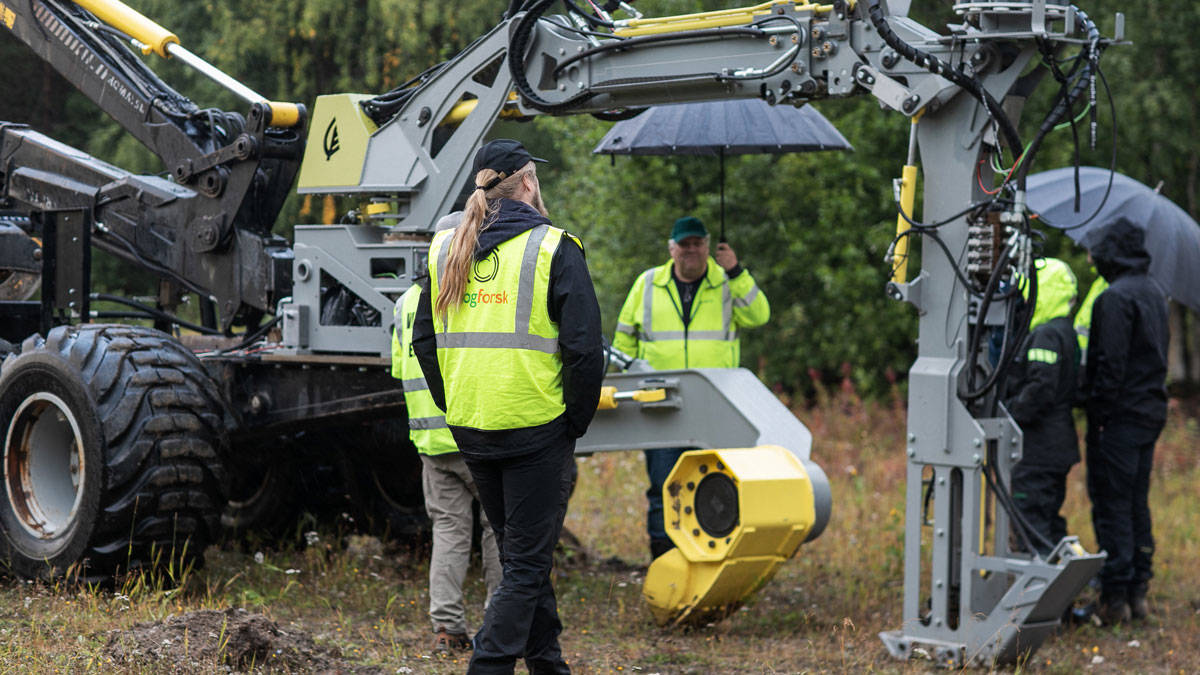
An autonomous system that scarifies and plants has gone from idea to prototype. This is an important result from the completed collaboration project Autoplant.
“Autoplant, which has been running for five years, has been an important collaborative project, which has shown the power that arises when research, technology companies and forestry work towards a common goal,” says Linnea Hansson, Skogforsk, who has been project manager for Autoplant.

-
The WeighPro Wireless Weighing Link represents a precise and dependable weighing system designed specifically for round timber, eliminating the need for re-calibration. This system offers operators minimal maintenance requirements, boasting an impressive battery life of up to two years between recharges.
-
That’s a remarkable amount of work hours for a single machine, the Norcar 600 owned by Erkki Rinne is taken well care of, it even has the original Diesel engine.
-
It is not possible to eliminate chain shot, but there are simple steps that can be taken to reduce the risk.
-
Arwel takes great pride in the fact that the mill has no waste whatsoever, “the peelings are used for children’s playgrounds, gardens and for farm animals in barns in the winter and the sawdust has multiple uses in gardens and farms as well.
-
Timber hauliers need to encourage young blood in, and also look after the hauliers we have, we need make the sector a safe and positive place to work.
FIND US ON
The goal has been to develop a new system for autonomous forest regeneration, with high precision, low environmental impact and a better working environment. This has been done through the development of various sub-solutions that together build up the system.
A vital part of the system is Bracke Forest’s new head that both scarifies and plants autonomously. Under good conditions, the head can work at speeds up to two kilometres per hour. It is also scalable and can have 1-3 arms depending on the size of the base machine.
“We have gone from idea and concept sketches to a working prototype. It is an important step forward and gives us knowledge that will be valuable in the continued development of the forest regeneration machines of the future,” says Ruben van Westendorp, Development Manager at Bracke Forest.
Today, the head is pulled by a regular forwarder, but in the long term it will be possible to pull it by autonomous machines of different sizes. The project has therefore studied the terrain characteristics, energy consumption and productivity of different basic machines. At the same time, a decision support system for automatic planting and route planning, “Pathfinder”, has been developed to enable autonomous driving.
“Pathfinder both helps the system to choose tree species according to what has grown best in that particular area, and suggests routes that avoid sensitive land or land where natural and cultural environment values have been taken into account. Pathfinder can also be used in today’s scarifiers,” says Linnea Hansson.
Less soil impact has been a central issue, and follow-ups show that the scarification method used gives up to 80 per cent less impact compared to conventional harrowing. An automatic quality follow-up of planted seedlings, based on image analysis and AI, has also been developed.
“A camera at the back of the machine takes a picture of each plant so that it can be seen immediately whether it is well planted or not,” says Linnea Hansson.
Autoplant has also covered work environment issues, the interaction between man and machine, and the laws and regulations required for the new technology to be introduced and commercialised. Overall, the project has laid a foundation for continued development towards more productive, resource-efficient and sustainable forestry.
AutoPlant is a Vinnova-funded collaborative project between the parties Skogforsk, LTU, KTH, Bräcke, Skogstekniska klustret, SCA, Södra, Sveaskog, Holmen and StoraEnso.
Source photo and video: Skogsforsk

Contact forestmachinemagazine@mail.com to get your products and services seen on the world’s largest professional forestry online news network.
#homeoflogging #writtenbyloggersforloggers #loggingallovertheworld
Written by loggers for loggers and dedicated to bringing you the latest forestry news