
HVO100 can significantly reduce forestry’s fossil emissions – without requiring new technology. But despite clear climate benefits, the transition is slowed down by the economy and uncertain rules of the game.
HVO100-Sweden has adopted ambitious climate goals. By 2045, the country will reach net-zero greenhouse gas emissions, in line with the EU climate framework and the European Green Deal. Several important interim goals must be met by 2030. In this transition, the forest plays a key role – both as a carbon sink and as a supplier of renewable products and raw materials. At the same time, forestry requires energy for forest management as well as for harvesting and onward transport.

-
The WeighPro Wireless Weighing Link represents a precise and dependable weighing system designed specifically for round timber, eliminating the need for re-calibration. This system offers operators minimal maintenance requirements, boasting an impressive battery life of up to two years between recharges.
-
That’s a remarkable amount of work hours for a single machine, the Norcar 600 owned by Erkki Rinne is taken well care of, it even has the original Diesel engine.
-
It is not possible to eliminate chain shot, but there are simple steps that can be taken to reduce the risk.
-
Arwel takes great pride in the fact that the mill has no waste whatsoever, “the peelings are used for children’s playgrounds, gardens and for farm animals in barns in the winter and the sawdust has multiple uses in gardens and farms as well.
-
Timber hauliers need to encourage young blood in, and also look after the hauliers we have, we need make the sector a safe and positive place to work.
FIND US ON
Today, that energy is often of fossil origin. Within the Swedish Forest Industries Federation’s future promises for the circular society, the goal is to have no fossil emissions in the value chain by 2040 (the Swedish Forest Industries Federation 2025). The companies’ own environmental goals also include targets for reduced direct and indirect fossil emissions in the value chain.
Harvesting work, i.e. felling and forwarding timber to roads in both thinning and final felling, accounts for about 30 percent of fossil emissions in the forestry value chain (calculated from a life cycle perspective up to the industrial gate) if all machines are assumed to run on MK1 diesel (Toller. 2026). MK1 diesel is the main diesel grade in Sweden, free of sulphur and adapted for diesel vehicles and certain stationary engines, with a mix of fossil and renewable raw materials based on the reduction obligation. The emissions come from the combustion of diesel in the work machines out in the terrain and reducing these emissions is therefore a key issue. The quickest and easiest solution is a continued transition to the use of more HVO100. Based on dialogue with actors in the industry, it is estimated that contractors and forest companies today use more than 10 percent HVO100 or high-blend diesel, but the variations between players are large.
What is HVO100?
HVO stands for Hydrogenated Vegetable Oil, and is a renewable, synthetically produced diesel that should not be confused with traditional biodiesel such as FAME/RME. Chemically, HVO100 works in a similar way to traditional MK1 diesel. Although there are some differences, for example in density and energy content, these have only a marginal impact on fuel consumption (Drivkraft Sverige, 2026a). A crucial difference, however, is that HVO100 is produced from renewable raw materials, such as residues and vegetable oils, instead of fossil crude oil.
For the user, the transition is easy: in practice, all modern forest machines are already approved to run on HVO100 without technical modifications. This means that the fuel is basically a so-called “drop-in” fuel that can be replaced straight off. However, there are indications that the fuel estimate in the machine computer may need to be recalibrated during a fuel change to ensure correct calculation of fuel consumption in the machines.
The advantages of HVO100 are several compared to MK1 diesel:
- 80–90 percent lower greenhouse gas emissions MK1 diesel (depending on raw material and reduction level).
- Same combustion properties and performance.
- Odorless and cleaner handling.
- Good cooling and storage properties, which are important in forestry’s often remote fuel depots, as well as from a preparedness point of view.
- Fully miscible with regular Mk1 diesel, providing a smooth transition.
- Is a well-established biofuel in other industries.

Domestic production of HVO100 has grown strongly in recent years, with players such as VAROPreem and St1 at the forefront, and together with Finnish Neste’s large-scale production, the supply is currently considered to be good. HVO100 is distributed nationally and is available at over 500 filling stations, however, it is less frequent between filling stations in the northern part of Sweden (Drivmedla.se). Demand for HVO100 is expected to increase, which, together with the fact that today’s raw material base is limited, may pose challenges for the long-term supply. Manufacturers are looking at new types of biomass streams in order to offer an attractive fuel in the long term.
Major emission reductions are within reach
If all harvesters and forwarders switch from MK1 diesel to HVO100, emissions from the driving work could be greatly reduced, Figure 1. How large the reduction can be depends on the reduction obligation and its variation from year to year. In 2023, the reduction obligation was 30.5 percent, and then a switch from using only MK1 diesel to using only HVO for the drive would reduce emissions by almost 80 percent. Lower reduction obligations in recent years make the effect of a change even greater. Since harvesting accounts for such a large proportion of forestry’s emissions, it means a significant overall reduction. In practice, a complete shift to HVO in the driving work could reduce emissions from the entire value chain by about a quarter – without waiting for new mechanical technology or extensive investments in charging infrastructure.
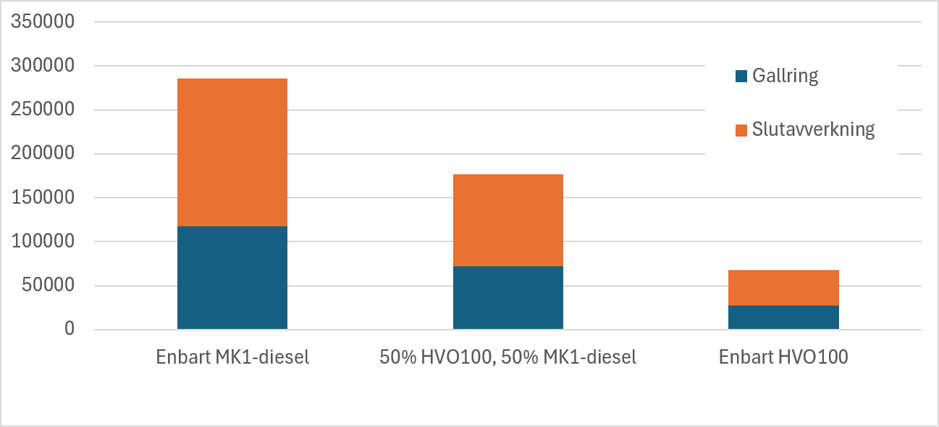
Figure 1. The importance of the choice of fuel for emissions during harvesting (felling and forwarding of timber to roads in both thinning and final felling). Greenhouse gas emissions in tonnes of CO2 equivalents when using only MK1 diesel, only HVO100 and half of each for the year 2023. Please note that emissions for diesel vary from year to year due to the reduction obligation.
No technical barriers – but financial
Technically, there are basically no obstacles, as described above. The major barrier is instead economic because the HVO100 price has always been higher than for MK1 diesel, even though price changes have followed each other (Figure 2). In 2025, HVO100 was on average SEK 6.9 more expensive per litre than MK1 diesel for work machines. The difference is due both to a higher basic price and to the fact that MK1 diesel for work machinery is covered by a tax subsidy. The divided additional cost for HVO100 per litre in 2025 was approximately SEK 3.0 in basic price (Drivkraft Sverige, 2026b), and in addition to this, an average of SEK 3.9 due to the tax subsidy (Swedish Tax Agency, 2025). HVO100 and other clean biofuels are already tax-exempt and thus the tax subsidy for work machines can only be used on fossil fuels.
With an average fuel consumption of about 1.9 litres per cubic metre of timber (m3FUB) For felling and forwarding, this means an increased average cost of approximately SEK 13 per cubic metre of timber by road. However, prices vary over time, the same figure for April 2026 resulted in an additional cost of about SEK 10.2 per litre and an average of SEK 19.4 per cubic metre of timber by road.
Several entrepreneurs express a desire to change, but believe that they do not have the financial space to bear the additional cost themselves. For the transition to become a reality, the cost of renewable fuel needs to be shared along the entire value chain – from forest owners to industry and end customers.
There are economic uncertainties linked to the tax subsidy for MK1 diesel for work machines. The subsidy is decided annually and is currently fixed throughout 2026. However, the long-term direction is unclear, which may complicate strategic choices. A further aspect of uncertainty is how the EU’s new emissions trading system, ETS2, will affect machinery (Swedish Environmental Protection Agency 2026). In the long term, fossil fuels will gradually become more expensive through carbon dioxide pricing, which may change the calculation in favour of renewable alternatives such as HVO100.
Source Skogsforsk
Contact forestmachinemagazine@mail.com to get your products and services seen on the world’s largest professional forestry online news network.
#homeoflogging #writtenbyloggersforloggers #loggingallovertheworld
Written by loggers for loggers