
Can AI teach a forwarder to load? Through simulation and field tests, autonomous forwarder cranes are trained to choose efficient and safe grips in timber piles.
Photo; Skogsforsk
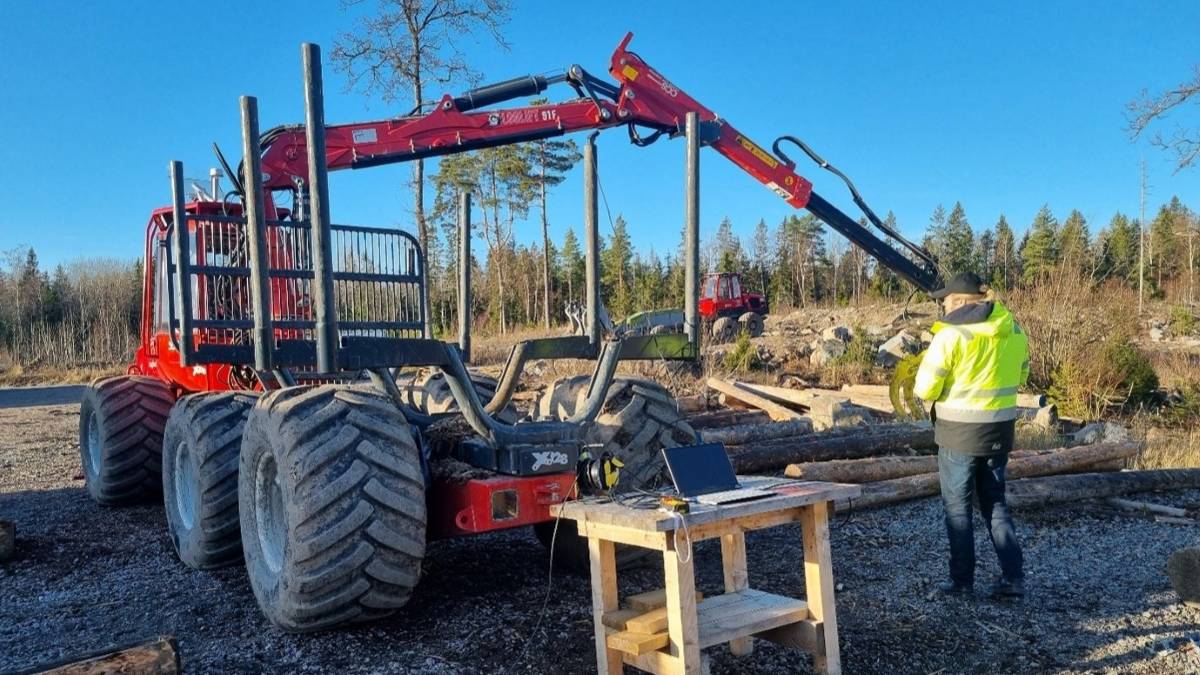
Can AI teach forwarders to self-load?-Loading a forwarder with logs may seem easy to an experienced operator. In reality, it is an advanced task: the operator must constantly assess log position, avoid soil and stones, and load as efficiently as possible. In the article Synthesizing multi-log grasp poses in cluttered environments,
-
The WeighPro Wireless Weighing Link represents a precise and dependable weighing system designed specifically for round timber, eliminating the need for re-calibration. This system offers operators minimal maintenance requirements, boasting an impressive battery life of up to two years between recharges.
-
That’s a remarkable amount of work hours for a single machine, the Norcar 600 owned by Erkki Rinne is taken well care of, it even has the original Diesel engine.
-
It is not possible to eliminate chain shot, but there are simple steps that can be taken to reduce the risk.
-
Arwel takes great pride in the fact that the mill has no waste whatsoever, “the peelings are used for children’s playgrounds, gardens and for farm animals in barns in the winter and the sawdust has multiple uses in gardens and farms as well.
-
Timber hauliers need to encourage young blood in, and also look after the hauliers we have, we need make the sector a safe and positive place to work.
FIND US ON
Researchers from Umeå University, with help from the Forestry Research Institute of Sweden and Algoryx Simulation, have developed a method in which artificial intelligence is trained to find suitable grip positions for an autonomous forwarder crane.
This study focuses on identifying and gripping logs lying around so they can be lifted at the same time. This is without the grapple colliding with surrounding obstacles such as stones, stumps, or other logs that should not be lifted.
AI is trained in virtual forest environments
To train the AI system, we first created a large number of virtual forest environments. Through physics-based simulation, we generated hundreds of piles of logs with varying appearances. Logs, stones, stumps and terrain were placed in different combinations and simulated according to the same physical laws that apply in real life. Next, a detailed simulation of a real grapple tested thousands of grapple positions in each log pile. The system saved only the positions that worked as training data.
Simulation creates large amounts of training data
In this way, a comprehensive dataset was built with thousands of successful and unsuccessful lifting attempts. The advantage of simulation is that it allows many experiments without risking damage to machines or people. In addition, many more training situations can be created than would be practically possible in real forest environments.
The AI model is based on a U-Net-type neural network, an architecture common in image analysis. The model’s input combines camera images, depth information, and segmentation masks that identify the target logs for the lift. Based on this information, the model calculates where the grapple should be placed relative to the timber pile, how it should be oriented, and how wide it should be opened. At the same time, the model estimates how good a given gripping position is.
For example, a position that catches four logs may be better than one that only catches two. The model can also account for how well balanced the load is expected to be when the logs are lifted. This lets the system adapt to different work goals, such as maximising timber per lift or prioritising stability in the grapple.
High accuracy and ability to avoid obstacles
When we tested the model on previously unseen piles of logs, it performed very well. In simulation, it found working gripping positions in up to 96 per cent of cases. The results also showed that the model could handle piles with more logs than those used during training. This suggests that the system has not only memorised training data, but has actually learned general principles for how logs should be gripped.
We also tested how the model reacts to different types of obstacles. The results showed that the AI learned to avoid large rocks and other obstacles. By combining camera images with depth information, the model could assess whether there was enough room for the grapple to reach between the logs.
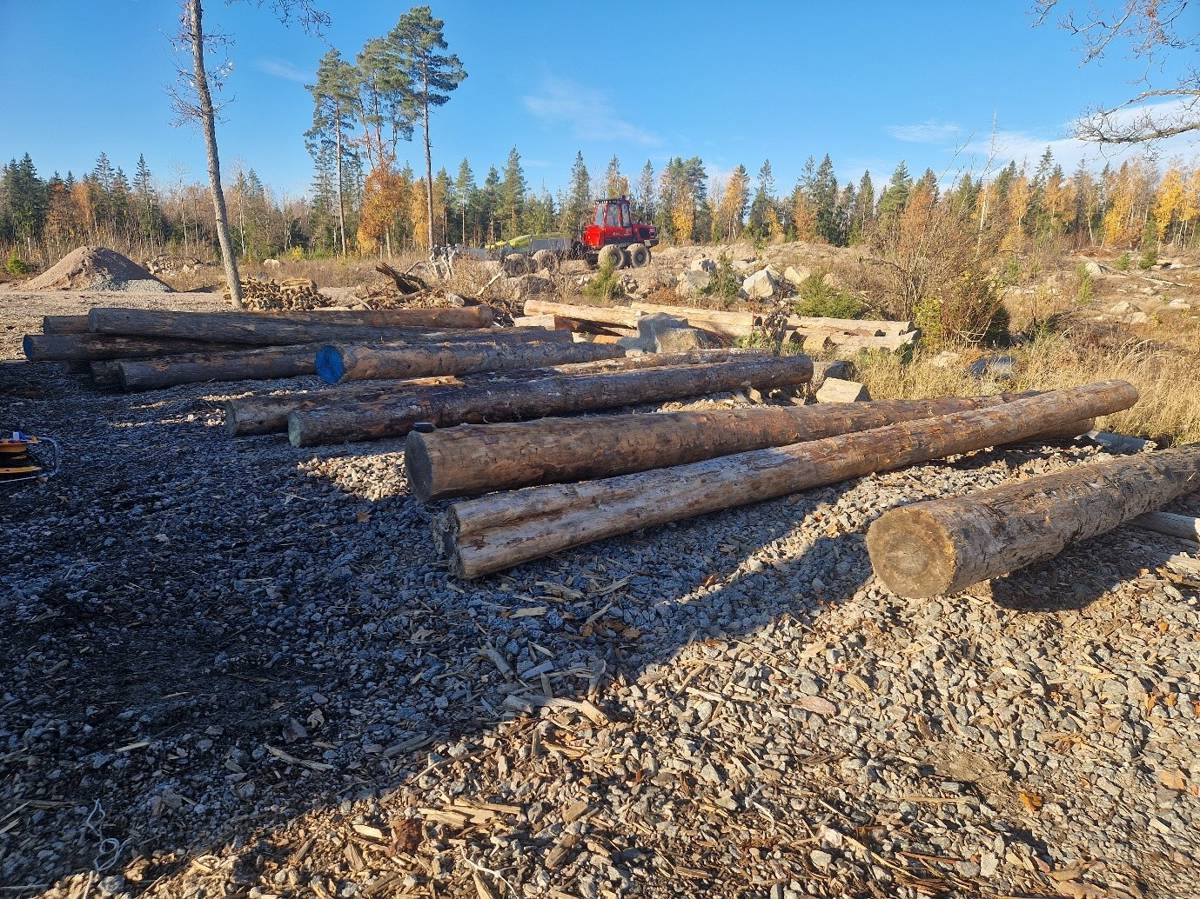
Piles of logs scanned. Photo: Skogforsk

Reality test at Jälla
To test whether the technology also worked in reality, practical tests were carried out at the Forestry Research Institute’s Forest Technology Testbed at Jälla outside Uppsala. Six piles of logs of varying sizes and “sprawl” were placed on the ground within grasping distance of the forwarder. The piles were 3D scanned and the scan was positioned with a very high accuracy RTK GNSS.
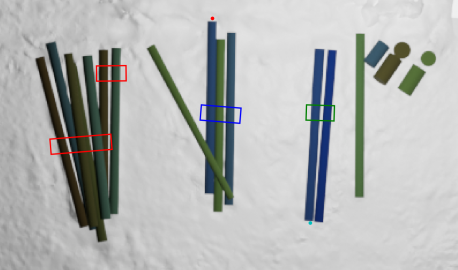
Digital replica of log piles with the AI model’s suggestions for grapple positions. Photo: Arvid Fälldin/Umeå University
From 3D scanning to lifting trials
Based on the data collected at Jälla, we built a digital copy of the log piles, and the AI model suggested suitable gripping positions for loading. We tested this by placing the grapple at the specified GNSS coordinate about 1 meter above the log pile and adjusting the grapple’s opening and angle based on the model’s instructions. Then we lowered the grapple straight down until one leg touched the ground, closed it, and lifted straight up.
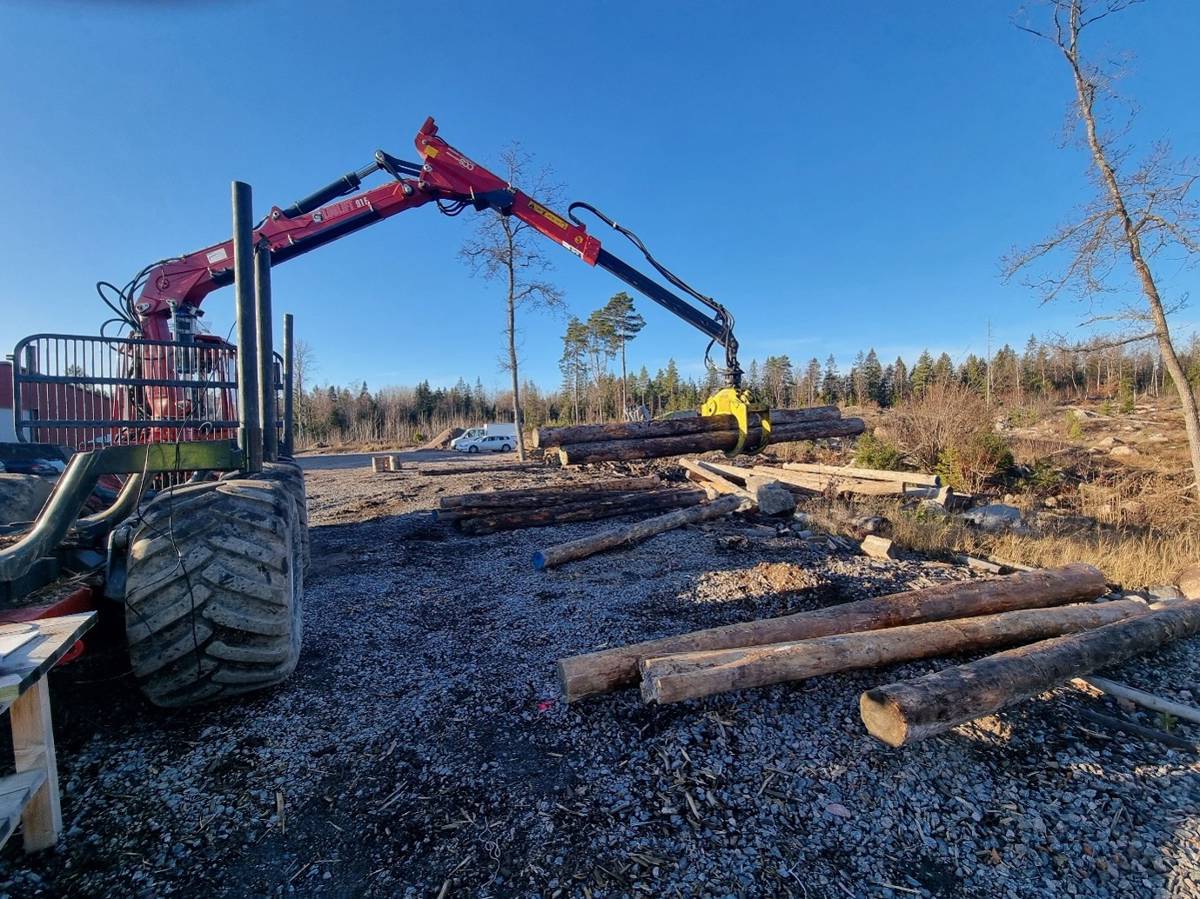
Successful gripping. Photo: Skogforsk
Promising results point the way forward
The real-world test results were promising. Most lifting attempts were successful, even though the system was still in early development. At the same time, the tests revealed some important weaknesses. Among other things, the model sometimes preferred to open the grapple as little as possible. It can work well in an ideal simulation but becomes sensitive to small positional errors when used in real life. A displacement of just a few centimetres can make the difference between a successful and unsuccessful grip.
We used insights from these tests to improve the method. The model was adjusted to use a larger grapple opening when the situation allows. In this way, the model became more robust against measurement errors and uncertainties that always exist in a real work environment.
The study also shows that combining simulation and real-life experiments is very powerful. Simulations let you train models on millions of conceivable situations, while field tests reveal what details are missing when the technology is used in practice. By switching between these two worlds, you can progressively improve the models.
Source; Skogsforsk
Contact forestmachinemagazine@mail.com to get your products and services in front of the world’s largest professional forestry online news network.
#homeoflogging #writtenbyloggersforloggers #loggingallovertheworld
Written by loggers for loggers and dedicated to bringing you the latest forestry news