

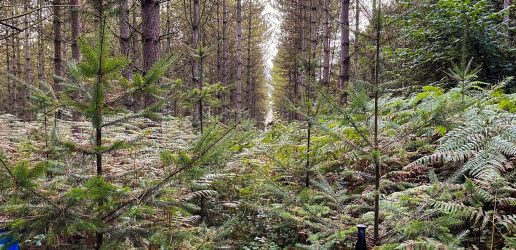
Underplanting extends range of coniferous tree species to diversify future commercial timber production
New research by Forest Research, published in Forest Ecology and Management, shows that underplanting extends the range of coniferous tree species that could potentially be used to diversify future commercial timber production in the United Kingdom.
In the UK, commercial timber production is dominated by conifer forests consisting primarily of just nine introduced species, which poses serious risks to the UK forest industry due to the likelihood of future climate change and the increasing incidence of damaging pests and diseases.

-
That’s a remarkable amount of work hours for a single machine, the Norcar 600 owned by Erkki Rinne is taken well care of, it even has the original Diesel engine.
-
Kieran Anders is a forestry contractor working in the lake district. His work involves hand cutting and extracting timber using a skidder and tractor-trailer forwarder.
-
It is not possible to eliminate chain shot, but there are simple steps that can be taken to reduce the risk.
-
Arwel takes great pride in the fact that the mill has no waste whatsoever, “the peelings are used for children’s playgrounds, gardens and for farm animals in barns in the winter and the sawdust has multiple uses in gardens and farms as well.
-
Timber hauliers need to encourage young blood in, and also look after the hauliers we have, we need make the sector a safe and positive place to work.
FIND US ON
Forest Research set up two experiments to test the suitability of 17 alternative species in a relatively warm, dry, location where opportunities for diversification are currently thought to be limited.
Dr Ian Willoughby FICFor, Principal Scientist, Forest Research said: “As expected, five years after planting on a conventional clear-cut site, apart from Scots pine, few other species had established. However, we found that Maritime pine grew well and would seem to have potential in our future climate on similar sheltered, freely draining clearfelled areas.”
When planted underneath an existing canopy of trees a much wider range of species thrived, with Douglas fir, grand fir, European silver fir, western red cedar, coast redwood and Leyland cypress all growing strongly.
However, we found that Maritime pine grew well and would seem to have potential in our future climate on similar sheltered, freely draining clearfelled areas.
During periods of very warm and very cold weather, the temperatures under the canopy were less extreme than on the open site.
The research concluded that underplanting appears to be a potentially useful technique, worthy of further study, for establishing shade tolerant, emerging species, which might otherwise prove to be unsuitable for deployment on clearfell sites – as long as the locations chosen are sufficiently windfirm for an overstorey crop to be retained.
To read the paper in full, visit Underplanting extends the range of coniferous tree species that could potentially be used to diversify future commercial timber production in the United Kingdom – ScienceDirect
Sign up for our free monthly newsletter here
Contact forestmachinemagazine@mail.com to get your products and services seen on the world’s largest professional forestry online news network.
#homeoflogging #writtenbyloggersforloggers #loggingallovertheworld
Written by loggers for loggers and dedicated solely to the equipment used in forestry operations.