If you are pricing a new harvester, trying to keep an older forwarder earning, or working out how to get more timber roadside with fewer hold-ups, forestry technology trends stop being theory very quickly. They show up in fuel use downtime, operator fatigue, data quality and whether a machine still stacks up against the next contract.
Forestry Technology in the woods is not gadgetry for its own sake. It is whether new kit actually improves production, safety and margins in mixed British conditions – steep banks, soft ground, awkward access, short weather windows and increasing pressure on compliance. That is the filter worth using when looking at where the sector is heading.
-
The WeighPro Wireless Weighing Link represents a precise and dependable weighing system designed specifically for round timber, eliminating the need for re-calibration. This system offers operators minimal maintenance requirements, boasting an impressive battery life of up to two years between recharges.
-
That’s a remarkable amount of work hours for a single machine, the Norcar 600 owned by Erkki Rinne is taken well care of, it even has the original Diesel engine.
-
It is not possible to eliminate chain shot, but there are simple steps that can be taken to reduce the risk.
-
Arwel takes great pride in the fact that the mill has no waste whatsoever, “the peelings are used for children’s playgrounds, gardens and for farm animals in barns in the winter and the sawdust has multiple uses in gardens and farms as well.
-
Timber hauliers need to encourage young blood in, and also look after the hauliers we have, we need make the sector a safe and positive place to work.
FIND US ON
Related Posts
Forestry technology trends on working sites
The strongest trend across harvesting and extraction is not one single breakthrough. It is the steady joining-up of machine control, operator support and job data. Ten years ago, a lot of this was sold as future talk. Now it is turning into standard expectation on new machines, and it is starting to influence used values as well.
Manufacturers are building more intelligence into core machine functions. Crane control, head positioning, boom tip accuracy and hydraulic response are all getting sharper. For operators, that means less wasted movement and less fatigue over a long shift. For contractors, it means production gains that come from repeatability rather than heroics.
There is a trade-off, of course. Smarter systems can improve output, but they also add complexity. When electronics go down, diagnosis is not always a quick field fix with a spanner and experience. The benefit is there, but only if dealer support, parts access and software backup are strong enough to keep a machine working.
More automation in the cab
Semi-automation is moving from premium talking point to practical buying factor. On harvesters, that shows up in assisted measuring, optimised cutting routines and settings that help operators maintain consistency across different crop conditions. On forwarders, it is more about crane assistance, load handling and route efficiency.
The key point is that automation in forestry is not replacing operators any time soon. It is reducing strain on skilled operators and helping newer ones reach decent productivity faster. In a sector where experienced labour is hard to find and harder to retain, that matters.
Still, automation is not a cure for poor setup or weak operator training. A good operator on a well-maintained older machine can still outperform a badly managed new one loaded with electronics. Buyers need to look beyond the brochure and ask what support is actually available after handover.
Telematics becomes a management tool
Telematics has matured. It is no longer just a map on a screen showing where the machine is parked. Better systems now give useful data on idle time, fuel use, fault codes, service intervals, production rates and machine behaviour. For owners running multiple machines over spread-out sites, that is becoming central to decision-making.
Used properly, telematics helps identify where money is leaking out. A machine that spends too long idling, a recurring pressure issue, an operator habit that drives fuel use, or a maintenance pattern that points to a bigger fault – all of that can be picked up earlier. In a tight-margin contracting business, early warning is worth real money.
The usual sticking point is not the technology itself. It is whether the business has time and discipline to act on the data. Plenty of operators and owners are data-rich but action-poor. If nobody checks the reports or trusts the information, the system becomes another subscription rather than a management tool.
Precision forestry is getting more practical
Precision forestry has often sounded like something aimed at large estate management or Scandinavian-scale operations. In practice, some of the most useful developments are now filtering into ordinary UK forestry work, especially where planning, extraction and haulage need to be tighter.
Better GPS integration, mapping platforms and site data collection are improving how jobs are planned before a machine even tracks onto site. Woodland managers and contractors can make better calls on access routes, loading areas, extraction distances, soft ground risk and stacking points. That does not remove surprises, but it cuts avoidable ones.
Drones, mapping and survey work
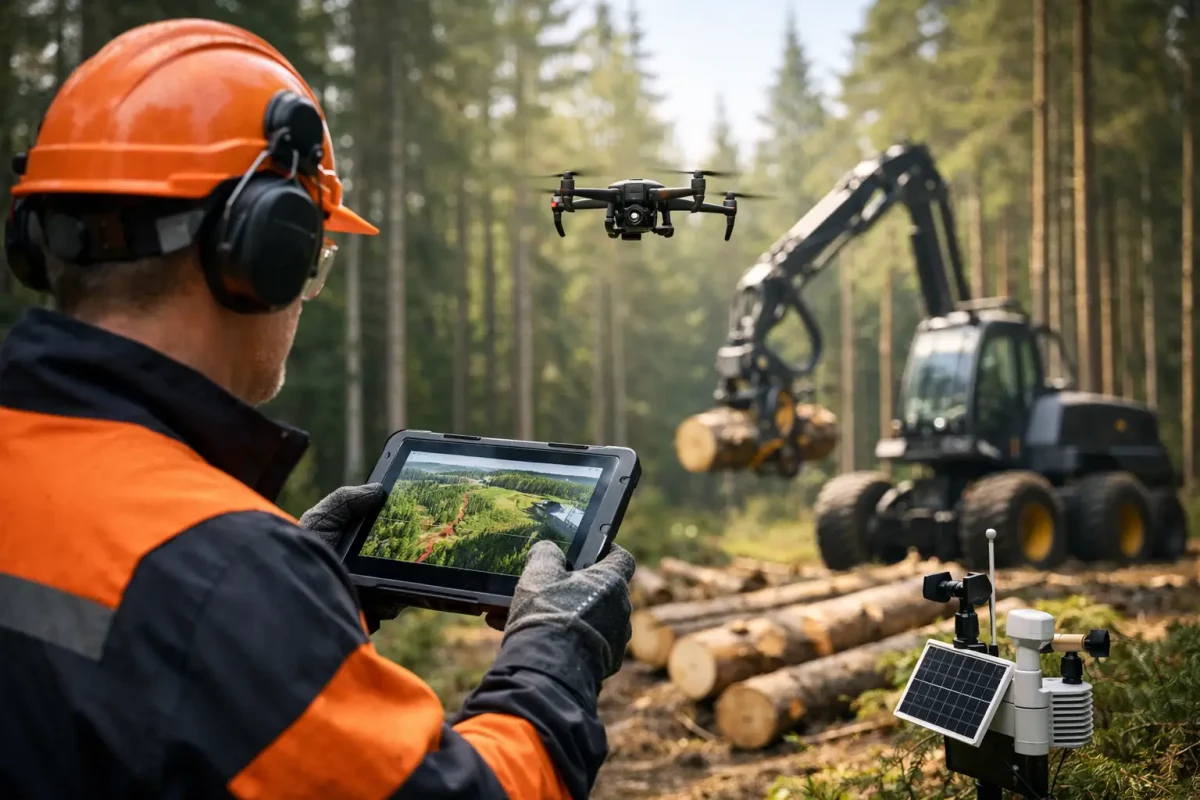
Drones are one of the clearer examples of technology becoming genuinely useful rather than just impressive. They can help with pre-harvest assessment, windblow evaluation, boundary checks, drainage inspection and progress reporting. On difficult sites, they offer a quick view without putting people straight into awkward ground.
For contractors, the value is often commercial as much as operational. Better imagery and cleaner site data can help with planning discussions, customer reporting and proving what conditions were actually like when work was done. That can be important where delays, damage claims or access disputes crop up.
There are limits. Drones do not replace proper ground truthing, and they are only as useful as the person interpreting what they capture. Weather, battery life, tree cover and legal restrictions also shape what is practical day to day.
Measuring timber more accurately
Digital measurement and inventory tools are improving, especially where harvest data can feed straight into planning and supply records. That helps reduce mismatches between what is cut, what is stacked and what eventually moves by lorry. In a supply chain where margin can disappear in handling errors and poor information, tighter measurement is valuable.
This trend also links to certification and traceability. Buyers increasingly want better evidence around species, volume, source and movement. The technology exists to make that easier, but it relies on consistent use across the chain. One weak hand-off can still break the flow of good information.

Low-emission machinery is advancing, but slowly
One of the most talked-about forestry technology trends is the move towards lower-emission machines, whether through cleaner diesel platforms, hybrid systems or full electric concepts. There is real progress here, but the practical picture is mixed.
For smaller kit, yard equipment and some support machinery, electrification is easier to imagine in daily use. For heavy harvesting and extraction in remote woodland, the barriers are still obvious. Battery weight, run time, charging access and cold-weather performance all matter. A concept machine on a trade stand is one thing. A machine that must work a full shift on a wet site three miles from the nearest decent road is another.
That said, hybridisation and smarter power management may prove more relevant in the near term than all-electric heavy forestry kit. Systems that reduce fuel use, manage peak loads better and lower idle losses are likely to deliver practical gains sooner. Contractors do not buy on sentiment. They buy on uptime, operating cost and resale.
Safety systems are becoming harder to ignore
Safety technology is improving in ways that make sense for real operations. Better camera systems, proximity alerts, stability monitoring, lighting packages and remote diagnostics all help reduce risk around machines and haulage. On busy sites with multiple machines, banksmen, visiting staff and tight turnaround areas, improved visibility alone can make a difference.
For haulage operators, technology around load security, brake performance, tyre monitoring and driver support is also moving on. With enforcement pressure around roadworthiness and overloading, these systems are not just nice extras. They can help protect licences, reputation and insurance position.
Again, there is an it-depends factor. Alarm-heavy systems can lead to warning fatigue if they are badly calibrated or poorly integrated into the job. The best safety technology supports good operators without becoming a nuisance that gets ignored.
Parts, service and software now influence buying decisions
A major shift in machinery buying is that hardware alone no longer wins the argument. Forestry businesses are looking harder at aftersales, software support, remote diagnostics and update capability. A machine might be mechanically sound, but if software faults drag on for days or a dealer cannot support the electronics, ownership becomes painful.
This is especially relevant in the used market. Buyers are starting to ask whether systems are transferable, whether subscriptions apply, whether diagnostic access is restricted and how future-proof the machine really is. A cheaper machine can become expensive if essential support sits behind closed systems.
That may also widen the gap between brands with solid support networks and those with weaker backup. In a sector where every lost shift hurts, support structure matters nearly as much as machine spec.
What the next few years will probably look like
The forestry businesses that benefit most from new technology are unlikely to be the ones chasing every shiny launch. They will be the ones picking tools that solve a clear operational problem – better production data, lower fuel burn, easier planning, safer loading, faster fault finding.
Expect more machine assistance, more connected fleet management and more pressure for traceable data through the timber chain. Expect lower-emission development to continue, but with practical adoption varying by machine type and duty. And expect buyers to become more hard-nosed about whether technology works in British forestry rather than whether it looks clever in a sales presentation.
That is probably the healthiest direction for the trade. Good forestry technology should earn its place the same way any decent machine does – by standing up to a wet week, a hard shift and a close look at the numbers.
Sign up for our free monthly newsletter here
Contact forestmachinemagazine@mail.com to get your products and services seen on the world’s largest professional forestry online news network.
#homeoflogging #writtenbyloggersforloggers #loggingallovertheworld
Written by loggers for loggers and dedicated solely to the equipment used in forestry operations.