The wrong choice of base machine shows up quickly in forestry. You see it in rutting on a wet bank, in time lost getting between blocks, or in a harvester that looks strong on paper but is working against the site all week
That is why the tracked vs wheeled harvester question is not a showroom debate. It is an operational one, and in UK conditions it often comes down to what the ground, crop and access will tolerate.
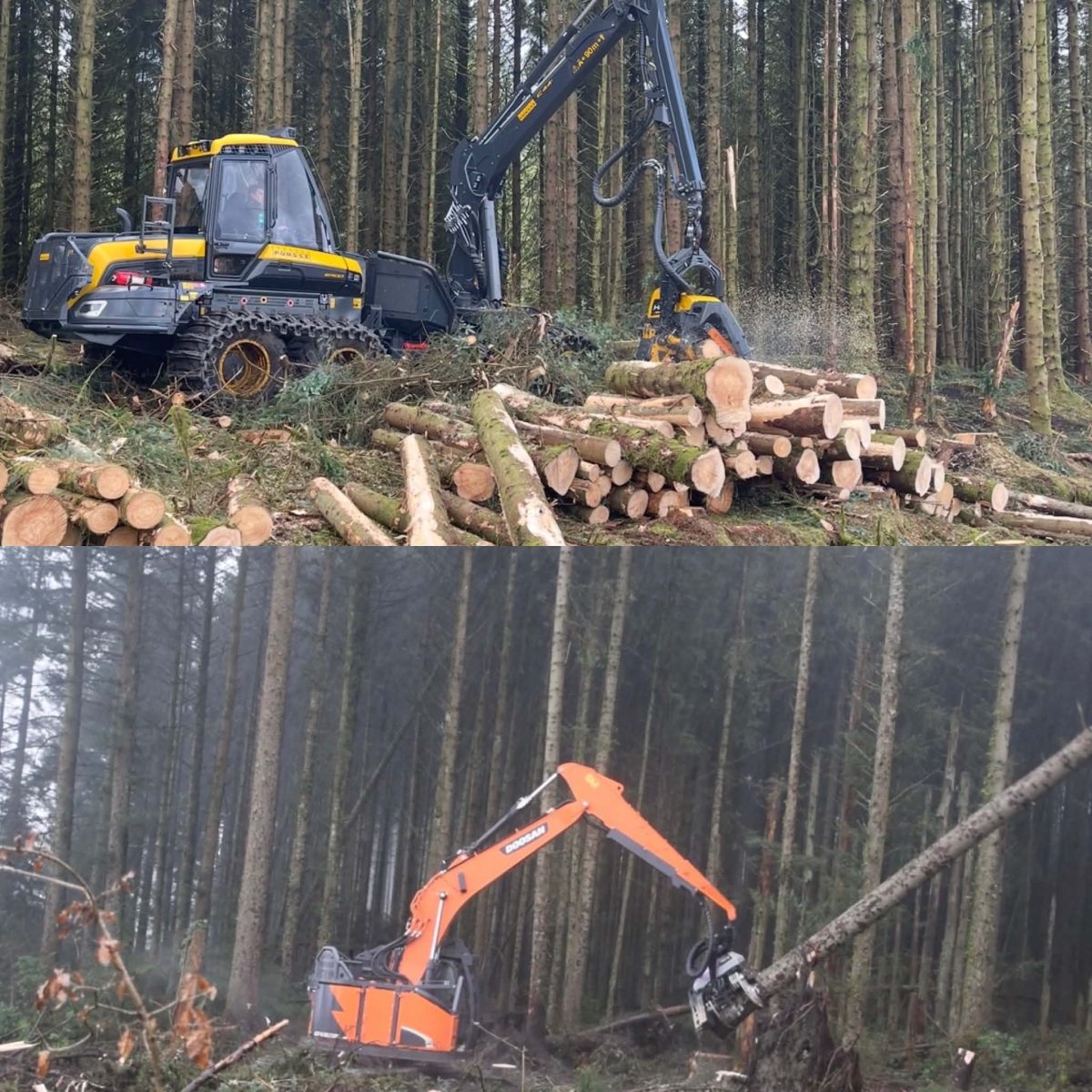
There is no tidy winner across the board. A tracked machine can be the right answer in steep, soft or awkward terrain where flotation and stability matter most. A wheeled harvester can be the better business tool where travel speed, versatility and lower transport friction make more sense. Contractors who get this choice right usually do so by matching the machine to the dominant work profile, not by chasing a single headline specification.
-
The WeighPro Wireless Weighing Link represents a precise and dependable weighing system designed specifically for round timber, eliminating the need for re-calibration. This system offers operators minimal maintenance requirements, boasting an impressive battery life of up to two years between recharges.
-
That’s a remarkable amount of work hours for a single machine, the Norcar 600 owned by Erkki Rinne is taken well care of, it even has the original Diesel engine.
-
It is not possible to eliminate chain shot, but there are simple steps that can be taken to reduce the risk.
-
Arwel takes great pride in the fact that the mill has no waste whatsoever, “the peelings are used for children’s playgrounds, gardens and for farm animals in barns in the winter and the sawdust has multiple uses in gardens and farms as well.
-
Timber hauliers need to encourage young blood in, and also look after the hauliers we have, we need make the sector a safe and positive place to work.
FIND US ON
Tracked vs wheeled harvester: what really separates them
At a glance, the distinction seems simple. Tracks spread weight over a larger footprint and tend to give a planted feel on poor ground. Wheels generally offer faster travel, easier repositioning and a more familiar platform for mixed forestry work.
In practice, the gap is wider than that. Machine geometry, undercarriage design, tyre size, bogie setup, levelling systems and head choice all affect performance. A modern wheeled harvester with the right tyres, bogie tracks and levelling can go into ground that older assumptions would have ruled out. Likewise, a tracked machine is not automatically the low-cost answer just because it can reach tougher sites.
For operators, the key factors are usually cost, ground pressure, slope capability, extraction distances within the block, road access between jobs, transport logistics and how many months of the year the machine is expected to work in wet conditions.
Ground conditions usually make the decision
If a contractor is regularly working on peat, wet mineral soils, recently weather-broken sites or steep slopes with poor bearing capacity, tracked undercarriages earn their keep quickly. Lower ground pressure reduces ground damage, and the machine often feels more predictable when the surface starts moving underneath it. That matters not only for productivity, but for operator confidence and stand damage.
A tracked harvester also tends to be more forgiving where the machine must sit across rough benches or work on side slopes for long periods. Stability at the carrier level can improve head control, especially in timber where accurate placement matters and repetitive overreach punishes the machine.
That said, forestry is full of sites that are awkward rather than extreme. On firmer ground, in first thinnings, along ride networks, or in managed blocks with decent brash mats, a wheeled machine may be entirely suitable. In some cases it can be more productive simply because it moves faster around the site.
The mistake is assuming the worst site should dictate every purchase. If 80 per cent of your work is on decent going and 20 per cent is difficult, it may make more commercial sense to optimise for the 80 per cent and manage the edge cases with timing, brash discipline or subcontract support.
Soil protection and site impact
Ground damage is not only a cleanup issue. It affects reinstatement cost, client confidence and future access. Tracked machines generally have an advantage where rut control is a priority, particularly in sensitive woodland or on wetter sites where repeated passes from a wheeled machine can leave a mess very quickly.
But tyre choice, inflation management, operator behaviour and extraction planning still count. A poorly managed wheeled machine can cause obvious damage, yet a badly operated tracked machine can shear and disturb the surface as well. The undercarriage helps, but it does not cancel out poor planning.
Productivity is about more than cut volume
On a pure stem-processing basis, both machine types can be highly productive when properly matched to the crop. The difference tends to show in all the non-cutting minutes that make up the day.
A wheeled harvester usually wins on travel speed within and between work areas. If the machine is covering distance across a block, shifting extraction lines, or moving regularly between nearby sites, those minutes add up. Operators coming from wheeled forwarders and harvesters also tend to feel at home with the platform, which can shorten the learning curve.
Tracked machines can claw that time back when the terrain becomes difficult enough that a wheeled machine is forced to slow down, detour, or stop altogether. In broken ground, the ability to hold position and work confidently may outweigh any loss in travel speed. There is little value in being fast on paper if the machine is weathered off the site after heavy rain.
Head size and boom geometry matter here too. A heavy, high-capacity head on marginal ground can expose the limits of a wheeled carrier more quickly than many buyers expect. The same head on a stable tracked base may let the operator work with less compromise. The machine should be assessed as a package, not as a carrier alone.
Transport, access and job-to-job movement
This is where wheeled machines often make the strongest commercial case. If your contracts involve regular relocation, roadside access, tight programme changes and short-duration jobs, a wheeled harvester is usually easier to live with. Loading, hauling and unloading are often more straightforward, and in some cases the machine can make short moves with less hassle.
Tracked machines bring more transport considerations. Width, weight, trailer compatibility, loading angles and route restrictions can all become sharper issues. None of that means they are impractical, but it does mean every move needs organising properly, and that has a cost in time and money.
For contractors covering a wide patch, especially in fragmented private woodland work, mobility can matter as much as in-forest performance. A machine that loses half a day every time it changes site is expensive, even if it is outstanding once it arrives.
Purchasing and running costs
The cost of a tracked vs wheeled harvester decision is also a big factor for contractors. A new tracked harvester can be purchased for the same cost as a wheeled harvester which is a few years old.
This is important for contractors on a limited budget as you can be looking at a 3 year warranty on a new tracked harvester over 3-6 months warranty on the same priced used wheeled harvester.
Running costs have to be taken into consideration as wheeled harvesters are specialised machines which makes some spare parts more expensive and not as readily available as mass produced excavator harvester conversions.
Fuel economy and service intervals depend on size, power and manufacturers guidelines.
Resale and fleet fit
A wheeled machine often has broader resale appeal simply because the buyer pool is larger. That can help when refreshing the fleet. Tracked machines may hold strong value in specialist niches, but the market is narrower and more dependent on region and application.
Fleet commonality matters as well. If your business already runs wheeled harvesters and forwarders, adding another wheeled platform may simplify parts stocking, operator cover and service planning. If you are working difficult ground year-round and already support tracked plant, then a tracked harvester may fit the business naturally.
Where each machine type tends to make sense
Tracked harvesters suit contractors working steep, wet, soft or environmentally sensitive ground where access is often marginal and uptime depends on flotation and stability. They also make sense where machine confidence on rough terrain directly affects output and safety.
Wheeled harvesters suit mixed contract work, better roaded sites, first and second thinnings, and businesses that need efficient movement between jobs. They are often the more flexible choice where terrain varies, but not constantly at the severe end.
There is also a middle ground. Some contractors use wheeled machines with bogie tracks, wider tyres and levelling systems to stretch capability without committing to a full tracked carrier. Others keep a specialist tracked machine for problem sites and run wheeled machines for the bulk of the programme. That can be a smarter answer than asking one machine to do everything badly.
The buying question to ask first
Before looking at brand, cab, hydraulics or finance package, ask a simpler question: what type of ground pays your wages most weeks of the year? Not the occasional prestige job, and not the worst site you have ever seen. The work that keeps the machine busy.
If that work is wet, steep and unforgiving, a tracked machine deserves serious attention. If it is varied, mobile and commercially tight, a wheeled harvester will often make the stronger case. Either way, the right answer is the one that protects margin after transport, maintenance, utilisation and site reinstatement are accounted for.
Good buying in forestry is rarely about maximum capability. It is about buying enough machine for the real job, then keeping it productive across the season. That is the point where a machine stops being interesting and starts earning.

Sign up for our free monthly newsletter here
Contact forestmachinemagazine@mail.com to get your products and services seen on the world’s largest professional forestry online news network.
#homeoflogging #writtenbyloggersforloggers #loggingallovertheworld
Written by loggers for loggers and dedicated solely to the equipment used in forestry operations.