
Since 2008, the Kuratorium für Waldarbeit und Forsttechnik (KWF, German Center for Forest Work and Technology) e. V. in Groß-Umstadt is collecting market data on sales of new forestry machines in Germany, Austria, and Switzerland. Since unauthorized and partly wrong figures have been
published in the industry, the following statistics present sales figures for 2025. While Switzerland saw a slight overall increase, sales figures in Germany and Austria have slightly declined.
KWF Forest Machine Statistics for 2025, it should be noted that since 2021, only actual sales figures have been included in the analysis.
Missing reports from individual manufacturers are not incorporated into the statistics through estimates.

-
The WeighPro Wireless Weighing Link represents a precise and dependable weighing system designed specifically for round timber, eliminating the need for re-calibration. This system offers operators minimal maintenance requirements, boasting an impressive battery life of up to two years between recharges.
-
That’s a remarkable amount of work hours for a single machine, the Norcar 600 owned by Erkki Rinne is taken well care of, it even has the original Diesel engine.
-
It is not possible to eliminate chain shot, but there are simple steps that can be taken to reduce the risk.
-
Arwel takes great pride in the fact that the mill has no waste whatsoever, “the peelings are used for children’s playgrounds, gardens and for farm animals in barns in the winter and the sawdust has multiple uses in gardens and farms as well.
-
Timber hauliers need to encourage young blood in, and also look after the hauliers we have, we need make the sector a safe and positive place to work.
FIND US ON
GERMANY
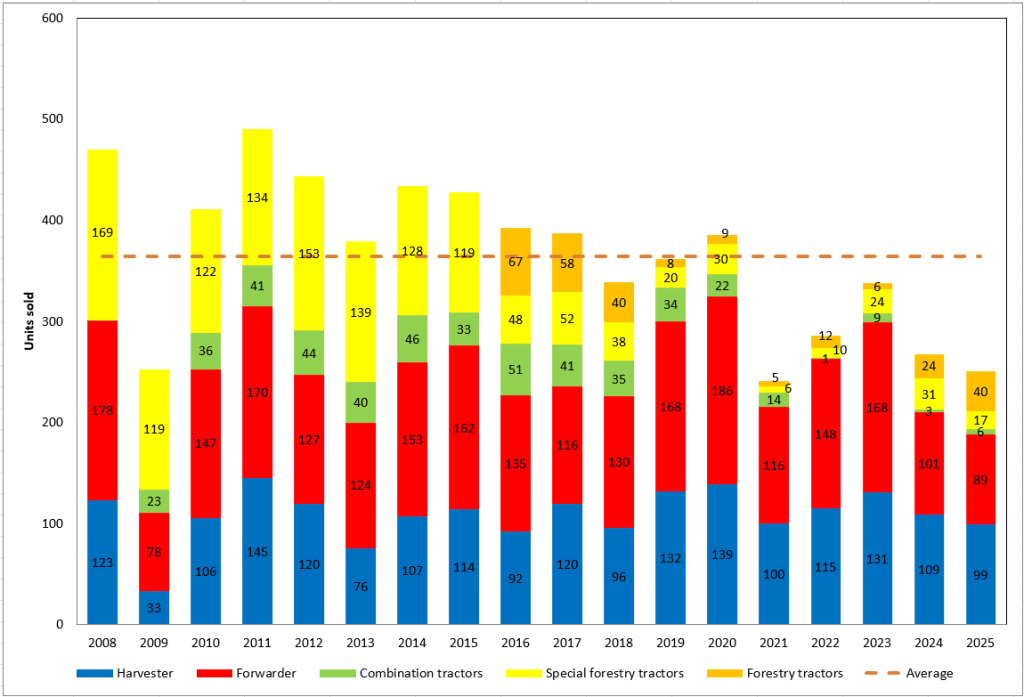
In 2025, a total of 251 specialized forestry machines were sold (and reported) in Germany. This is a drop of 17 machines, or 93.7 %, compared to the sales figure for 2024. It corresponds to 68.9 % of the long-term average of 364 specialized forestry machines sold annually since 2008.
In 2025, 188 CTL (cut-to-length, forwarder/harvester) machines were sold. Compared to the long- term average of nearly 250 machines, this represents a below-average sales rate of approximately 24% for CTL machines.
Most manufacturers have provided information for the CTL sector, while for combination tractors, forestry tractors and forestry tractors, it can be assumed that the actual sales figures are higher.
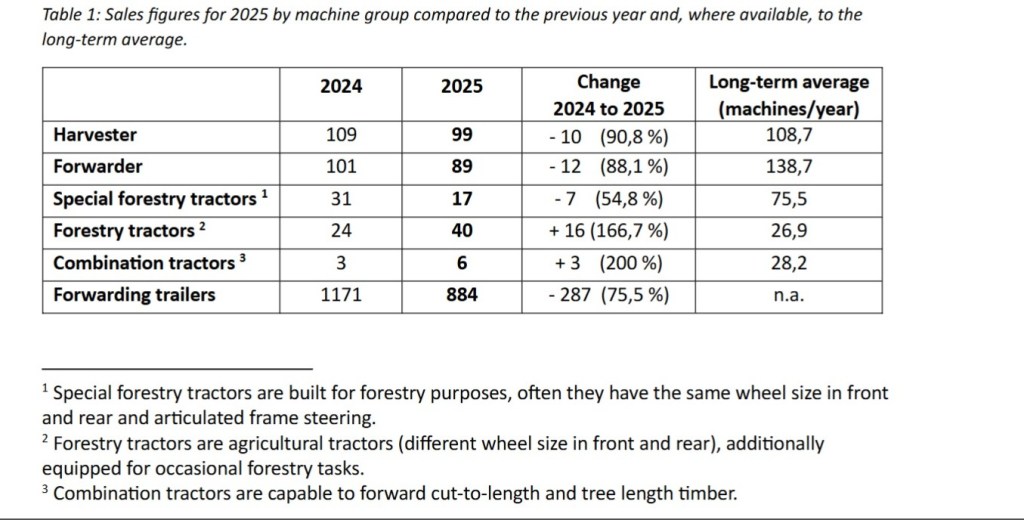
Marked by the calamities caused by windthrow and especially bark beetles, a sharp increase in new acquisitions was recorded in 2019/2020. The increased machinery capacity allowed for a flexible response to the forestry situation.
As in the past, a significant decline could be expected in the following years after such a peak. This has also been clearly noticeable since 2021. Experts attribute the weak sales figures not only to the declining volume of damaged timber logged, but also to increased prices, a shortage of skilled workers, business closures and generational changes in the industry.
Harvester
Regarding the technical specifications of the harvesters delivered in Germany in 2025, it can be observed that 8-wheeled machines continue to significantly predominate, accounting for 80 % of the
delivered machines.
Approximately 86 % of the harvesters, for which information was provided about the installation of a communication and positioning system, have the corresponding technology.
Almost 5 % of new machines are equipped with traction/synchronous winches, while 95% of harvesters do not have winches installed upon delivery.
Most of the machines were delivered to Bavaria, Baden-Württemberg and Lower Saxony. The regional structure of the harvester market suggests that there are correlations with the forest structure, but
also with persistent volumes of bark beetle timber in some places.

Forwarder
All recorded forwarders are 8-wheeled machines. The payload of the delivered machines is predominantly 12-14 tons, however, information is missing for about a quarter of them.
The tire widths of 600 mm that were common a few years ago have now been completely replaced by tire widths of 700 mm or more, which takes soil protection into account.
Almost all forwarders delivered in 2025 were not equipped with a traction winch. As with harvesters, there is a noticeable trend towards using external technology for this purpose.
The crane reach of forwarders has increased significantly: While only 5 % had a reach of over 10 m in 2024, this figure rises to a good 40 % of the machines in 2025.
As with the harvesters, most of the machines were delivered to Bavaria, Baden-Württemberg, and Lower Saxony. Here, too, the sales figures suggest a correlation with forest structure and the volume of damaged timber.
Forwarding trailer
Data on logging trailers was collected for the first time in 2023. These are listed in the table, but were not included in the overview graphic (Figure 1). An evaluation of the individual parameters does not appear useful here, as detailed information is unavailable for roughly half of the reported logging trailers.
Other machine groups
Only 17 forestry tractors were registered. Unlike last year, only about 10 % of the machines were equipped with a constant-pull winch.
In 2025, sales data for remote-controlled compact tool carriers or “small forestry crawlers” were also collected, but due to the low response rate, an evaluation is not meaningful here, and the same applies to combination machines.
Germany 2025
AUSTRIA
In 2025, a total of 64 specialized forestry machines were sold (and registered) in Austria. This is one machine less than in the previous year, 2024 (98.5 % of the previous year’s figure), but represents 121.4 % of the long-term average since 2009 of 52.7 special machines sold.
Harvester
The 33 machines reported for 2025 are three more machines than in the previous year (110.0 % compared to 2024) and correspond to 137.5 % of the long-term average (24.0 harvesters/year).
Forwarder
The 30 machines reported for 2025 are four less than in the previous year (88.2 % of the previous year’s value) and correspond to 123.5 % of the long-term average (24.3 forwarders/year).
Combined tractors
No machines were reported for 2025 – as in the previous year. The long-term average since 2009 is 0.6 combination tractors per year.
Forest tractors and special forest tractors
For 2025, as in 2024, one machine was registered. The long-term average since 2009 is 3.8 forestry (specialized) tractors per year.
Forwarding trailer
For 2025, 141 timber trailers were reported sold. This is 185 machines less than in the previous year.
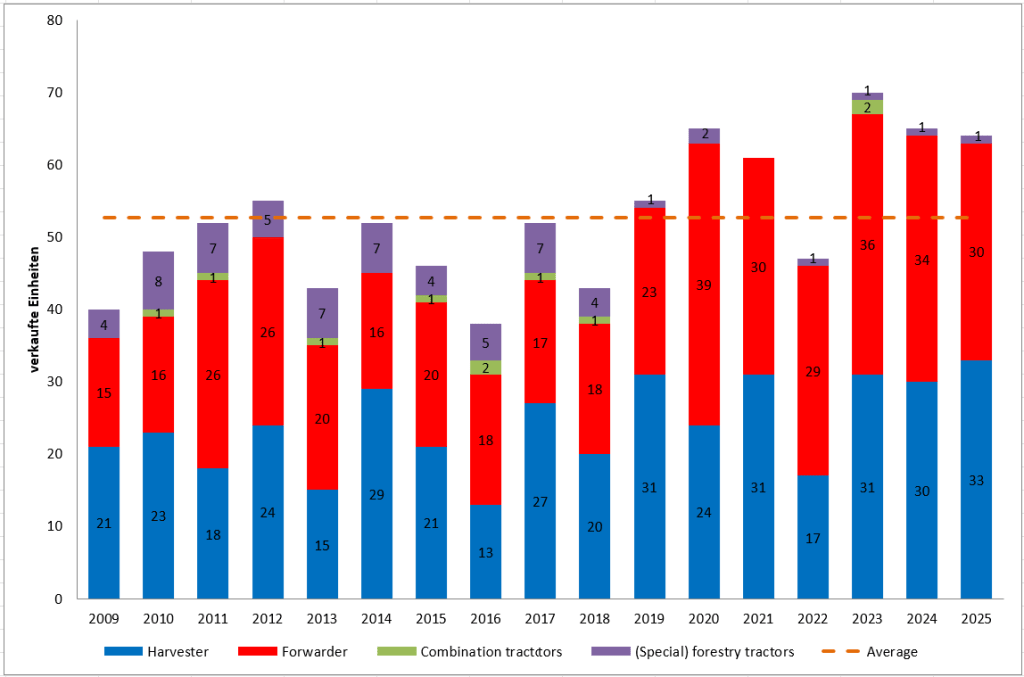
Austria 2025
SWITZERLAND
A total of 31 specialized forestry machines were sold (and reported) in 2025. This is seven more machines than in the previous year, 2024 (129.2 % of the previous year’s figure). Over the long-term observation period since 2009, this represents 76.7 % compared to the long-term average of 40.4 specialized machines sold.
Harvester
The six machines reported for 2025 are two fewer than in the previous year (75 % of the previous year’s value) and correspond to 68.1 % of the long-term average (8.8 harvesters/year).
Forwarder
The 15 machines reported for 2025 are 5 more machines than in the previous year (150 % of the previous year’s value) and correspond to 134.1 % of the long-term average (11.2 forwarders/year).
Combination tractors
One machine was registered for 2025, compared to none the previous year. The long-term average is 4.3 machines per year.
Forestry (special) tractors
In 2025, nine machines were registered, three more than in the previous year (150 % of the previous year’s value), this corresponds to 55.6 % of the long-term average (16.2 forestry (special) tractors) annually).
Forwarding trailer
For 2025, 21 logging trailers were registered. That is 13 fewer than in the previous year (34 machines).
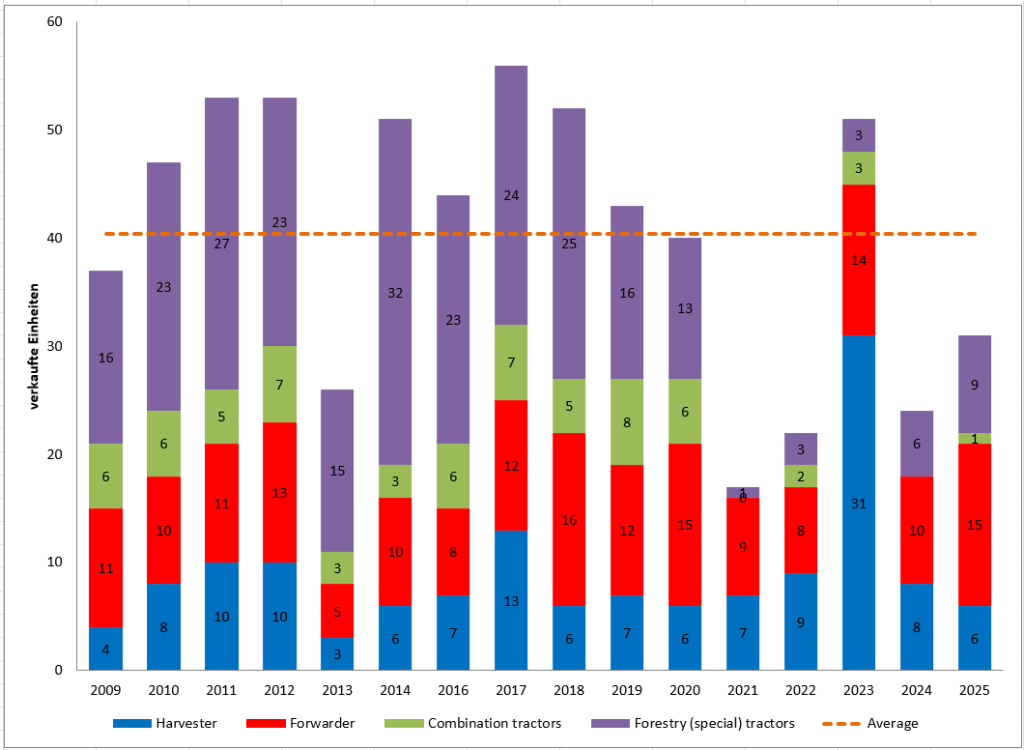
Switzerland 2025
Thanks
The KWF expressly thanks all machine manufacturers, large machine dealers, and importers for their trust and good cooperation and looks forward to your continued support, acknowledging the considerable effort involved in providing the data by publishing it.
The Kuratorium für Waldarbeit und Forsttechnik e. V. (KWF, German Centre for Forest Work and Technology) is the centre of expertise for forestry technology and work methods in Germany. The KWF is an institution co-financed by the federal government and the German states, and is responsible for all federal states and types of forest ownership. Including its predecessor institutions, the KWF has over 100 years of experience in practical consulting and applied research. Its work focuses on valuating forestry technology and work processes from the perspectives of occupational safety, ergonomics, ecology, and economics, in order to achieve the best possible conditions for people working in the forest and to preserve and develop our forests. Furthermore, the KWF is the testing institution for forestry technology in Germany. Another main focus of the work is the collection, processing and dissemination of data through professionally qualified and target group-oriented communication.
Sign up for our free monthly newsletter here
Contact forestmachinemagazine@mail.com to get your products and services seen on the world’s largest professional forestry online news network.
#homeoflogging #writtenbyloggersforloggers #loggingallovertheworld
Written by loggers for loggers and dedicated solely to the equipment used in forestry operations.