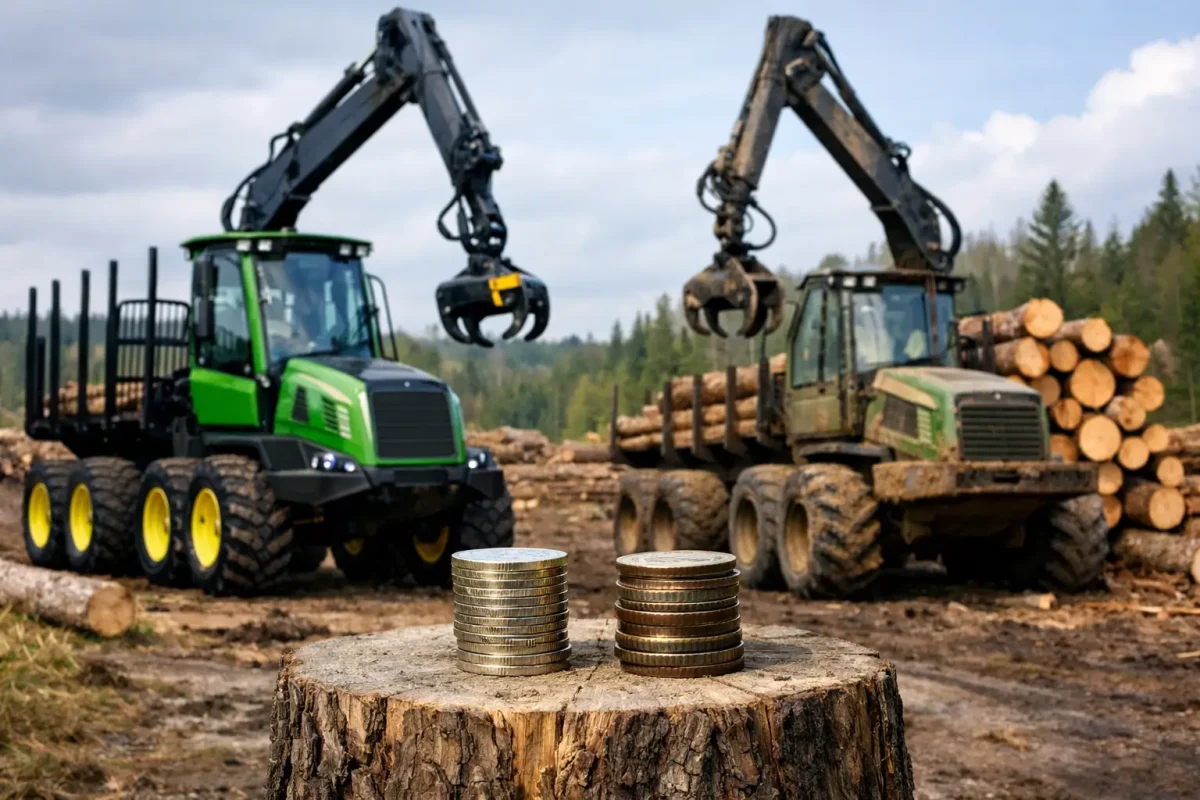
A forwarder that misses a week in the middle of a wet winter contract can cost far more than the repair invoice. That is why the new v used forwarder decision is not simply about the purchase price. It is about whether the machine can keep timber moving, protect the site, match the harvester’s output and leave enough cash in the business to carry the quieter months.
The most common buying mistake is comparing a new forwarder’s price with a used machine’s price and stopping there. Build a cost per productive hour instead. Include finance or capital cost, fuel, planned servicing, tyres, insurance, expected repairs, transport, operator costs and realistic annual working hours.
Then give downtime a figure. If the forwarder stops, does the harvester continue and build a roadside problem? Does the lorry lose a load? Can another contractor cover the work? A contractor with workshop capacity, spare parts and an older backup machine can carry more used-machine risk than a one-machine operation working to a hard deadline.
It is also worth costing resale from the outset. New machines often have a clearer trade-in route, particularly when kept within a dealer network and serviced on schedule. Used machines can hold their value well if bought correctly, but a high-hour machine with deferred repairs is harder to move on. Keep records from day one, including servicing, repairs, tyre changes and major component work. The next buyer will ask the same questions you should be asking now.
Make the deal fit the business
A new forwarder is usually the stronger choice when output is high, contracts are secure, downtime is costly and dealer support is close enough to mean something. It can also be right where operator comfort and fuel efficiency will genuinely improve production over a long ownership period.
A used forwarder is often the better business decision where annual hours are moderate, capital needs protecting or the buyer has the mechanical knowledge to assess and maintain it properly. The key is to buy condition, history and suitability, not a low headline price or a fashionable model.
The forwarder that pays is the one that arrives on site correctly specified, is maintained before faults become failures and can still be sold with confidence when the next opportunity comes along. Buy the machine that keeps the timber moving without putting the rest of the business under strain. protect the site, match the harvester’s output and leave enough cash in the business to carry the quieter months.
New V Used Forwarder-For some contractors, a new machine is the sensible way to lock in predictable running costs and dealer support. For others, a well-chosen used forwarder can do the same job with substantially less capital tied up. The right answer depends on the work in front of it, the strength of the workshop and how much downtime the business can realistically absorb.
-
The WeighPro Wireless Weighing Link represents a precise and dependable weighing system designed specifically for round timber, eliminating the need for re-calibration. This system offers operators minimal maintenance requirements, boasting an impressive battery life of up to two years between recharges.
-
That’s a remarkable amount of work hours for a single machine, the Norcar 600 owned by Erkki Rinne is taken well care of, it even has the original Diesel engine.
-
It is not possible to eliminate chain shot, but there are simple steps that can be taken to reduce the risk.
-
Arwel takes great pride in the fact that the mill has no waste whatsoever, “the peelings are used for children’s playgrounds, gardens and for farm animals in barns in the winter and the sawdust has multiple uses in gardens and farms as well.
-
Timber hauliers need to encourage young blood in, and also look after the hauliers we have, we need make the sector a safe and positive place to work.
FIND US ON
New v used forwarder: start with the work
Before comparing quotations or classifieds, put the proposed machine against the timber programme. A forwarder working short roadside extraction on firm ground has a very different life from one hauling heavy spruce over long extraction distances, climbing rough banks or operating on soft peat. Payload, bogie configuration, tyre size, crane reach and bunk capacity all matter more than the badge on the bonnet.
Be honest about annual hours too. A machine expected to work 1,800 to 2,500 hours a year is a different financial proposition from one doing occasional thinning, estate work and storm clearance. High utilisation favours a machine with dependable support, known service intervals and minimal unplanned stoppage. Lower annual hours can make a used machine much easier to justify, provided its condition is properly checked.
Also consider who will run it. An experienced operator can get productive quickly in almost any sound forwarder, but a modern cab, sensible control layout, effective seat suspension and good visibility are not luxuries on ten-hour shifts. Operator fatigue shows up in production, fuel use, machine damage and retention.
What a new forwarder really buys
A new forwarder buys a known starting point. Hours are low, the maintenance record begins with your own team, and any early defects should be dealt with under warranty. That certainty has value when the machine is central to a harvesting system and there is no spare unit waiting in the yard.
Modern machines can also bring measurable gains. Better crane control, fuel management, telematics, traction systems and cab ergonomics can improve the working day. Depending on the model and application, a larger load space, stronger crane or more suitable tyre package may reduce the number of trips required. Those gains must be tested against actual production figures, not just brochure claims, but they are real where the specification matches the site.
Finance can make a new machine look manageable because monthly payments are clear and residual values may be supported. The danger is focusing only on the monthly figure. Add deposit, interest, insurance, service packages, tracks or chains, guarding, fire suppression, delivery and any specialist extras needed to make the machine ready for forestry work. A machine is not cheap because the first payment is low.
Dealer backing is another major factor. Ask practical questions: where is the nearest field technician, what parts are held locally, what is the usual response time, and is there a loan machine or hire option when a major component fails? Warranty wording matters as well. Check the hours, duration, exclusions and whether travel time is covered. A warranty that does not get the machine back to work quickly has limited use during a tight production window.
New is not automatically risk-free. Early-model software issues, sensor faults and unfamiliar emissions systems can still create stoppages. A newly launched model may offer worthwhile improvements, but contractors relying on one machine to feed a timber haulage programme may prefer a proven platform with strong dealer knowledge behind it.
Where a used forwarder can make sense
Used forwarders appeal because the capital requirement is lower and the first owner has taken the sharpest part of the depreciation. A machine with sensible hours, a documented history and the right specification can provide several productive years without putting the same pressure on cash flow as a new purchase.
That can be particularly attractive for businesses expanding carefully, contractors covering a second shift, or woodland operations whose work is seasonal. It can also make commercial sense to buy a used machine and retain money for an excavator, low-loader work, additional labour or a reserve fund for repairs.
The best used purchase is rarely the cheapest advert. It is the machine with evidence behind it. Service invoices, workshop records, previous ownership, hour history and a clear explanation of its work all matter. A forwarder that has spent its life on well-managed, short-haul sites may have had a far easier existence than one with fewer hours working steep, abrasive ground and long extraction distances.
Age alone tells little. A cared-for 10,000-hour machine may be a safer proposition than a neglected 6,000-hour example. Equally, an immaculate cab does not prove the driveline, centre joint or crane have been looked after. Look beneath the paint and polished panels.
Inspect the expensive areas, not just the obvious ones
A proper inspection should be carried out before money changes hands, ideally by someone who knows that make and model and has no interest in the sale. Run the machine from cold, work the crane through its range and test it under load if possible. A yard demonstration is useful, but it does not replace seeing the forwarder travel, steer and operate at working temperature.
Pay close attention to the crane base, slew bearing, pins and bushes, boom sections, hoses and rotator. Check for excessive play, weld repairs, cracked mounts and hydraulic leaks. Crane work is constant, and a tired crane can turn an apparent bargain into a sizeable repair bill.
Inspect the centre joint and frame carefully, along with bogies, wheel motors, hubs, propshafts and brakes. Look for oil leaks, metal in drained oils where checks are possible, unusual noise and uneven tyre wear. Tyres are a significant cost in their own right. Confirm their remaining life, size, suitability for the ground and whether tracks or chains are included and serviceable.
Inside the cab, test every function. Air conditioning and heating matter. So do lights, cameras, wipers, seat controls, measuring systems and the operator’s display. Electrical faults can be time-consuming to trace, especially on older machines that have accumulated repairs, additional wiring and moisture exposure.
Finally, make sure the machine’s legal and practical specification suits the intended work. Width, transport weight, guarding, lighting, fire suppression arrangements and load area all need checking. If it will travel regularly between sites, transport dimensions and low-loader compatibility should be known before the deal is signed.
Put downtime into the calculation
The most common buying mistake is comparing a new forwarder’s price with a used machine’s price and stopping there. Build a cost per productive hour instead. Include finance or capital cost, fuel, planned servicing, tyres, insurance, expected repairs, transport, operator costs and realistic annual working hours.
Then give downtime a figure. If the forwarder stops, does the harvester continue and build a roadside problem? Does the lorry lose a load? Can another contractor cover the work? A contractor with workshop capacity, spare parts and an older backup machine can carry more used-machine risk than a one-machine operation working to a hard deadline.
It is also worth costing resale from the outset. New machines often have a clearer trade-in route, particularly when kept within a dealer network and serviced on schedule. Used machines can hold their value well if bought correctly, but a high-hour machine with deferred repairs is harder to move on. Keep records from day one, including servicing, repairs, tyre changes and major component work. The next buyer will ask the same questions you should be asking now.
Make the deal fit the business
A new forwarder is usually the stronger choice when output is high, contracts are secure, downtime is costly and dealer support is close enough to mean something. It can also be right where operator comfort and fuel efficiency will genuinely improve production over a long ownership period.
A used forwarder is often the better business decision where annual hours are moderate, capital needs protecting or the buyer has the mechanical knowledge to assess and maintain it properly. The key is to buy condition, history and suitability, not a low headline price or a fashionable model.
The forwarder that pays is the one that arrives on site correctly specified, is maintained before faults become failures and can still be sold with confidence when the next opportunity comes along. Buy the machine that keeps the timber moving without putting the rest of the business under strain.
Contact forestmachinemagazine@mail.com to get your products and services seen on the world’s largest professional forestry online news network.
Contact forestmachinemagazine@mail.com to get your products and services seen on the world’s largest professional forestry online news network.
#homeoflogging #writtenbyloggersforloggers #loggingallovertheworld
Written by loggers for loggers and dedicated to the equipment used in forestry operations.