
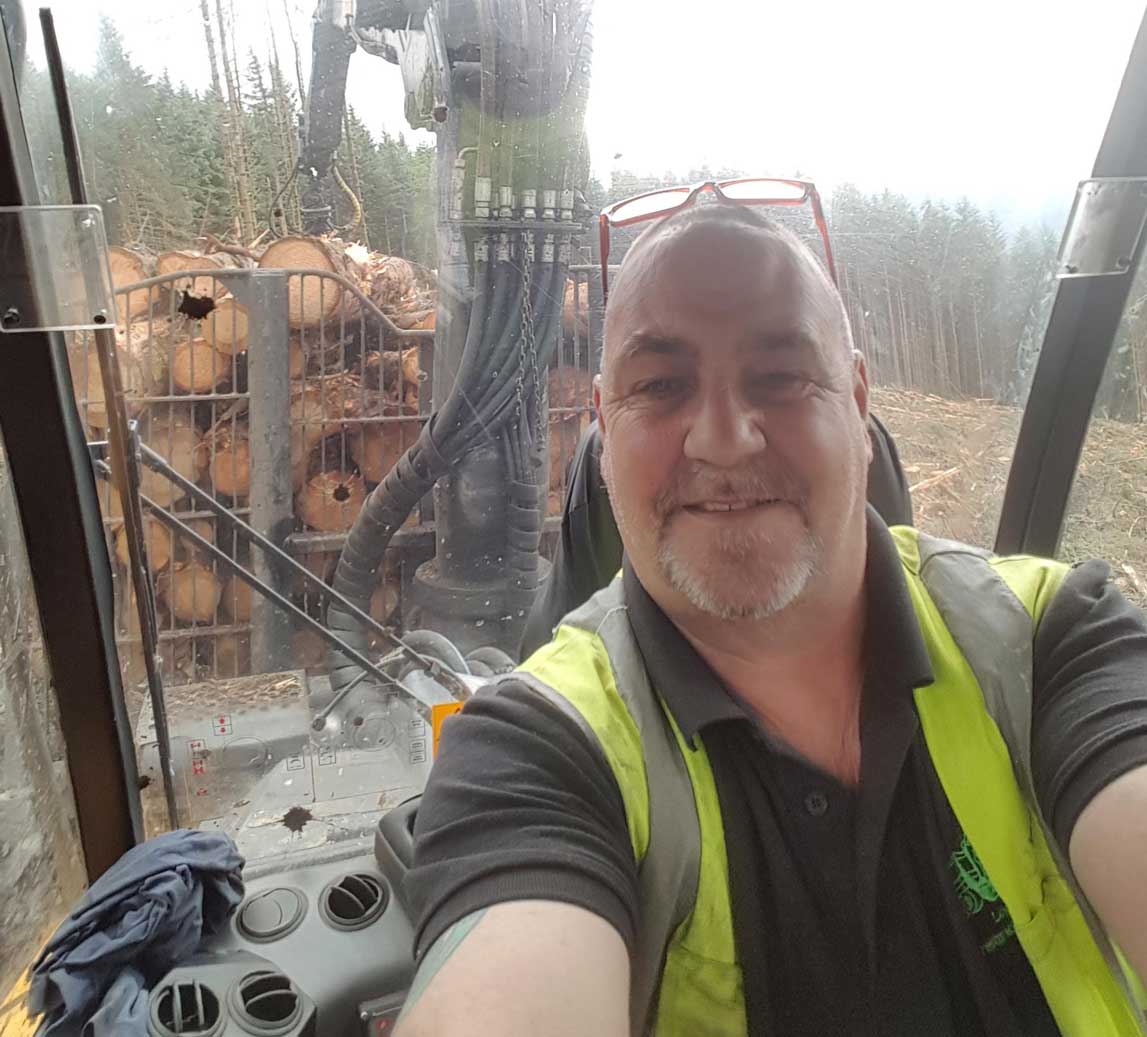

A harvester fire in the middle of a dry conifer block is not a routine machine breakdown. Access may be poor, water may be a long way off, and a small hydraulic or electrical fire can put a machine, standing timber and crew at immediate risk.
The best forestry fire suppression equipment isn’t one product or one extinguisher type. It is a practical package built around the machines, fuel, access and likely ignition sources on a particular site.
For forestry contractors, the aim is straightforward: contain a small incident safely, protect people first, and give the emergency services clear access and accurate information. No kit changes the rule that crews should withdraw early where fire is spreading, smoke is heavy, or there is any risk of entrapment.

-
The WeighPro Wireless Weighing Link represents a precise and dependable weighing system designed specifically for round timber, eliminating the need for re-calibration. This system offers operators minimal maintenance requirements, boasting an impressive battery life of up to two years between recharges.
-
That’s a remarkable amount of work hours for a single machine, the Norcar 600 owned by Erkki Rinne is taken well care of, it even has the original Diesel engine.
-
It is not possible to eliminate chain shot, but there are simple steps that can be taken to reduce the risk.
-
Arwel takes great pride in the fact that the mill has no waste whatsoever, “the peelings are used for children’s playgrounds, gardens and for farm animals in barns in the winter and the sawdust has multiple uses in gardens and farms as well.
-
Timber hauliers need to encourage young blood in, and also look after the hauliers we have, we need make the sector a safe and positive place to work.
FIND US ON
Best forestry fire suppression equipment starts with risk
A working site can carry several different fire risks at once. Harvesters, forwarders and chippers run hot around dry debris. Hydraulic oil and diesel create fuel sources. Battery systems, wiring looms and exhaust after-treatment systems add further ignition points. Fuel bowsers, workshops, and welfare units require a separate look.
Before specifying equipment, assess the job as it will actually be worked. A thinning site close to a metalled road and a water point needs a different response from a remote clearfell reached by a narrow forest road. Consider the season, vegetation dryness, machine numbers, fuel-handling arrangements, mobile phone coverage, wind direction, and whether an appliance could reach the site entrance.
This assessment should sit alongside the wider site emergency plan, not in a folder back at the yard. Operators need to know the grid reference or what3words location for the entrance, the extraction routes, the water sources, the assembly point and who is responsible for calling 999. On larger or higher-risk operations, cover this in the morning briefing and whenever the work face moves.
Machine-mounted extinguishers: the first line, not the whole plan
A suitable extinguisher on every working machine remains the basic requirement. It must be accessible from ground level where possible, secured against vibration, clearly identified and checked at the required intervals. An extinguisher buried behind tools or only reachable by climbing over a machine is unlikely to help when seconds matter.
ABC dry powder units are widely used on forestry plant because they can tackle solid combustibles, flammable liquids and electrical fires. Their weakness is the clean-up: powder gets everywhere, can damage electrical components and may turn a repairable incident into a costly strip-down. That is still preferable to losing a machine, but it is worth recognising the trade-off.
Water mist extinguishers can be effective across several fire types and cause less collateral mess, although you should check capacity, temperature protection, and supplier support. Foam extinguishers can be useful around liquid fuels but may not suit every operating policy or environmental requirement. For electrical systems and battery-related incidents, follow the machine manufacturer’s guidance rather than assuming a standard extinguisher will suffice.
In practice, one larger unit mounted externally or in an accessible compartment, backed by a smaller cab extinguisher, often gives better coverage than relying on a single small cylinder. The operator must be able to get out first. Nobody should stay in a compromised cab to retrieve firefighting equipment.
Automatic suppression systems for high-value plant
Automatic fire suppression systems are increasingly worth considering on harvesters, chippers, mulchers and other high-value machinery operating long hours in dry material. These systems use detection tubing or sensors around high-risk zones, then automatically discharge an extinguishing agent or allow manual activation.
They are not cheap, and installation quality matters. A badly routed line or poorly placed nozzle is false economy. But where a machine works remotely, or where downtime and replacement costs are high, automatic suppression can stop an engine-bay fire before the operator can safely respond. Specify it around the machine layout, including engine compartments, hydraulic areas, and battery boxes, rather than fitting it as a generic add-on.
Automatic systems also need inspection. Damaged detection tubing, discharged cylinders and obstructed nozzles can leave a contractor believing they are protected when they are not.
Water supply for the work site
Hand extinguishers are for incipient fires. Once vegetation, brash stacks or a machine exterior is involved, a meaningful water supply becomes far more useful, provided the crew has a safe escape route and the fire is still manageable.
A site bowser or slip-on firefighting unit can provide that capability. For many forestry applications, a sensible setup includes a baffled water tank, petrol or diesel pump, hose reel, suction hose, branches, and enough hose length to work around a machine without putting people too close to the fire. A pressure washer tank alone is rarely a substitute. Its volume can be limited, and its pump may not be designed for sustained firefighting use.
The right capacity depends on access and resupply. A large bowser looks reassuring, but it may be useless if it cannot travel the forest road safely or reach the active work face. Smaller skid units on pickups, trailers or utility vehicles can be a more workable choice on dispersed sites. They also need proper payload calculations, secure mounting and an operator who understands pump operation.
Where a stream, pond or reservoir is available, a portable pump with suitable suction equipment may extend the water supply. Do not assume a watercourse is automatically usable. Check access, permission, contamination concerns, and dry-weather levels beforehand.
Equipment for crews on foot
Backpack pumps, hose packs and fire beaters still have a place in forestry, particularly for dealing with small edge fires in grass, needles or light surface fuel. They are simple, portable and useful where vehicles cannot go. They are not suitable for a fast-moving fire in heavy brash, steep ground or strong wind.
A practical crew cache for higher-risk work may include:
- backpack pumps and fire beaters for small vegetation fires;
- a portable pump, suction hose and delivery hose where a reliable water source exists;
- eye protection, gloves and suitable clothing for the task;
- communications, site maps and a charged device for calling emergency services.
Treat this as first-response equipment, not an invitation to take on a wildfire. If the fire spreads beyond immediate control, changes direction, produces thick smoke, or threatens people, machines, timber stacks, or public roads, withdraw and call the fire and rescue service.
Fuel, batteries and hot-work areas need separate cover
Fuel storage is where many site plans fall short. Position diesel bowsers away from ignition sources and, where practical, away from the main machine parking area. Keep extinguishers visible and accessible, control spills promptly, and prevent dry debris building up around pumps, generators and charging equipment.
Battery charging deserves the same discipline. Lithium-ion tools and machine batteries bring different failure modes, including thermal runaway and re-ignition. Follow the equipment manufacturer’s emergency instructions, provide ventilation where charging is carried out, and avoid improvised charging locations in containers packed with fuels, oils and PPE.
Hot works such as welding, grinding or cutting should be tightly controlled on site. Clear combustible material, keep suitable extinguishing media nearby, assign a fire watch and inspect the area after the work is completed. On dry, windy days, postponing a non-essential repair can be the most professional decision.
Buying decisions that stand up in the field
When comparing suppliers, look beyond the purchase price. Check service coverage, refill arrangements, replacement cylinders, frost protection, mounting brackets and whether the kit can be maintained locally. An excellent system that cannot be serviced promptly is a poor choice for a contractor with machines working across several counties.
Also consider how equipment affects the operator’s workday. Can the extinguisher be checked quickly during daily greasing and walk-rounds? Is the bowser easy to drain, fill and tow? Can a lone operator deploy the hose safely? These details determine whether equipment is ready when needed.
The strongest fire provision is usually unglamorous: clean machines, daily debris removal, sound wiring, controlled refuelling, clear access, trained people and equipment that is maintained rather than merely carried. Put the right suppression kit on site before the dry spell starts, brief the crew on its limits, and make sure everyone knows when the correct move is to leave the fire and get help.
Contact forestmachinemagazine@mail.com to get your products and services in front of the world’s largest professional forestry online news network.
#homeoflogging #writtenbyloggersforloggers #loggingallovertheworld
Written by loggers for loggers and dedicated to bringing you the latest forestry news