
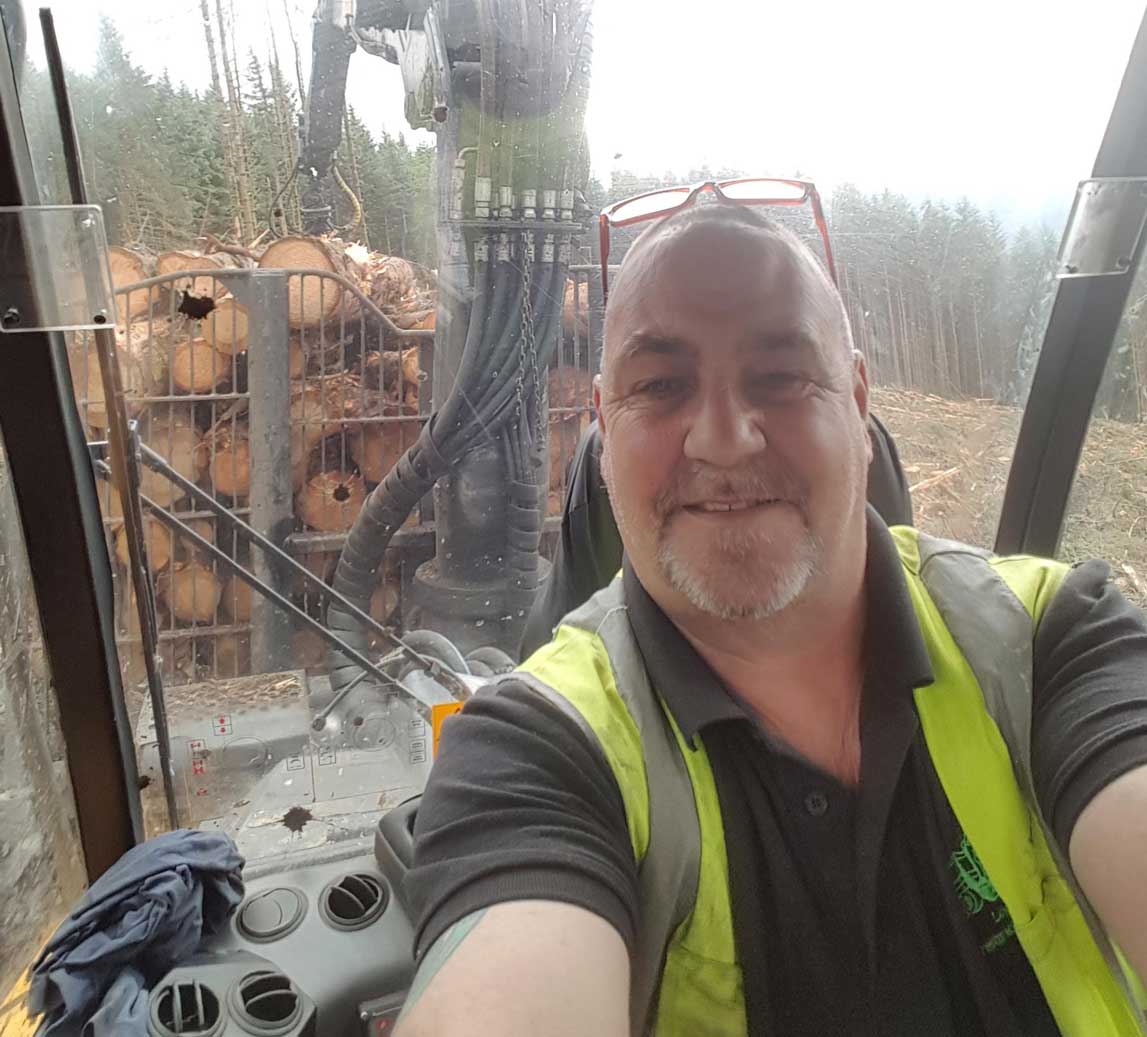
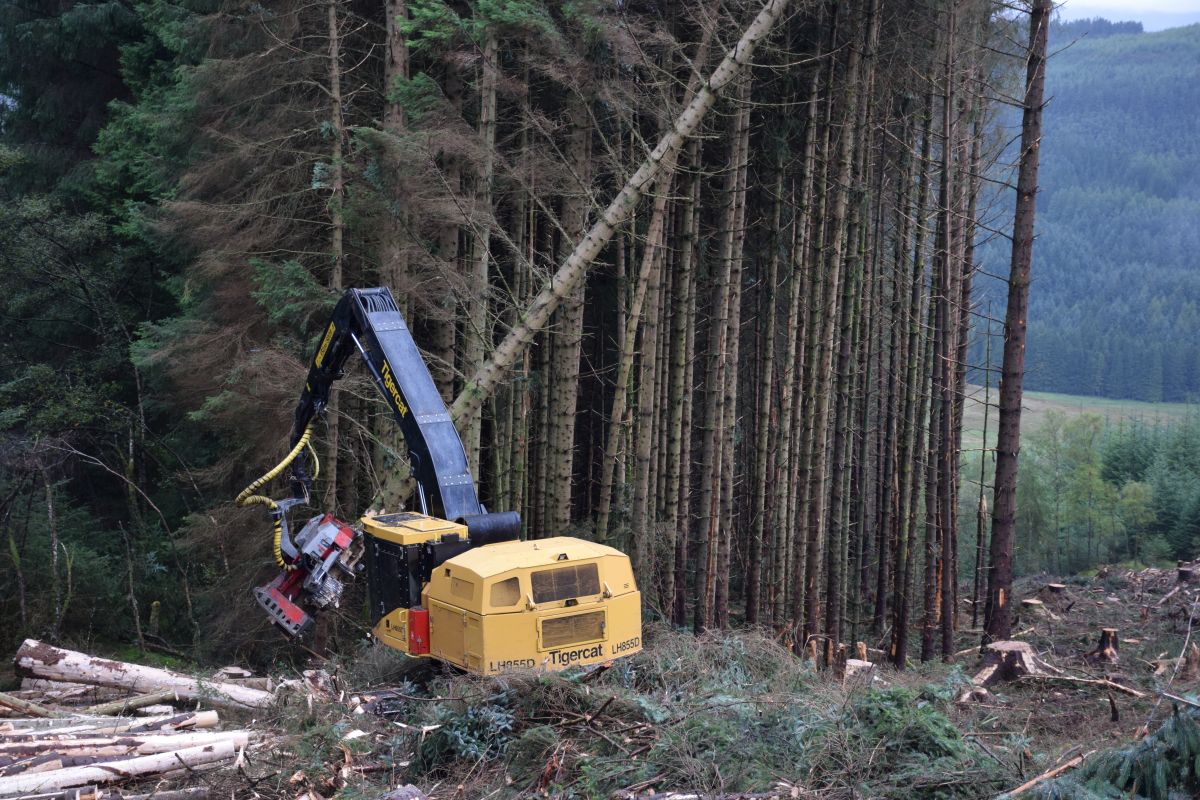
Put a new operator in a modern harvester and the machine will often flatter them for an hour. Levelling cabs, smooth crane controls and measuring systems can make the first shift look decent enough. The real test of harvester operator training starts when the crop changes, the weather turns, the ground gets soft and production still has to be made without wrecking standing timber, extraction routes or the machine.
What harvester operator training should actually cover
Too much training still leans heavily on basic machine familiarisation. That matters, but it is only the start. A proper programme needs to build judgement as well as control. The operator has to read the stand, understand extraction routes, manage presentation to the head, protect the remaining crop and keep the machine working inside safe limits.
In first thinnings, that often means learning patience before speed. An operator who rushes a thinning can do expensive damage in very little time. Poor boom placement, bad machine positioning and lazy tree selection leave behind stem wounds, hung-up trees and racks that never really recover. In clearfell, the pressure shifts. Output rises in importance, but quality of stacking, cross-cutting accuracy and machine care become just as visible.
-
That’s a remarkable amount of work hours for a single machine, the Norcar 600 owned by Erkki Rinne is taken well care of, it even has the original Diesel engine.
-
Kieran Anders is a forestry contractor working in the lake district. His work involves hand cutting and extracting timber using a skidder and tractor-trailer forwarder.
-
It is not possible to eliminate chain shot, but there are simple steps that can be taken to reduce the risk.
-
Arwel takes great pride in the fact that the mill has no waste whatsoever, “the peelings are used for children’s playgrounds, gardens and for farm animals in barns in the winter and the sawdust has multiple uses in gardens and farms as well.
-
Timber hauliers need to encourage young blood in, and also look after the hauliers we have, we need make the sector a safe and positive place to work.
FIND US ON
The best training also covers the less glamorous work that keeps production going. Daily checks, hose inspection, track and tyre condition, chain maintenance, feed roller wear and correct settings on the harvesting head all affect performance. Operators who understand the machine mechanically tend to spot trouble earlier and cost less to run.
Classroom tickets are not enough
There is still a place for formal certification, site induction and basic health and safety. Nobody in the trade is arguing against that. But tickets on their own do not produce a capable operator, especially on high-value harvesting kit.
A harvester is not a digger on forestry tracks. It is a production machine working in changing ground conditions, variable timber sizes and often poor visibility. Training that ends once the certificate is issued leaves contractors with a familiar problem – a nominally qualified operator who still needs months of close supervision before they are genuinely useful.
That is not a criticism of new entrants. It is simply the reality of the job. Good forestry businesses treat certification as the floor, not the finish line.
The difference between machine control and production forestry
This is where a lot of harvester operator training either succeeds or falls away. Being able to slew, reach, grab and process is one thing. Doing it in a way that protects margin is another.
A productive operator plans each move before the crane comes off the bunk line. They think about where the next tree will land, how the machine will advance, where the brash mat needs building and how the forwarder will later access the produce. That kind of foresight does not come from a simulator alone. It comes from coached time in the seat, in live timber, with someone experienced enough to explain not just what to do but why it matters.
The commercial side matters too. Poor cross-cutting decisions can lose value quickly, especially where assortments are tight and market specifications are being watched closely. Waste at the stump, untidy stacks and contamination from poor housekeeping all eat into return. A trainee operator needs to understand that every movement has a cost attached to it.
Training needs to match the crop and contract
There is no single model that fits every operator or every site. Someone trained mainly in softwood clearfell may struggle in broadleaf work or sensitive thinning. Equally, a good operator on tidy, accessible ground can look ordinary very quickly on steep banks, wet sites or awkward roadside presentations.
That is why context matters. Harvester operator training should be built around the kind of work the operator is expected to do. If the business mainly handles first and second thinning, training should lean heavily into crop selection, rack discipline and low-impact machine movement. If the workload is mostly clearfell, then output, log quality, machine set-up and production rhythm come further to the front.
What good in-seat coaching looks like
The best coaching in forestry is usually direct, unsentimental and very specific. It is not a stream of theory. It is a supervisor or senior operator saying, in effect, move the machine there, present the stem like this, keep your crane lower, build your mat before you push on, do not chase that awkward tree from the wrong side.
That sort of coaching works because it is immediate. The trainee can see the result in real time. They can feel the difference in machine balance, crane speed and head control. Over a few weeks, small corrections become habit.

Good coaching also leaves room for progression. Early on, the focus may be on safe positioning, visibility and basic processing. Later, the conversation shifts towards fuel use, output per shift, minimising stand damage and keeping the machine productive through weather and site changes. The operator is not just learning controls – they are learning how to think like someone responsible for a six-figure asset and a production target.
Simulators help, but they have limits
Simulator training has improved and it absolutely has a place. For brand-new starters, it builds familiarity with control patterns, head functions and basic boom coordination without risking a machine, a crop or a stack of repair bills. It can shorten the painful early stage where every movement feels awkward.
But it should not be oversold. Simulators cannot fully replicate seat time on rough ground, poor light, rain on screens, changing timber form or the pressure of working around other machines on a live site. They are best used as a stepping stone, not a substitute.
For employers, the value is practical. If a candidate shows decent aptitude on a simulator, they may justify the cost of supervised machine time. If they struggle badly even there, that tells you something as well.
Why contractors struggle to build operators
The industry talks a lot about skills shortages, and rightly so. Harvester operator training is expensive, slow and risky. You are taking an inexperienced person and putting them near one of the most costly machines on the site. During training, output drops, supervision demands rise and the chance of avoidable damage goes up.
That creates a hard choice for contractors. On one hand, the sector needs new operators badly. On the other, few businesses can absorb long periods of low productivity, particularly when margins are already tight and machine finance, insurance and labour costs keep moving the wrong way.
This is why the best training setups tend to be structured rather than ad hoc. A clear plan, realistic milestones and a named mentor usually produce better results than throwing someone in the cab when the regular operator is off. It also helps if the trainee spends time with the whole operation, not just the harvester. Understanding forwarding, stacking, haulage access and roadside discipline makes for a better operator later.
How to judge whether training is working
Output matters, but it should not be the first measure. Early on, look at avoidable damage, machine sympathy, consistency and attitude to correction. An operator who is steady, safe and teachable is often worth backing, even if their numbers are not there yet.
Over time, the key indicators become clearer. Are they building proper brash mats? Are they selecting and presenting stems cleanly? Is the stand being left in decent order? Are they keeping assortments right? Are breakdowns being reported early rather than hidden until they become expensive? Those are stronger signs of progress than one good day on a favourable site.
It is also worth watching how the operator handles pressure. Plenty look competent when everything is straightforward. The better ones stay methodical when the head sensor plays up, the weather closes in or the crop gets awkward.
Harvester operator training is a business decision
For forestry firms, training is often discussed as a labour issue or a safety issue. It is both, but it is also a straight commercial decision. A well-trained operator protects timber value, controls repair costs, reduces stand damage and gives the business more flexibility when contracts shift.
That matters even more now that machines are increasingly sophisticated and expensive to support. A careless operator can burn through profit by the month. A good one can make an average contract pay.
Forest Machine Magazine has long reflected the trade reality that machinery only earns when the person in the seat knows how to use it properly. Harvester operator training is part of that equation, not an optional extra to be squeezed in when time allows.
The businesses that treat training seriously tend to get the same thing in return – operators who last, machines that hold together better and work that leaves the site in decent shape. In this sector, that still counts for a lot.
Sign up for our free monthly newsletter here
Contact forestmachinemagazine@mail.com to get your products and services seen on the world’s largest professional forestry online news network.
#homeoflogging #writtenbyloggersforloggers #loggingallovertheworld
Written by loggers for loggers and dedicated solely to the equipment used in forestry operations.