

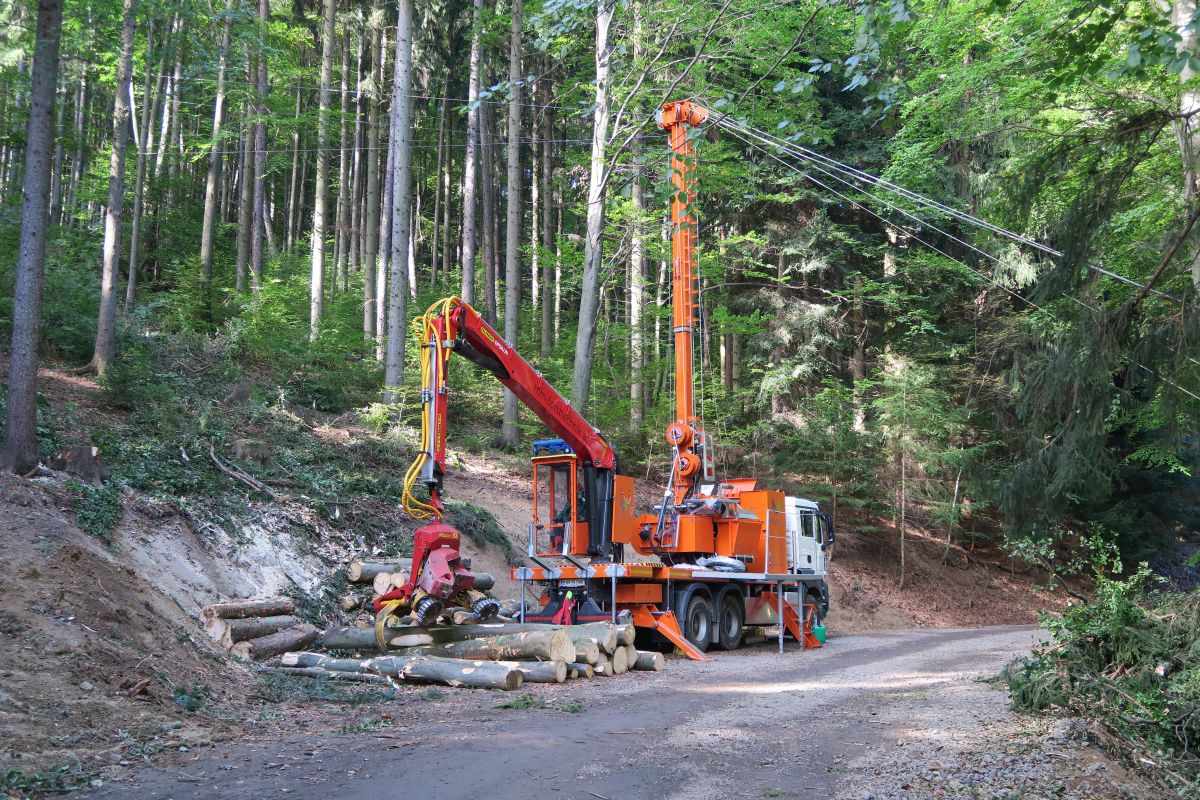
The economic downturn is now also affecting the Austrian softwood roundwood market. This has led to falling prices and full storage yards at sawmills.
Austrian Timber Demand-Due to the constantly changing situation surrounding the war in Iran, and particularly the Strait of Hormuz, energy prices remain high. As is well known, this is weighing on overall economic development, especially the already struggling construction industry. “Due to the tense economic situation, sales of coniferous sawlogs have declined,” summarize the experts from the Forestry and Timber Industry Department at LK Austria regarding the past days and weeks. Combined with high supply and “mostly well-stocked sawmills,” the current demand for coniferous sawlogs is very low.

-
The WeighPro Wireless Weighing Link represents a precise and dependable weighing system designed specifically for round timber, eliminating the need for re-calibration. This system offers operators minimal maintenance requirements, boasting an impressive battery life of up to two years between recharges.
-
That’s a remarkable amount of work hours for a single machine, the Norcar 600 owned by Erkki Rinne is taken well care of, it even has the original Diesel engine.
-
It is not possible to eliminate chain shot, but there are simple steps that can be taken to reduce the risk.
-
Arwel takes great pride in the fact that the mill has no waste whatsoever, “the peelings are used for children’s playgrounds, gardens and for farm animals in barns in the winter and the sawdust has multiple uses in gardens and farms as well.
-
Timber hauliers need to encourage young blood in, and also look after the hauliers we have, we need make the sector a safe and positive place to work.
FIND US ON
“While existing forest stockpiles in Lower Austria and the affected areas of Styria are being removed only very slowly due to quota-based supply, they have been nearly depleted in the rest of the country,” the market analysts report. Against the backdrop of this year’s severe spring drought, foresters with forest stockpiles should be cautious anyway. “The spring precipitation deficit remains very pronounced, and the susceptibility of individual stands to bark beetle infestation is high,” officials in Vienna note. Breeding material still present in the forest must be removed as soon as possible to curb the spread of the beetles.
However, foresters are currently having to accept falling prices for these types of products, including pulpwood. “Prices have been lowered due to the supply-and-demand situation,” officials report. For the main spruce/fir assortment (Classes A, B, C, 2b), the national average price is 121.70 euros per solid cubic meter, free on the roadside (net). Compared to the previous month, prices have thus fallen by an average of 4 euros. The largest decline was seen in Upper Austria, which has had a good supply for some time. Overall, however, a lower price range of around 120 euros is reported from all federal states. According to experts, the marketing of pine is also proving difficult. The price (Class A, B, C, 2a+) also fell by 4 euros to just under 84 euros per solid cubic meter on average across Austria. The price range extends from 75 euros in Upper Austria to peak prices of 95 euros in Lower Austria.

From a forestry perspective, experts are advising caution when felling pine trees these days due to weather conditions—specifically, blue stain. In this regard, they refer to Section 19 of the Austrian Timber Trade Practices. Once the buyer has been notified that the timber is ready for pickup, they have seven business days to remove it. “After this period expires, the risk of quality deterioration passes to the buyer,” the experts remind us. To preserve evidence, they recommend taking photos of the logs. Incidentally, the price of roundwood for larch is holding up well. It fell by only a few cents on average and remained stable at more than 150 euros per solid cubic meter.
Upturn in Industrial Timber
The situation is different for coniferous industrial timber. According to LK analysts, facilities in the paper, pulp, and panel industries have below-average raw material inventories. A reduced supply of sawmill byproducts, waste wood, and industrial roundwood is leading to increased demand, which is also reflected in higher prices. “Available assortments are being quickly transported and sold,” the report states. In terms of price, pulpwood (spruce/fir) currently averages around 43 euros per solid cubic meter and is thus trending slightly upward in all federal states. In Salzburg, peak prices are even approaching the 50-euro mark. A regional price increase was also recorded for beech industrial roundwood.
Regional Variations in Energy Wood
The energy wood market, however, is developing differently across regions. “While the extended heating season in Lower Austria is driving sustained material consumption and a corresponding increase in demand, marketing energy wood outside of long-term contracts is difficult in Upper Austria,” report market observers. In the rest of the country, the energy wood market is following its usual seasonal pattern. This seasonal pattern also dominates average prices. Softwood firewood currently stands at just under 84 euros per cubic meter, with slight declines in the west. Hardwood, meanwhile, is trading steadily at around 113 euros per cubic meter. Wood chips are also showing a minimal seasonal decline. On average, 116 euros per dry ton can be achieved for high-quality goods, delivered to the mill. Peak prices of up to 165 euros are reported from Lower Austria. Average-quality wood changes hands at significantly lower prices, averaging 106 euros per dry ton.
Source; bauernzeitung.at
Sign up for our free monthly newsletter here
Contact forestmachinemagazine@mail.com to get your products and services seen on the world’s largest professional forestry online news network.
#homeoflogging #writtenbyloggersforloggers #loggingallovertheworld
Written by loggers for loggers and dedicated solely to the equipment used in forestry operations.