
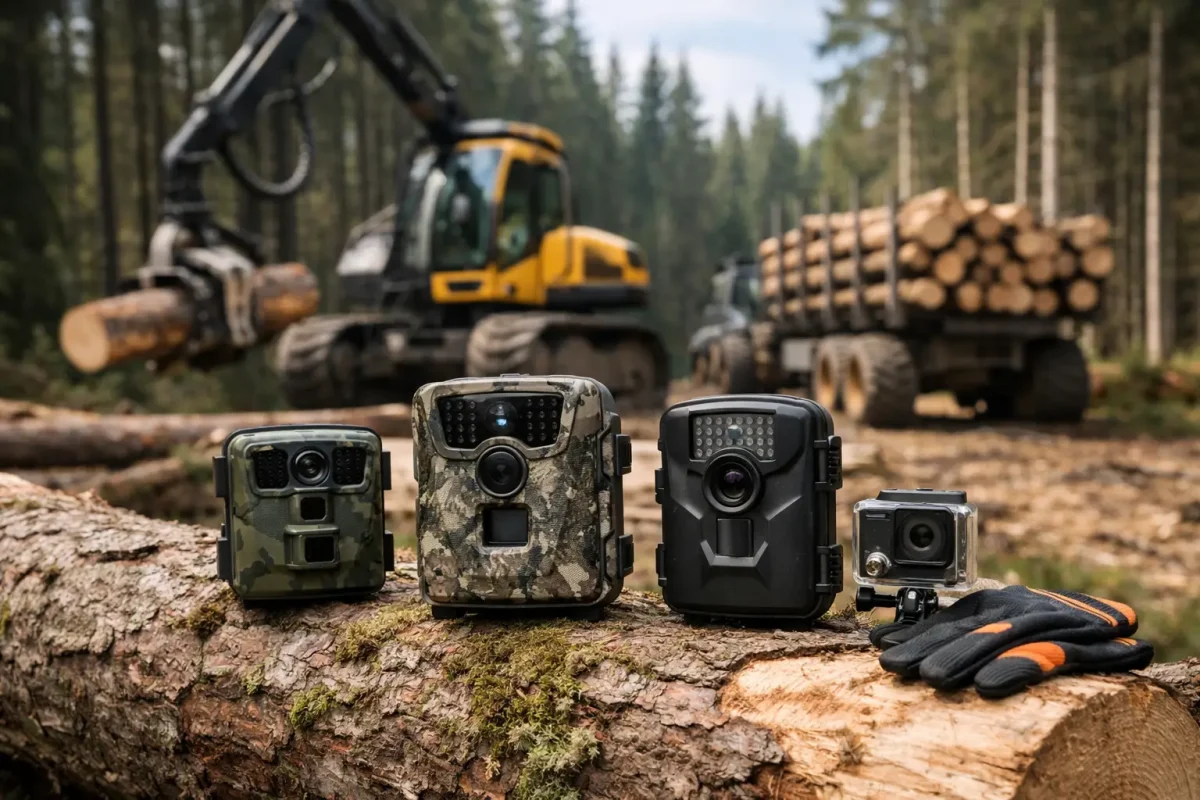
A camera system earns its keep when it prevents the operator having to climb down, lean out of a cab window or reverse on guesswork. On a harvesting site, visibility is rarely a simple rear-view problem. Mud, brash, low light, tight stacking areas and changing attachments all create blind spots.
The best forestry cameras for operators are therefore not necessarily the ones with the biggest screen or the longest feature list. They are the systems that keep giving a usable picture through a wet, vibrating working week.
For a harvester, forwarder, timber lorry or wood-processing machine, the camera needs to suit the job, the machine and the way the operator actually works. A cheap vehicle kit may look acceptable on the bench, then fail at the first connector after a winter of wash-downs and vibration. Specifying properly at the start costs less than replacing cameras, cables and brackets halfway through a contract.

-
The WeighPro Wireless Weighing Link represents a precise and dependable weighing system designed specifically for round timber, eliminating the need for re-calibration. This system offers operators minimal maintenance requirements, boasting an impressive battery life of up to two years between recharges.
-
That’s a remarkable amount of work hours for a single machine, the Norcar 600 owned by Erkki Rinne is taken well care of, it even has the original Diesel engine.
-
It is not possible to eliminate chain shot, but there are simple steps that can be taken to reduce the risk.
-
Arwel takes great pride in the fact that the mill has no waste whatsoever, “the peelings are used for children’s playgrounds, gardens and for farm animals in barns in the winter and the sawdust has multiple uses in gardens and farms as well.
-
Timber hauliers need to encourage young blood in, and also look after the hauliers we have, we need make the sector a safe and positive place to work.
FIND US ON
Start with the blind spot, not the catalogue
Before choosing a camera, walk around the machine and identify the movements that cannot be seen properly from the seat. On a forwarder, that may be the rear corner when reversing between racks, the bunk area during loading, and the trailer drawbar or rear bogie where fitted. On a harvester it may be the route behind the machine, a difficult-side track edge or a view of the head when working in dense standing timber.
On a timber lorry, reversing into a mill yard, watching the trailer during tight turns and checking the load area can each justify a different camera position. A chipper, firewood processor or crane-fed processing line has another set of risks: feed presentation, discharge area and exclusion zones around the machine.
A camera is an aid to observation, not a substitute for a proper site system, mirrors, machine checks or getting out to inspect when conditions demand it. The point is to reduce avoidable uncertainty and give the operator a quicker, clearer view at the moment it matters.
The best forestry cameras for operators are built for abuse
Forestry machines produce a harsher environment than most road vehicles. Constant vibration, hydraulic oil mist, branch strikes, pressure washing, temperature swings and fine dust all find weaknesses quickly. Look beyond the sales image and check the basic build specification.
An IP67 rating is a sensible minimum for an externally mounted camera, with IP68 or IP69K worth considering where the installation will be routinely washed down. The rating is only one part of the picture. A tough metal housing, a protected lens, a solid mounting arrangement and sealed connectors matter just as much. A camera hanging from a light-gauge bracket on the back of a forwarder will shake itself loose, whatever its water rating says.
Use a bracket that can be adjusted but will not creep under vibration. Place the unit where it has a useful field of view without sitting in the direct path of branches, stones or a tyre’s spray. Sometimes a small guard is worthwhile. It must not obscure the lens or create a snagging point for brash.
Cables deserve the same attention as cameras. Run them through protective conduit where possible, keep them away from hot exhaust components and moving crane sections, and leave enough allowance at articulated points. Every cable entry and join is a future fault location. A wired system is generally the safer bet on a hard-worked forest machine, particularly where a dependable image is needed while reversing or loading.
Wired, wireless or digital?
A conventional wired analogue camera system remains a practical choice for many operators. It is straightforward, comparatively affordable and easy for a competent installer to diagnose. However, picture quality varies, and long cable runs can show interference if the system is poorly fitted.
AHD, or analogue high definition, gives a sharper image than older composite video while retaining the familiarity of a wired installation. It is often a strong middle ground for forwarders, harvesters and lorries where clear detail is useful but the owner does not need a fully networked machine system.
Digital camera systems can provide excellent image quality, multiple camera inputs and better integration with modern displays. They are attractive where operators need several views at once or need to record footage for incident review. The trade-off is cost and complexity. If a digital system fails, it may require a supplier with the right diagnostic tools rather than a quick repair in the workshop.
Wireless kits are useful for detachable trailers, temporary installations or machines where running a cable is genuinely awkward. They are less convincing as the primary safety-critical view on a machine working among standing timber. Signal drop-outs, delay and interference may be occasional, but occasional is too often when the picture is needed during a tight reverse. If wireless is chosen, test it on site with the machine running and all normal electrical equipment operating.
Image quality matters, but so does latency
A high-resolution picture sounds simple, but usable image quality comes from several factors. A wide-angle lens can show more of the work area, yet the extreme edges distort distance. That can be acceptable for a general rear view, but less useful when judging clearance beside a gatepost, stack or standing stem.
Low-light performance is especially relevant in British winter working. Infrared LEDs can help when manoeuvring in darkness, although reflected glare from dust, rain or close objects can leave the picture washed out. A camera with good low-light sensitivity and a sensible exposure range is often more useful than one relying solely on powerful infrared illumination.
Watch for latency, the delay between movement outside and the image on screen. Even a fraction of a second can be irritating when reversing a lorry, and it is not acceptable for a view used to guide precise crane work. Ask to see the system operating rather than relying on specification sheets. A clear image that arrives late is not a clear operational view.
Put the monitor where it can be used
The best camera system is wasted if the operator has to look away from the work every few seconds. The monitor should sit within a natural glance from the main working area, without blocking instruments, the windscreen or sightlines to people on the ground. Cab layouts differ sharply, so a position that works in one machine may be poor in another.
A seven-inch monitor is sufficient for a single rear camera in many cabs. Where there are three or four feeds, a larger, high-brightness display makes sense. Split-screen views are useful, but only if each image remains large enough to interpret. Four tiny images may look impressive and provide little real assistance.
Brightness is not a minor detail. A monitor that is fine in a shed can be unreadable with low winter sun behind the operator. Choose a screen rated for daylight visibility, with accessible brightness controls and a shade or recessed mounting where needed. Automatic camera switching can also help: for example, selecting a reverse view when reverse is engaged. It should still allow the operator to call up any camera manually.
Specify for the work, then maintain it
A sensible forestry setup is usually built around a primary reversing camera and one or two task-specific views, rather than fitting cameras everywhere. For a forwarder, a rear-facing camera plus a bunk or crane-area view may give the best return. A harvester may benefit more from a rear camera and a side or head view, depending on terrain and the cab’s existing visibility. For haulage, the priority is commonly rear manoeuvring and trailer observation.
Consider these four checks before placing an order:
- Confirm the camera and monitor run on the machine’s 12V or 24V electrical system, with proper fused protection.
- Check that connectors, extension leads and replacement cameras are available from a UK supplier.
- Decide who will install and support the system when it develops a fault in the middle of a job.
- Make sure the display does not interfere with approved cab safety structures, controls or visibility.
Keep lenses clean as part of the daily walk-round. A smear of grease or dried spray can turn a good camera into a false reassurance. Check brackets, cable clips and connectors regularly, especially after working rough ground or clearing windblow. If the image flickers, investigate early: loose earths, damaged cable insulation and water ingress rarely improve on their own.
The right camera arrangement should make the operator calmer and more accurate, not add another screen to manage. Trial the views in the conditions the machine actually faces – in rain, at dusk, with a loaded bunk or trailer, and when turning in confined ground. That is where a forestry camera proves whether it belongs on the machine.
Sign up for our free monthly newsletter here
Contact forestmachinemagazine@mail.com to get your products and services seen on the world’s largest professional forestry online news network.
#homeoflogging #writtenbyloggersforloggers #loggingallovertheworld
Written by loggers for loggers and dedicated solely to the equipment used in forestry operations.