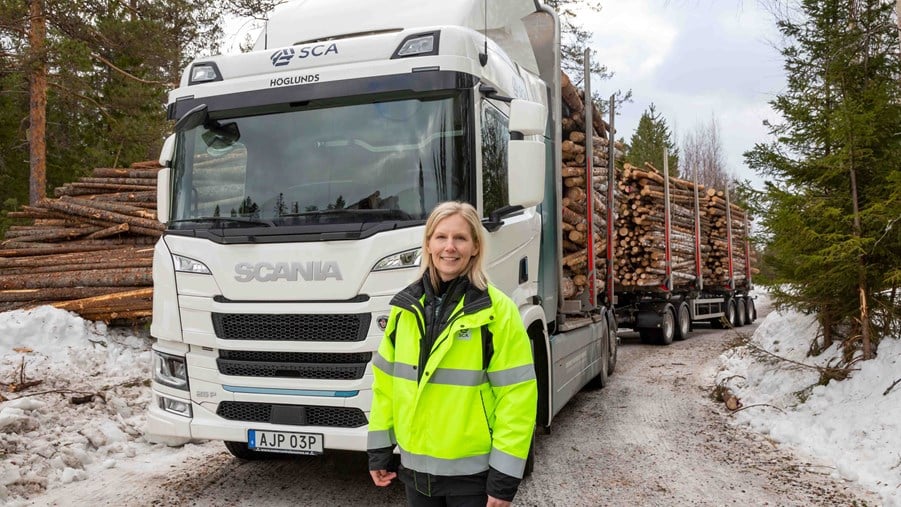
In collaboration with Swedish truck maker Scania, forest company SCA has developed the world’s first electric logging truck. The vehicle is used between SCA’s wood terminal in Gimonäs and its Obbola paper mill outside Umeå in the north of Sweden, a 30-kilometre round trip.
The Swedish forest industry is one of Sweden’s largest transport buyers. In terms of exports, sea is the dominant mode of transport, but domestically it is often road or rail. Switching entirely to fossil-free transport is a key step towards pushing for more sustainable development. It is also one of the Swedish forest industries’ pledges included in its Road to the Future policy document. And that is why the world’s first electric timber truck, which is currently in service on the forest roads outside Umeå, is so important:
“Our industry has come a long way towards being free from fossil fuels, and with this collaboration we’re also taking a step towards more sustainable solutions for heavy truck transport,” says Susanne Rutqvist, Product Director with responsibility for climate issues at SCA.
Reduce carbon dioxide emissions by 55 tonnes
The electric timber truck runs between SCA’s wood terminal in Gimonäs and its Obbola paper mill outside Umeå, a total round-trip of 30 kilometres. The truck needs to be charged twice a day, and calculations show that this will reduce SCA’s carbon dioxide emissions by approximately 55 tonnes a year. As SCA uses a large number of timber trucks, the overall climate benefit can hopefully be multiplied over time. The timber truck has also been successfully tested for use in the forest, which places even greater demands on the truck’s capabilities. So, what are the obstacles to wider rollout?
“Charging infrastructure and electricity production! Politicians need to step up and expand the capacity of the network so that Sweden and the EU can achieve their climate objectives,” says Rutqvist.
“Charging must be optimised”
An opinion echoed by Tobias Ejderhamn, Sales Director eTruck Solutions at Scania:
“Charging and use must be optimised. Batteries are costly and heavy. This means that the truck’s chassis must be adapted to the truck’s intended use so that no charging is redundant and no extra weight in the form of unnecessary batteries increases energy consumption.”
As charging takes time, it makes sense to charge the truck when it would be stationary anyway. This is why SCA has built its own charging station at the Obbola plant.
“Being able to develop trucks together with SCA is extremely instructive for us. The forest industry puts the very toughest demands on vehicles and charging solutions. The trucks have to operate in the cold, with heavy loads and drive in challenging environments,” Ejderhamn adds.
Scania believes that it will be able to reach capacity timber truck production within three years.
-
The WeighPro Wireless Weighing Link represents a precise and dependable weighing system designed specifically for round timber, eliminating the need for re-calibration. This system offers operators minimal maintenance requirements, boasting an impressive battery life of up to two years between recharges.
-
That’s a remarkable amount of work hours for a single machine, the Norcar 600 owned by Erkki Rinne is taken well care of, it even has the original Diesel engine.
-
It is not possible to eliminate chain shot, but there are simple steps that can be taken to reduce the risk.
-
Arwel takes great pride in the fact that the mill has no waste whatsoever, “the peelings are used for children’s playgrounds, gardens and for farm animals in barns in the winter and the sawdust has multiple uses in gardens and farms as well.
-
Timber hauliers need to encourage young blood in, and also look after the hauliers we have, we need make the sector a safe and positive place to work.
FIND US ON
Related Posts
Data collection
The Forestry Research Institute of Sweden (Skogforsk) is the central research body responsible for the Swedish forestry sector, and is jointly financed by the government and members of the Institute. Skogforsk is responsible for data collection in the SCA/Scania timber truck project, and will publish their findings before the end of the year.
Fact Box
The first electric logging truck was built in 2022 and the pilot project could start in earnest. The truck can be driven with a total weight of 64 tonnes on public roads and 80 tonnes on private roads. Scania expects to be able to achieve capacity production of electric timber trucks within one to three years.
Forest Machine Magazine is written and edited by a forest professional with over 40 years hands on experience. We are dedicated to keeping you informed with all the latest news, views and reviews from our industry.
To support us you can subscribe to our bi-monthly magazine which is delivered to your door from only £15 per year.
Subscribe here
#homeoflogging #writtenbyloggersforloggers #loggingallovertheworld