
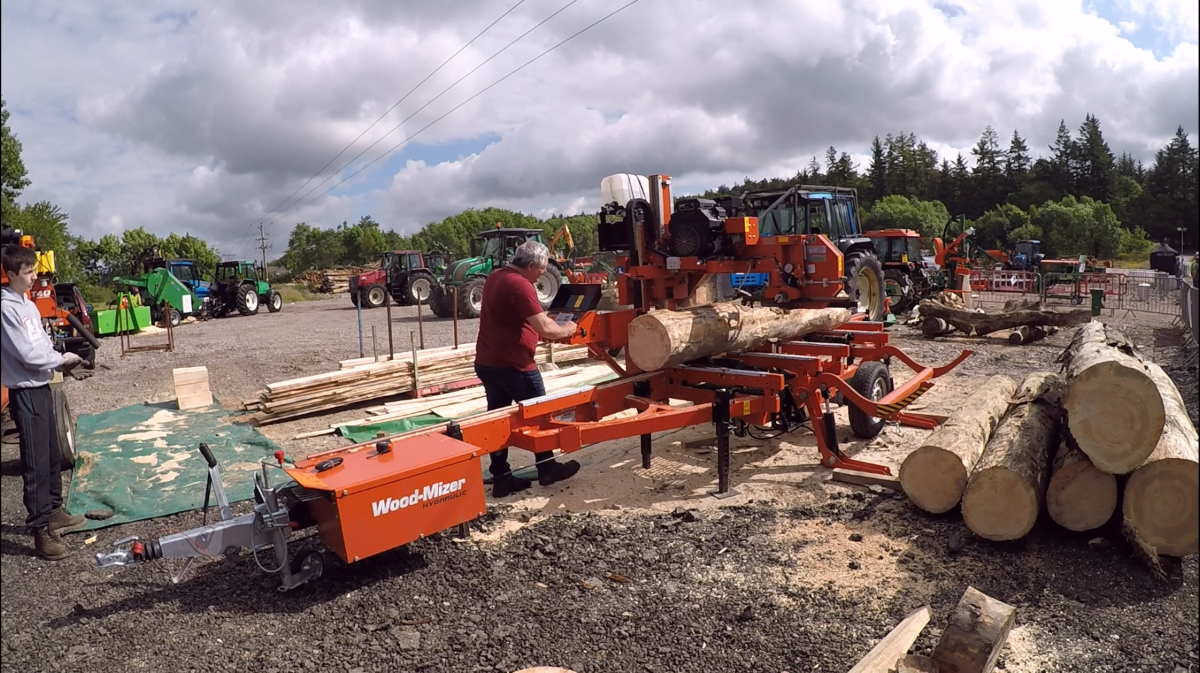
A portable sawmill review only matters if it reflects real working conditions. For forestry contractors, estate operations and small commercial mills, the right portable setup is less about brochure figures and more about what it will cut, how reliably it will travel, and whether it earns its keep over a full season.
Portable sawmills sit in an interesting part of the market. They are not trying to replace fixed production mills with proper handling lines and sorting capacity. What they offer is flexibility – the chance to convert timber where it falls, reduce haulage on low-grade or awkward material, and open up value from woodland lots that do not justify moving everything off site in the round. That is the sales pitch. The reality depends heavily on the machine type, the timber being processed and the standard of the operator.

-
The WeighPro Wireless Weighing Link represents a precise and dependable weighing system designed specifically for round timber, eliminating the need for re-calibration. This system offers operators minimal maintenance requirements, boasting an impressive battery life of up to two years between recharges.
-
That’s a remarkable amount of work hours for a single machine, the Norcar 600 owned by Erkki Rinne is taken well care of, it even has the original Diesel engine.
-
It is not possible to eliminate chain shot, but there are simple steps that can be taken to reduce the risk.
-
Arwel takes great pride in the fact that the mill has no waste whatsoever, “the peelings are used for children’s playgrounds, gardens and for farm animals in barns in the winter and the sawdust has multiple uses in gardens and farms as well.
-
Timber hauliers need to encourage young blood in, and also look after the hauliers we have, we need make the sector a safe and positive place to work.
FIND US ON
Portable sawmill review – what counts in the field
The biggest mistake buyers make is judging a portable mill by maximum cut width alone. Capacity matters, but day-to-day output is usually decided by handling, setup time, blade or chain changes, and how the mill copes once the timber stops being uniform. A machine that looks impressive on paper can become slow work if every second log needs packing, dogging and careful repositioning.
In practical terms, there are three broad camps. Bandsaw mills are the common choice for buyers chasing recovery and cleaner boards. Swing-blade mills are often favoured where larger section timber is the target and the operator wants to break down logs quickly into beams and flitches. Chainsaw mills remain the simplest and cheapest route in, but they are generally the slowest and hardest on fuel, chain life and operator stamina.
None of those formats is universally best. It depends what leaves the deck at the end of the day and what it cost to get there.
Bandsaw mills
For many operators, a bandsaw mill is the sensible middle ground. Kerf loss is lower than with a chainsaw setup, which matters when you are cutting good-value hardwood or trying to maximise recovery from medium diameter stems. Surface finish is usually better as well, especially when blades are sharp and feed speed is disciplined.
The trade-off is that bandsaw mills are more sensitive to setup and maintenance than some first-time buyers expect. Track alignment, blade tension, guide condition and log loading all affect cut accuracy. In soft, dirty or knotty timber, blade life can shorten quickly. On neglected sites, where bark is carrying grit and timber has been skidded through mud, consumable costs can rise fast.
Hydraulic handling makes a major difference here. Manual mills can work well for low-volume operators, but on a commercial basis, repeatedly turning and lifting decent-sized stems by hand soon becomes the bottleneck. If the budget stretches to hydraulic loading, clamping and turning, output improves not by a little but by a lot.
Swing-blade mills
Swing-blade machines suit a different sort of buyer. They are often strong on beam work, wider section timber and awkward stems where the operator wants to work the log in place rather than constantly reposition it. In remote woodland or estate work, that can be a real advantage.
These mills can be fast in the right material, and they travel well. They also tend to appeal where access is poor and the machine needs to go to the timber rather than the timber to the machine. For construction-grade sections, framing timber and agricultural use, they can be highly productive.
Their weak point is usually finish and recovery compared with a well-set bandsaw mill. Kerf is wider, and if the job is fine hardwood boards rather than structural timber, that wasted fibre adds up. Noise and dust levels can also be less forgiving for long shifts.
Chainsaw mills
A chainsaw mill still has a place, but mostly where portability matters more than production. They are useful for occasional site milling, oversized butts, storm-damaged timber in awkward places, or one-off jobs where taking a trailer mill in makes no sense.

As a commercial answer for regular production, though, most operators outgrow them quickly. They are physically demanding, slower through the cut and harder to keep consistent over long runs. Kerf is heavy, finish is rougher, and fuel use is not trivial. For an arborist adding value to occasional stems, fair enough. For a business expecting repeatable throughput, it is usually a stepping stone rather than a long-term solution.
Output is more than cut speed
Published output figures deserve caution. They are often based on ideal timber, tidy loading and a sharp cutting system at the start of the day. In the field, production depends on how long it takes to deck the timber, square the first face, remove slabs, stack boards and deal with defects.
A portable sawmill that can theoretically cut fast but has poor log handling is often beaten by a slightly slower machine with better workflow. The same goes for towability and setup. If a mill takes too long to level, too long to secure, or too long to prepare for road travel, it loses hours before the first board is sawn.
This matters especially in Britain, where many jobs are on mixed ground, in smaller woodlands, farm sites or estate corners that were never laid out for easy machinery movement. A mill needs to suit the roads, gateways and extraction realities as much as the timber size.

Build quality, support and parts backup
A portable sawmill review that ignores dealer support is not much use to a trade buyer. Downtime on a machine like this is rarely dramatic, but it is often costly in a slow, grinding way. A failed belt, damaged guide bearing, bent blade or electrical fault can waste a working week if parts backup is poor.
Imported mills can offer good value, but buyers should check what support exists in the UK before getting carried away by headline price. Blade supply, engine service parts, track sections, bearings and controls all need to be obtainable without a long wait. If the nearest competent support is effectively on another continent, the cheap buy can become an expensive lesson.
Chassis quality also deserves proper scrutiny. A portable mill spends its life being towed, levelled, set down and worked on uneven ground. Flex in the frame, poor galvanising, weak levelling legs or average wheel gear will show up soon enough. What looks fine parked on concrete can age badly on forestry roads and rough yards.
Running costs and operator skill
Running costs are often underestimated because buyers focus on engine size and fuel alone. The real spend tends to sit in blades, chain, sharpening equipment, drive belts, bearing wear and labour lost to poor setup or blunt tooling. Timber cleanliness has a direct effect here. If the machine is regularly fed bark full of stone and grit, costs rise and output falls.
Operator skill has just as much influence as machine specification. A good sawyer can get straight, saleable timber out of modest equipment. A poor one can make firewood from quality stems on an expensive mill. Feed pressure, log positioning, blade care and understanding timber tension are what separate acceptable production from professional production.
That is why demo days and genuine owner feedback matter. The machine should be judged by the standard of timber it can consistently produce in ordinary hands, not only by what a factory demonstrator achieves on selected logs.
Where each portable sawmill fits best
For estate management, farm diversification and smaller commercial hardwood work, a decent bandsaw mill often gives the best balance of recovery, finish and running cost. For mobile beam production, remote woodland jobs and larger section structural timber, a swing-blade can make more sense. For occasional specialist use, oversize pieces and difficult access, a chainsaw mill remains useful.
The wrong decision usually happens when buyers chase the biggest capacity they can afford but ignore handling, transport and workload pattern. If most stems are under 500mm, buying around rare oversized timber can leave you with a machine that costs more and moves less efficiently every other day of the year.
A sensible buyer starts with the timber profile, then the working location, then annual volume. Only after that should the conversation move to engine options, extras and accessories.
Portable sawmill review – the buying view
From a forestry buyer’s standpoint, the best portable sawmill is not the one with the highest claimed output or the longest options list. It is the one that matches your timber, your site access, your labour and your market for sawn product. If the business case relies on regular movement between sites, transport practicality matters. If margin depends on hardwood recovery, kerf and finish matter. If labour is tight, hydraulic handling matters.
There is no shortage of machines that can cut timber. The harder question is which one can make money in your conditions without becoming a maintenance hobby. That is where proper trade judgement comes in, and it is why any serious buyer should look beyond first price and ask what the mill will still be doing after two wet winters, rough tracks and a steady diet of imperfect stems.
Buy on the job you do most often, not the one you talk about most at the yard gate.
Contact forestmachinemagazine@mail.com to get your products and services seen on the world’s largest professional forestry online news network.
#homeoflogging #writtenbyloggersforloggers #loggingallovertheworld
Written by loggers for loggers and dedicated solely to the equipment used in forestry operations.