
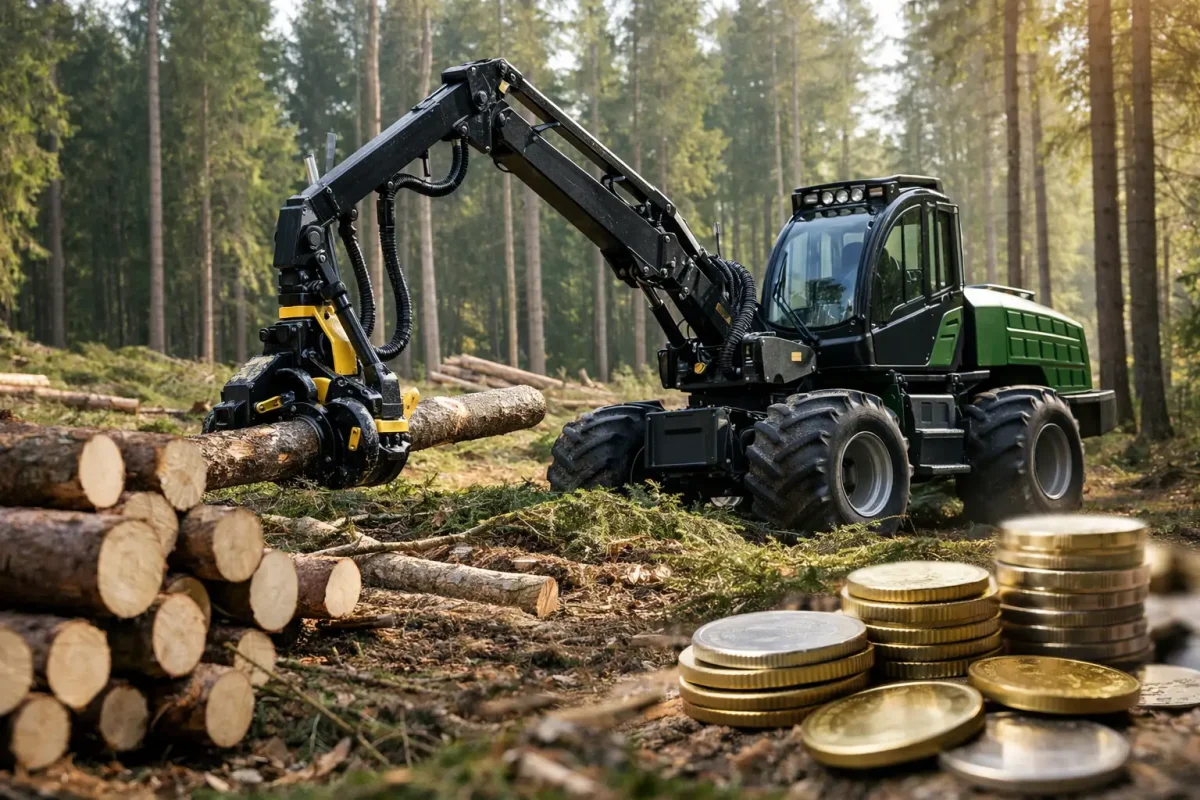
If you are pricing a machine for first thinning, clearfell or a contract expansion, the question is rarely just how much does a timber harvester cost. The real question is what the machine will cost your business over five to seven years, how many tonnes it needs to produce, and whether the work in front of it will actually pay for it.
For UK contractors, a timber harvester is one of the biggest capital decisions in the fleet. Sticker price matters, but so do finance rates, head specification, undercarriage choice, warranty cover, dealer backup and how quickly the machine can get back to work when something breaks on a wet site in February.

-
The WeighPro Wireless Weighing Link represents a precise and dependable weighing system designed specifically for round timber, eliminating the need for re-calibration. This system offers operators minimal maintenance requirements, boasting an impressive battery life of up to two years between recharges.
-
That’s a remarkable amount of work hours for a single machine, the Norcar 600 owned by Erkki Rinne is taken well care of, it even has the original Diesel engine.
-
It is not possible to eliminate chain shot, but there are simple steps that can be taken to reduce the risk.
-
Arwel takes great pride in the fact that the mill has no waste whatsoever, “the peelings are used for children’s playgrounds, gardens and for farm animals in barns in the winter and the sawdust has multiple uses in gardens and farms as well.
-
Timber hauliers need to encourage young blood in, and also look after the hauliers we have, we need make the sector a safe and positive place to work.
FIND US ON
How much does a timber harvester cost in the UK?
As a working rule, a new timber harvester will typically sit anywhere from around £350,000 to £650,000 plus VAT, depending on size, base machine, crane reach, harvesting head, measuring system and factory options. Smaller thinning harvesters or excavator-based conversions can come in below that. Large, purpose-built six or eight-wheel machines with a top-end head and a full spec can push beyond it.
Used prices vary even more sharply. A serviceable older machine with high hours may start around £70,000 to £150,000. Mid-life, well-presented harvesters with sensible hours and decent history often land between £180,000 and £300,000. Late-model used machines from premium brands can still command £350,000 or more if availability is tight and the spec suits current contract demand.
That is why there is no single clean answer. Two harvesters may both be described as “used and ready for work”, but one has 9,000 hours, strong dealer history and a recently rebuilt head, while the other is carrying deferred spend in pumps, pins, rotator and measuring system. On paper they can look similar. In the woods they are not.
What drives timber harvester prices?
Machine size is the obvious starting point. A compact harvester for first thinning is a different buying decision from a heavier machine expected to process larger timber on steep or broken ground. More mass, more reach and more hydraulic performance generally mean more money up front.
The harvesting head also shifts the number quickly. Head choice affects not only purchase cost but daily output, fuel burn, knife wear, feed roller life and how well the machine matches your crop. A contractor cutting smaller softwood stands does not necessarily need the same head as an operator regularly handling heavier material. Buying too small can choke production. Buying too much head can leave you carrying extra weight and cost without earning it back.
Undercarriage and traction spec are another major factor. Wheeled harvesters remain the standard choice for many UK operations, but bogie design, tyre package, tracks and balancing all influence both price and site performance. On specialist ground, levelling systems or excavator-based carriers can shift the investment further again.
Cab comfort and control systems matter more than some buyers admit. Better visibility, operator aids, updated measuring software and stronger telematics do not just make the brochure look good. They can improve production consistency and reduce operator fatigue over long shifts. In a market where experienced operators are hard to keep, that has a commercial value.
New versus used – where the money really goes
A new machine gives you known history, warranty support and the ability to spec it for the work you already have lined up. You also get the benefit of current fuel efficiency, emissions compliance and software support. The downside is obvious enough – higher monthly cost and steeper depreciation in the early years.
Used is often where smaller contractors and owner-operators look first, and with good reason. A well-bought used harvester can still produce strong margins if it is matched to the work and bought with eyes open. The risk is not age by itself. The risk is buying somebody else’s postponed repair bill.
Hours matter, but hours alone do not tell the story. A 12,000-hour machine with disciplined maintenance, proper greasing, pump work already done and a documented head rebuild may be the safer buy than a lower-hour machine that has had a harder life. The key is to look past paint and panelwork.
If you are buying used, inspect the crane base, slew ring area, articulation, hose routing, pumps, feed motors, saw unit, measuring wheel setup and frame condition. Ask how it has been worked. First thinning on sensible sites is one thing. Big timber on rough ground with long travel distances is another.
The cost beyond the purchase price
This is where plenty of buying decisions go wrong. Contractors focus on the sale figure and undercook what the machine will absorb once it starts work.
Finance is the first layer. Depending on deposit, term and prevailing rates, monthly repayments can move sharply. A machine that looks manageable at one rate can become a different proposition when borrowing costs tighten.
Then there is insurance, transport, commissioning and any immediate setup work. Add in spare knives, bars, chains, measuring calibration, software updates and attachment setup, and the machine usually costs more to put into production than the invoice first suggests.
Running costs are where the true ownership picture forms. Fuel remains a big line, especially where travel distances on site are long or timber size pushes the head hard. Routine servicing is predictable enough, but unscheduled downtime is what hurts. Hydraulic failures, electrical faults and head rebuilds can take a solid month and turn it into a poor one.
Undercarriage wear, crane wear and harvesting head wear should be budgeted as normal business costs, not bad luck. Feed rollers, delimbing knives, saw motors, hoses and bearings are not surprises on a working machine. They are part of the production model.
How much should a contractor budget per year?
There is no universal figure, because utilisation changes everything. A harvester doing strong annual hours on reliable contracts can justify a much higher capital cost than a machine working irregularly between smaller jobs.
As a rough commercial view, many contractors will budget not just for repayments but for meaningful annual maintenance spend from day one. On an older used machine, that number can become substantial very quickly if major components have not already been addressed. On a newer machine, maintenance may be lighter at first, but finance and depreciation will carry more of the burden.
The key metric is cost per productive hour and, ultimately, cost per tonne. If the machine is standing because the diary is thin, even a cheap purchase can be expensive. If it is producing reliably on the right work, a dearer machine may be the better business decision.

How much does a timber harvester cost compared with a feller buncher or processor?
In UK forestry, the direct comparison is not always neat because system choice depends on crop, terrain and market. Still, harvesters tend to carry a premium where high-spec heads, measuring systems and purpose-built carriers are concerned. What they give you is mechanised felling, delimbing, cross-cutting and measurement in one package.
That can make labour planning cleaner and output more controllable, but only when the rest of the system keeps up. If extraction is the bottleneck, or haulage is inconsistent, a top-flight harvester can spend too much time waiting on somebody else’s delay. Machine cost only makes sense when the full harvesting chain is balanced.
When is a timber harvester worth the money?
Usually when three things line up. First, you have enough contracted volume to keep it earning. Second, you have operator capability to get the most from it. Third, you have dealer and service support that can keep downtime in check.
For some businesses, hiring in capacity or buying a sound used unit is the sensible bridge before stepping into a new machine. For others, especially where workload is established and uptime is everything, a new harvester with proper support is easier to justify.
There is also a regional reality in Britain. Terrain, forwarding distances, species mix and access vary widely from one contract to the next. A machine that is right for a softwood programme in one part of Scotland may not be the best answer for mixed work in Wales or England. Spec should follow timber and ground conditions, not just badge loyalty.
Buying on price alone is the costly mistake
Everybody wants to buy well, but the cheapest harvester on the market is rarely the cheapest machine to own. Lost production, poor parts backup, weak resale and repeated repair spend can wipe out the saving in short order.
A better approach is to cost the machine against the work. What volume will it cut? What standing time can the contract tolerate? How quickly can parts be supplied? Who will run it, and how consistent are they? Those answers matter more than chasing the lowest headline number.
If you are asking how much does a forestry harvester cost, the honest trade answer is this: enough to reward careful buying and punish guesswork. Price the machine, then price the support, the downtime risk and the workload behind it. That is usually where the right decision starts to show itself.
Sign up for our free monthly newsletter here
Contact forestmachinemagazine@mail.com to get your products and services seen on the world’s largest professional forestry online news network.
#homeoflogging #writtenbyloggersforloggers #loggingallovertheworld
Written by loggers for loggers and dedicated solely to the equipment used in forestry operations.