

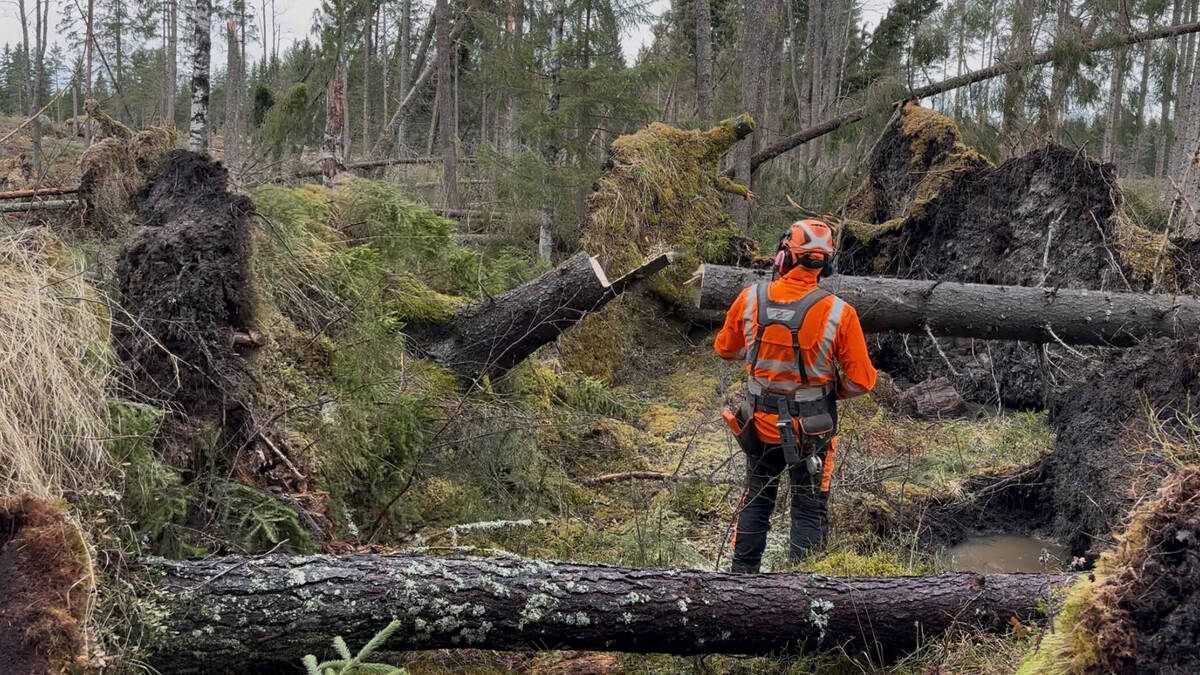
Windblown spruce trees are a breeding ground for spruce bark beetle infestation. New research shows that root cutting can impair the trees’ suitability as brood material and thus reduce the bark beetle’s propagation.
Cutting off Windblown Trees, Photo: Petter Öhrn, Skogforsk
After storms and dry summers, the spruce bark beetle (Ips typographus) has good opportunities to reproduce in windblown spruces. Rapid reprocessing of fallen trunks is often the most effective measure, but it is not always practical or economically feasible – for example, in small volumes of storm-felled forest, in protected areas or in difficult terrain. Therefore, alternatives are needed that can reduce the risk of further spread.

-
The WeighPro Wireless Weighing Link represents a precise and dependable weighing system designed specifically for round timber, eliminating the need for re-calibration. This system offers operators minimal maintenance requirements, boasting an impressive battery life of up to two years between recharges.
-
That’s a remarkable amount of work hours for a single machine, the Norcar 600 owned by Erkki Rinne is taken well care of, it even has the original Diesel engine.
-
It is not possible to eliminate chain shot, but there are simple steps that can be taken to reduce the risk.
-
Arwel takes great pride in the fact that the mill has no waste whatsoever, “the peelings are used for children’s playgrounds, gardens and for farm animals in barns in the winter and the sawdust has multiple uses in gardens and farms as well.
-
Timber hauliers need to encourage young blood in, and also look after the hauliers we have, we need make the sector a safe and positive place to work.
FIND US ON
Root cutting, i.e. cutting the trunk at the base so that the root contact is broken, is a possible measure that has previously been tested in smaller trials (Prevent damage from the spruce bark beetle), but which has now been tested on a larger scale. When water absorption is stopped, the trunk dries faster, which deteriorates the quality of the inner bark where the spruce bark beetle develops.
Practical conclusions
✅ Root cutting can be a complement when rapid reprocessing is not possible.
✅ Prioritise coarse windfalls, which are otherwise particularly valuable fry trees.
❌ Avoid the operation if the work cannot be carried out safely (see below).
Other results
Slightly more of the uprooted trees were attacked by the spruce bark beetle (67% of the uprooted trees and 50% of the uncut trees), but the beetles regenerated less well in the uprooted trees than in the uncut trees. Instead, the hexagonal bark beetle (Pityogenes chalcographus) increased in uprooted trees, especially in the upper part of the trunk. The six-toothed bark beetle mostly attacks already stressed trees and, like the common bark beetle, is a pest, although not to the same extent.
Root-cut trees had a lower infestation density and lower production of spruce bark beetle than uncut trees. Reproductive success dropped to less than one offspring per female, which in the long run can slow down the population.
Coarse trees provided better conditions for the spruce bark beetle than thinner trees, even after root cutting.
Sunlit trees generally had poorer spruce bark beetle development than shaded ones.
Interpretation – what do the results mean?
Root cutting causes the trunk to dry faster, which impairs the quality of the bark for the larvae of the spruce bark beetle. Even if the trees are still colonized, the conditions for successful propagation are poorer. The effect is enhanced in sunny and dry conditions.
However, a root cut can lead to a reduction in the quality of the wood.
Security
Working with storm-felled trees entails particular risks with falling root rollers and trunks ending up in tension and can backfire when cutting. Special skills and experience are therefore required. In more severe cases with trees in several layers, machines should be used.
Purpose of the study
The aim was to investigate whether root cutting of wind-felled spruce trees can reduce spruce bark beetle infestation and reproduction, as well as how tree size and environmental factors affect the effect.

This is how we did it
The study was conducted in central Sweden at six locations. A total of 119 wind-felled spruce trees were examined. Half of the trees were uprooted near the base with a chainsaw in the spring. Other trees were left uncut for inspection. During the late summer, bark beetle infestations and reproduction along the trunk were inventoried.
Summary
Root cutting of wind-felled spruce trees can reduce spruce bark beetle propagation by breaking root contact and accelerating the drying out of the trunk. The measure is simple and can be a useful tool when other measures are difficult to implement.
The results are planned to be published in a scientific article.
Source https://www.skogforsk.se
Sign up for our free monthly newsletter here
Contact forestmachinemagazine@mail.com to get your products and services seen on the world’s largest professional forestry online news network.
#homeoflogging #writtenbyloggersforloggers #loggingallovertheworld
Written by loggers for loggers and dedicated solely to the equipment used in forestry operations.