
Timber haulage is one of the most visible points of contact between the forest industry and the public so having a secure load is vital for inspiring public confidence
Securing Timber Loads-A timber load that shifts half a foot on a bend can turn a routine run into a roadside prohibition, a damaged trailer, or far worse. For hauliers moving roundwood, chipwood or cut products, knowing how to secure timber loads is not just a box-ticking exercise. It sits right at the join between safety, legal compliance and getting home without grief.
In forestry haulage, restraint starts long before the lorry leaves the stacking area. Good load security is built into timber presentation in the forest, trailer setup, bolsters, headboards, strap condition and the driver’s judgement on the day. The awkward bit is that there is no single answer that suits every load. Short pulp on a tidy roadside stack behaves differently from long sawlogs in poor weather, and both are a different proposition again from processed timber on a flatbed.

-
The WeighPro Wireless Weighing Link represents a precise and dependable weighing system designed specifically for round timber, eliminating the need for re-calibration. This system offers operators minimal maintenance requirements, boasting an impressive battery life of up to two years between recharges.
-
That’s a remarkable amount of work hours for a single machine, the Norcar 600 owned by Erkki Rinne is taken well care of, it even has the original Diesel engine.
-
It is not possible to eliminate chain shot, but there are simple steps that can be taken to reduce the risk.
-
Arwel takes great pride in the fact that the mill has no waste whatsoever, “the peelings are used for children’s playgrounds, gardens and for farm animals in barns in the winter and the sawdust has multiple uses in gardens and farms as well.
-
Timber hauliers need to encourage young blood in, and also look after the hauliers we have, we need make the sector a safe and positive place to work.
FIND US ON
How to secure timber loads in real working conditions
The first rule is simple enough: the load must stay put under normal driving conditions, including heavy braking, cornering, rough road surfaces and evasive manoeuvres. In practice, that means the timber has to be properly contained by the vehicle structure where possible, and properly restrained where containment alone is not enough.
With round timber, the trailer and its bolsters do much of the work. If the bolsters are suitable for the product length and stacked correctly, they help prevent lateral movement. But bolsters are not a free pass. The security of the load still depends on sound loading, even weight distribution and effective top restraint where required. If the stack is poorly built, mismatched in length, or perched above the support points, no number of straps will make it a good load.
That is where experienced loading pays for itself. Timber should sit square and tight between the stakes, with butts and tops arranged to avoid obvious voids and rocking. If pieces are crossing badly or bridging over gaps, the stack can settle once the vehicle moves off, leaving the restraints slack. Many roadside issues start with a load that looked fine in the forest but had not properly bedded down before the driver hit the first camber or roundabout.
Start with the timber stack, not the straps
If you want fewer problems on the road, start with consistent presentation at the pickup point. Timber stacked neatly and segregated by length and diameter is quicker to load and far easier to secure correctly. Mixed lengths and heavily tapered pieces make it harder to form a stable bundle, particularly on multi-bay trailers.
The loading machine operator has a big part to play here. Placing timber so that it is evenly spread, properly seated and not over-stacked above bolster height reduces the chance of movement straight away. Drivers know the difference between a load that has been built with haulage in mind and one that has simply been dropped on to the trailer to get the job done. The latter usually costs time later, whether that is in re-strapping, roadside checks or a load that needs sorting before entering the mill.
Weight distribution matters just as much. Axle weights, gross vehicle weight and fore-and-aft balance have to be right. A load that is legally restrained but badly distributed can still handle poorly, increasing the risk of shift under braking or on uneven ground. Wet timber, frozen timber and species variation all affect weight, so assumptions based on volume alone can catch people out.
The restraint system has to match the load
When people ask how to secure timber loads, they often mean how many straps or chains they need. That is understandable, but it is the wrong starting point. The right restraint depends on what is being carried, the vehicle body type, the route, and whether the load is contained, blocked or free to move if a restraint loosens.
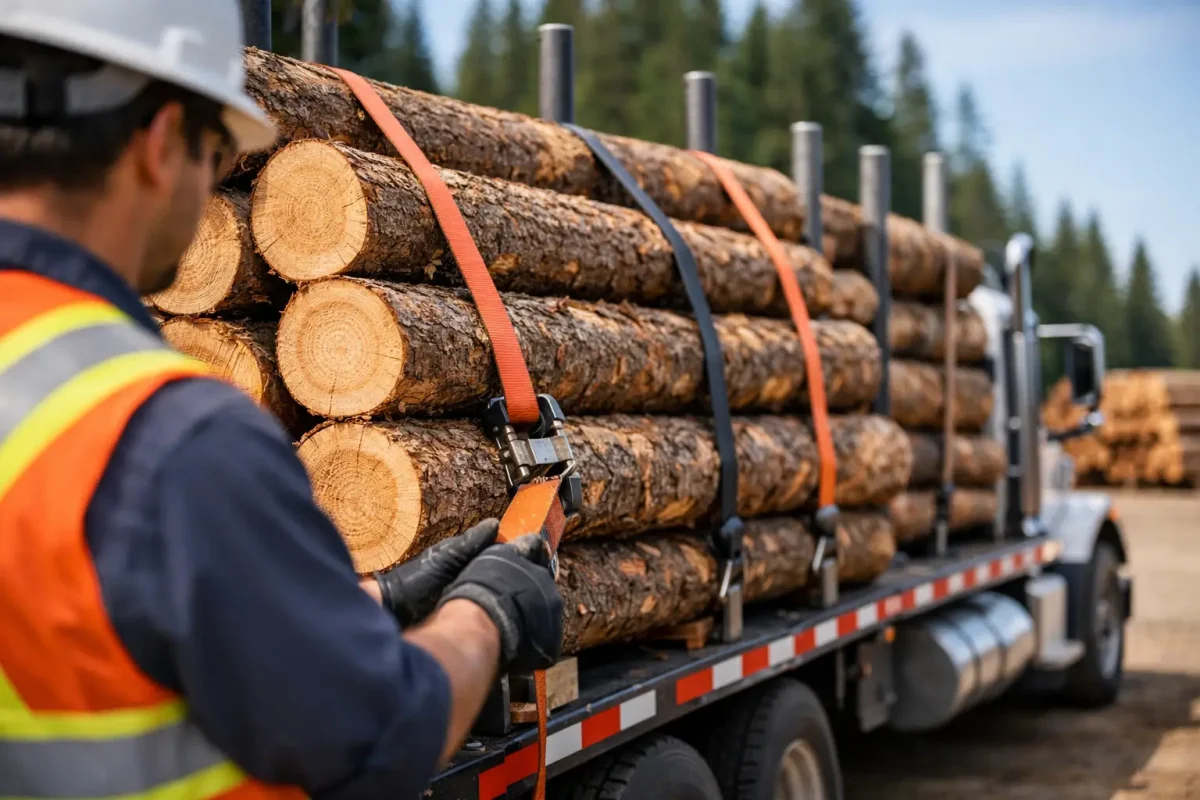
For round timber on purpose-built timber trailers, top-over lashings are commonly used to keep the load compact and reduce the chance of bounce or separation. The restraints need to be in good order, correctly rated and positioned so they actually hold the timber rather than sitting across high points with no real grip. Worn webbing, bent hooks, damaged tensioners and poor anchor points are all basic failures that enforcement officers spot quickly.
Chains may be more suitable in some operations, particularly where abrasion or rough bark would quickly shorten the life of webbing. Processed timber products on flatbeds often need a different approach again, with direct lashings, friction and edge protection all playing a part. The point is that the restraint method must suit the product. Using what happens to be on the vehicle is not a system.
Keep an eye on friction, weather and settlement
Timber is not a dead load. It can settle, roll, compress and shift, especially in wet weather or after the first few miles on poor roads. Bark, mud, ice and sawdust all reduce
friction between the timber and the bed or between pieces within the stack. Once friction drops, the restraints have to do more work.
That is why an early stop to check load tension is good practice, particularly after leaving the forest. A load that was tight at the roadside can loosen quickly once it has bounced across ruts and joined the public road. Rechecking straps or chains after the first part of the journey is a lot easier than explaining a shifted load in a lay-by with DVSA parked behind you.
Drivers also need to think about route conditions. A short run from forest gate to local processor is one thing. A longer road haul involving roundabouts, steep descents and dual carriageway speeds demands a wider margin of safety. The load may be legal at departure, but if road and weather conditions change, driving style and inspection frequency need to change with them.
Common mistakes that still cause problems
Most load security failures are not caused by obscure technical points. They come from familiar mistakes made under time pressure.
One is relying on the appearance of the load instead of testing whether it is genuinely stable. Another is using damaged restraints because they are still technically usable for one more day. A third is poor communication between machine operator and driver, especially when the trailer has been loaded by someone who will not be the one taking it down the road.
Over-height loading is another regular issue. If timber is stacked too high above the bolsters, containment is reduced and the chance of pieces working loose increases. Likewise, significant variation in log length within the same bay can leave shorter pieces with less support, making them more likely to move.
Then there is complacency. Operators who move the same route every day can start trusting the routine. But the routine changes the minute the timber is wetter than usual, the stack is a bit rougher, the loading angle is poor, or a strap has taken a knock and gone unnoticed.

Inspections are part of the job, not a delay
A proper walk-round before departure should cover bolsters, locking mechanisms, straps or chains, tensioners, anchor points, headboard condition where relevant, tyre condition and obvious signs that the timber is not seated correctly. If the load looks as though it may settle heavily, assume it will and plan your first check accordingly.
There is also a paperwork side. Operators need to be able to show that vehicles, trailers and restraint equipment are inspected and maintained. If something goes wrong, it will not be enough to say the driver usually gives it a quick look over. A clear inspection and maintenance culture carries weight, both operationally and legally.
For fleet operators, consistency matters. One driver running a disciplined system and another making it up as he goes is asking for trouble. Agreed loading standards, restraint policies and defect reporting give everyone the same baseline. That is not bureaucracy for the sake of it. It is how you reduce grey areas before they become incidents.
Training and judgement still matter more than gadgets
There is no shortage of kit marketed around load safety, and some of it is worthwhile. Better tensioning systems, improved restraint materials and smarter trailer design can all help. But none of that replaces judgement.
A good driver can spot when a load is wrong before a wheel turns. A good loader understands how species, length and taper affect stack behaviour. The best operations treat load security as a shared responsibility between the forest roadside, the transport office and the man in the cab.
That fits the reality of forestry haulage in Britain. Loads are picked up from uneven sites, in poor light, in wet weather, under production pressure. There will always be days when the timber is awkward and the ground is worse. Knowing how to secure timber loads properly means recognising when the answer is not another strap but a reload, a different trailer bay arrangement, or saying the load is not fit to travel as it stands.
For a trade that depends on moving heavy, awkward material efficiently, that kind of judgement is what keeps the wheels turning. Secure the load properly, check it early, and never let familiarity talk you into thinking this one will probably be all right.
Sign up for our free monthly newsletter here
Contact forestmachinemagazine@mail.com to get your products and services seen on the world’s largest professional forestry online news network.
#homeoflogging #writtenbyloggersforloggers #loggingallovertheworld
Written by loggers for loggers and dedicated solely to the equipment used in forestry operations.