

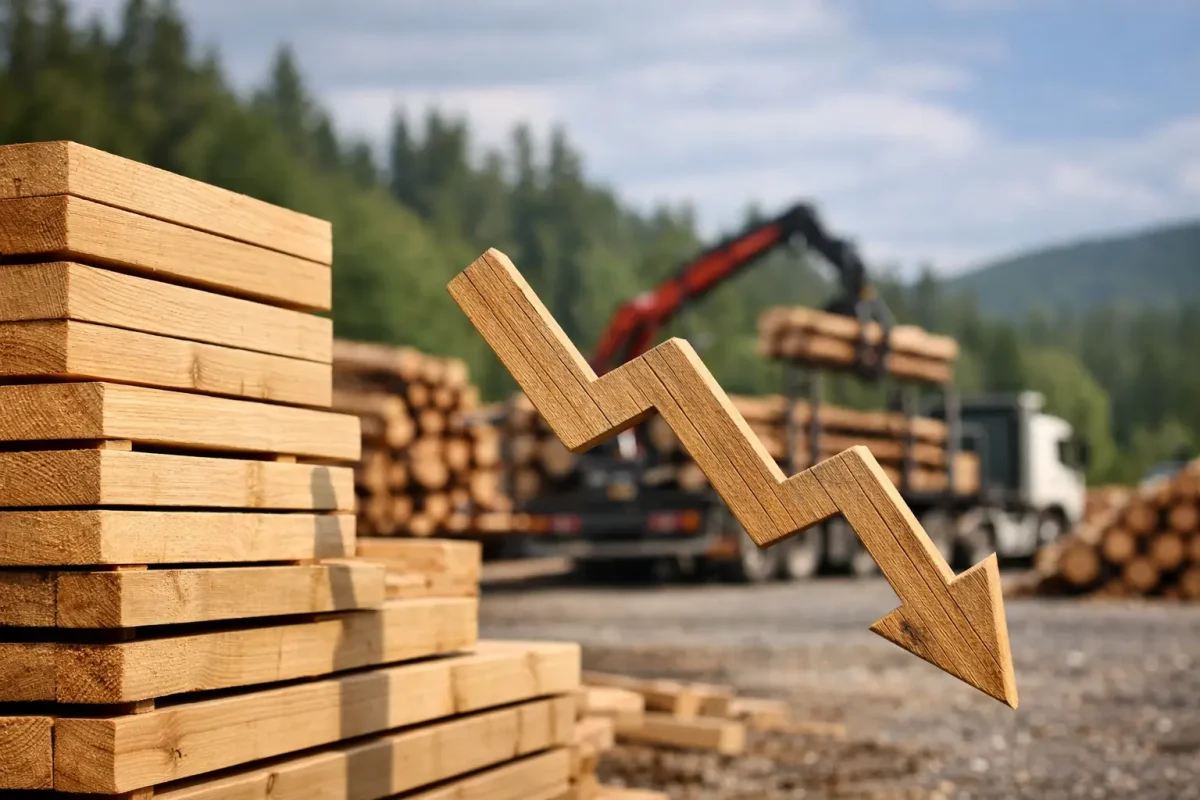
If you are asking why are timber prices falling, you are probably not doing it out of curiosity. You are looking at standing sales, roadside stacks, haulage rates, mill demand and machine costs that have not fallen at the same pace. For contractors, growers and timber buyers, the problem is not one headline reason. It is a market correction happening across several parts of the chain at once
Why are timber prices falling across the market?
In simple terms, timber prices tend to weaken when supply moves ahead of demand, when mills become more selective, or when end markets stop paying enough to support stronger log values. That is where much of the trade has been sitting. Softwood construction demand has cooled from earlier peaks, panel and packaging markets have been uneven, imported material still shapes buyer behaviour, and higher operating costs have not disappeared just because log prices have eased.

-
That’s a remarkable amount of work hours for a single machine, the Norcar 600 owned by Erkki Rinne is taken well care of, it even has the original Diesel engine.
-
Kieran Anders is a forestry contractor working in the lake district. His work involves hand cutting and extracting timber using a skidder and tractor-trailer forwarder.
-
It is not possible to eliminate chain shot, but there are simple steps that can be taken to reduce the risk.
-
Arwel takes great pride in the fact that the mill has no waste whatsoever, “the peelings are used for children’s playgrounds, gardens and for farm animals in barns in the winter and the sawdust has multiple uses in gardens and farms as well.
-
Timber hauliers need to encourage young blood in, and also look after the hauliers we have, we need make the sector a safe and positive place to work.
FIND US ON
The first thing to say is that not every product line is moving in the same way. Good straight sawlog in the right area, with sensible haul distance and reliable mill competition, can still perform reasonably well. Lower-grade material, awkward parcels, remote stands and timber needing expensive extraction or transport are more exposed when the market softens.
A lot of the pressure comes from demand settling back after an exceptional period. During the post-pandemic surge, construction activity, supply disruption and product shortages pushed timber values to levels that were never likely to hold forever. Sawmills paid hard to secure volume, import channels were strained, and buyers worked in a market driven by urgency. Once that urgency faded, prices had to find a more ordinary trading level.
That reset has been painful because cost inflation stayed in the system. Diesel, wages, finance, insurance, machinery parts and transport have all remained stubborn. So even where timber prices are only falling back to something closer to historic norms, the margin squeeze feels much sharper on the ground.
Demand from construction has cooled
One of the biggest drivers behind weaker timber pricing is slower construction demand. Softwood markets are closely tied to housebuilding, repair and maintenance, fencing, landscaping and other downstream uses. When developers slow starts, merchants buy cautiously and manufacturers trim production, that weakness travels back through the chain.
Interest rates have played their part. Higher borrowing costs hit housing activity and make both consumers and commercial builders more cautious. That does not just reduce demand for structural timber. It also affects pallets, packaging, site products and secondary processing where confidence matters as much as hard order books.
For UK forestry businesses, this matters because domestic mills will not chase volume at any price if they are struggling to move finished product. They become more selective on spec, more careful on stocks and less willing to bid aggressively against each other.
Sawmills are managing stock more tightly
When mills believe demand could soften further, they often shorten their buying horizon. Instead of building large log stocks, they buy what they need, keep control of working capital and push risk back up the supply chain. That creates a market where sellers see fewer competitive bids and slower movement.
It also means woodlands that are operationally more difficult can fall out of favour quickly. If a mill has enough cleaner, easier timber available nearby, it is less likely to stretch for awkward material from further afield. That can widen the gap between headline prices and what some growers or contractors can actually realise.
Supply has not tightened enough to support stronger prices
The other side of the market is supply. In some areas, there has simply been enough timber coming forward to keep buyers comfortable. Storm events, sanitation felling, management plans already in motion and the need for cashflow all keep volume moving even in a weaker market.
Once mills know there is timber available, buying discipline hardens. They do not need to overpay to secure continuity. That does not mean every yard is overflowing, but it does mean bargaining power shifts.
There is also a quality issue in the mix. If more lower-grade material is coming to market, whether through damaged crops, smaller diameter thinning or stands with limited specification options, average values can look softer very quickly. Biomass and pulp outlets matter here, because when those markets weaken, poorer assortments lose their price floor.

Energy wood and fibre markets are not carrying the same weight
For many harvesting operations, the value of the whole job depends on more than just sawlog. Chipwood, palletwood, pulp and biomass can be the difference between a workable site and one that struggles. If fibre markets soften, the sawlog alone has to carry too much of the economics.
That is one reason the answer to why are timber prices falling is not just about sawmills. Energy markets have been volatile, and biomass demand does not always translate into stronger roadside prices for low-grade timber. Processing costs, haulage distance, moisture content, contamination risk and local outlet capacity all affect what buyers can pay.
Where there are fewer viable fibre outlets, the market becomes more brittle. Stands that produce a high proportion of low-grade volume can quickly become unattractive, particularly once forwarding and haulage costs are fully counted.
Haulage costs change the real price fast
In a soft market, distance becomes a bigger issue. A nominally decent price at the mill can disappear once a longer lorry run is factored in. The same timber can work in one district and fail in another simply because of haulage.
That is especially relevant in the UK where road distance, vehicle availability, fuel cost and delivery slot pressure all shape net returns. If local demand is limited and timber has to travel further, the effective roadside value drops. Sellers then experience that as a price fall even if published market commentary looks relatively stable.

mports still influence what UK buyers will pay
Domestic timber does not trade in isolation. Imported sawn timber continues to influence pricing behaviour, especially when overseas supply is available at competitive rates. Even where British-grown timber is preferred for service, lead time or specification reasons, import competition still caps how far some product prices can rise.
If merchants and processors can source alternative material without major difficulty, UK mills are under pressure to keep finished prices realistic. That pressure comes straight back to log procurement.
Currency also plays a part. Exchange rate moves can make imported timber more or less competitive very quickly. A stronger supply position from Europe or elsewhere can cool the domestic market even when local harvesting conditions are unchanged.
The market is correcting after an overheated period
Part of the frustration in the sector comes from comparing current prices with the extraordinary highs seen during the recent spike. Those values were driven by disruption, scarcity and aggressive buying. They were useful while they lasted, but they were never a dependable base for long-term planning.
Seen that way, some of the fall is less a collapse and more a normalisation. The trouble is that forestry operations have had to make decisions on wages, kit replacement, finance and contracting rates in a high-cost environment. A normalised timber market can still feel poor when your harvester payment, tyre bill and workshop costs are set at 2025 levels.
That is why many in the trade are not just asking why prices are falling, but why margins are disappearing faster than expected. The answer is that output prices have eased while input costs remain sticky.
What falling timber prices mean for contractors and growers
For harvesting contractors, weaker timber values usually show up first in tighter site budgets and more pressure on production rates. There is less room for lost time, breakdowns, weather disruption or poor presentation. Buyers want cleaner assortments, accurate measurement and dependable delivery because the cushion has gone.
For growers and woodland managers, the issue is timing. Some crops still need to be felled for silvicultural reasons, disease management or access planning, regardless of the market. Holding back may make sense in some cases, but not all. Delay can carry its own cost if roads deteriorate, crop condition worsens or a better market never arrives in the timeframe hoped for.
This is where local knowledge matters more than broad market statements. Species mix, parcel size, extraction difficulty, buyer competition and distance to market all matter. A weak national picture does not automatically mean every sale should be postponed. Equally, a firm price on paper does not guarantee a profitable operation once all field costs are loaded in.
Will timber prices recover?
They will, but probably unevenly and not all at once. Recovery depends on stronger end-market demand, healthier construction activity, disciplined supply and confidence returning through the processing chain. Some product categories will improve sooner than others, and certain regions will always trade differently depending on mill capacity and haul economics.
The practical question for the trade is not whether timber prices can rise again, but what signals are worth watching. Mill order books, housebuilding activity, imported sawn timber availability, biomass demand and haulage costs will all tell you more than a single average price figure.
For now, the market is rewarding good specification, efficient logistics and realistic expectations. In a falling market, the businesses that stay closest to their numbers usually come out of it strongest.
Sign up for our free monthly newsletter here
Contact forestmachinemagazine@mail.com to get your products and services seen on the world’s largest professional forestry online news network.
#homeoflogging #writtenbyloggersforloggers #loggingallovertheworld
Written by loggers for loggers and dedicated solely to the equipment used in forestry operations.