Even though we are currently experiencing a significant heatwave, it won’t be long before the temperatures begin to drop, signalling the arrival of cooler weather. As the days grow shorter and the chill sets in, many people will inevitably start to turn their attention to the important task of keeping their homes warm and comfortable.
For professional firewood businesses, estates, forestry contractors and biomass operators, the right processor is not simply the fastest machine on paper. It is the one that suits your timber supply, your handling set-up and your market. A machine that flies through straight, clean softwood can become a frustration on bent hardwood. Equally, a processor with impressive headline capacity may be wasted if your loader, infeed deck or yard layout cannot keep it fed.

-
The WeighPro Wireless Weighing Link represents a precise and dependable weighing system designed specifically for round timber, eliminating the need for re-calibration. This system offers operators minimal maintenance requirements, boasting an impressive battery life of up to two years between recharges.
-
That’s a remarkable amount of work hours for a single machine, the Norcar 600 owned by Erkki Rinne is taken well care of, it even has the original Diesel engine.
-
It is not possible to eliminate chain shot, but there are simple steps that can be taken to reduce the risk.
-
Arwel takes great pride in the fact that the mill has no waste whatsoever, “the peelings are used for children’s playgrounds, gardens and for farm animals in barns in the winter and the sawdust has multiple uses in gardens and farms as well.
-
Timber hauliers need to encourage young blood in, and also look after the hauliers we have, we need make the sector a safe and positive place to work.
FIND US ON
What a firewood processor review should actually cover
Too many reviews stop at engine size, splitting force and claimed cubic metres per hour. Those matter, but they only tell part of the story. In the real world, output depends on the full system – timber presentation, operator visibility, infeed control, saw performance, splitting cycle time and discharge handling.
A worthwhile review starts with timber size range. Some machines are excellent in the 6in to 10in bracket and lose their edge once the stem diameter increases or the cord becomes an awkward length. Others are built to tackle heavier material but make less economic sense if most of your stock is smaller roundwood. Buyers need to be honest about average timber, not occasional oversized sticks that appear once a fortnight.
The saw unit deserves close attention. Circular saw processors tend to offer clean, fast cutting and lower daily chain maintenance, but they are not automatically the right answer for every operation. Chainsaw-based systems can be more forgiving in certain conditions and may suit lower capital budgets, though chain wear, sharpening time, and bar maintenance all need to be factored in. In a commercial yard, downtime over something as basic as cutting gear soon adds up.
Throughput on paper versus throughput in the yard
Manufacturers often quote output under ideal conditions. Straight timber, consistent diameter, skilled operator, constant feed, dry underfoot and no hold-ups at the outfeed. Fair enough, but few British yards get many days like that.
A more useful way to judge a processor is to ask how steadily it produces over a full shift. Can it maintain pace once the operator has settled in? Does it recover quickly after awkward pieces? Is the splitting chamber sized sensibly for the product you are making, or are you forever re-handling oversized billets?
For anyone producing bagged domestic logs, consistency matters almost as much as outright speed. Variable log length, stringy cuts or repeated oversize pieces create work further down the line at the cleaner, bagging line or loading area. A processor that is slightly slower but gives a uniform end product can be the better commercial machine.
Firewood processor review – key machine types
Broadly speaking, the market splits into compact tractor-driven machines, mid-sized PTO or engine-driven processors and heavier commercial units built for serious yard volumes. The compact end suits farms, estates and smaller merchants who process seasonally or as a sideline. They can be good value if matched to sensible timber and realistic output expectations.
Mid-range machines are where many professional operators look first. They offer enough capacity for regular production without requiring the footprint, capital outlay, and handling infrastructure of a large industrial setup. This part of the market is crowded, so build quality and dealer support often separate one machine from another more than headline specifications.
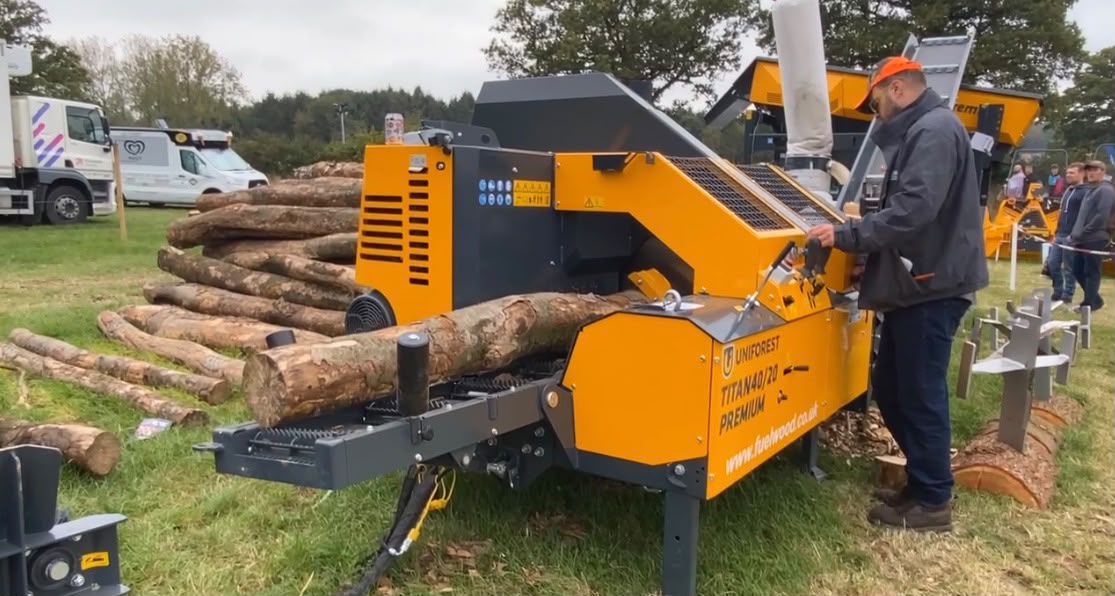
At the top end, high-output processors come into their own where timber flow, labour availability and sales volumes justify the spend. These machines can transform production, but only if the rest of the yard keeps up. Buying a big processor without adequate loading, stock control, and covered drying capacity is an expensive way to create a bottleneck elsewhere.
Build quality and serviceability matter more than bright paint
Any contractor who has spent winters around processing kit knows where weak points usually show up first. Conveyor bearings, hydraulic hoses, saw components, guarding fixings, splitting wedges and control linkages all take punishment. The best machines are not those that never wear out. They are the ones built so wear points are accessible, sensible to replace and not constantly failing.
Look closely at steel thickness, weld quality, hose routing and guarding design. A machine can feel impressive at a show and still become awkward in daily use if every routine task means removing covers, working around cramped access points or ordering proprietary parts with long lead times.
Serviceability is often undervalued during a purchase. Grease points should be easy to reach. Knives and wedges should be straightforward to change. Chain adjustment, bar access, or blade replacement should not take half a day in the workshop. If your busiest processing months are autumn and winter, simplicity counts.

Power source, hydraulics and control layout
PTO-driven processors remain a solid choice where a suitable tractor is already available and fuel use can be managed efficiently. They suit many yard and estate operations, particularly where the machine is not running flat out every working day. The trade-off is that tractor availability becomes part of the equation, and not every business wants a unit tied up on the processor when it could be elsewhere.
Engine-driven machines offer independence and can make sense for dedicated log production sites. The better ones provide stable hydraulic performance and tidy controls, but buyers should look hard at engine access, fuel consumption and noise. An awkward engine bay or poor component layout can make basic servicing more frustrating than it needs to be.
Controls should be judged by operator fatigue as much as function. Over a full day, awkward lever positions, poor visibility and jerky operation cost output. Good controls are predictable and allow the operator to keep timber moving without constantly fighting the machine.
Timber handling is where profits are made or lost
A processor review that ignores infeed and outfeed is only half a review. Log decks, chain feeds, decks with live rollers, outfeed conveyors, and bagging or bulk-handling options all affect real output far more than some buyers expect.
If timber arrives to the machine badly presented, productivity drops immediately. Bent stems, forks and short random lengths all expose weaknesses in feed design. A processor with a decent infeed arrangement and positive timber control can save labour and reduce the amount of time spent wrestling awkward cord into place.
Outfeed also deserves proper thought. If split logs bridge, spill or pile unevenly, the operator ends up stopping to sort the mess. Long discharge conveyors, proper height adjustment, and clean transfer into trailers, crates, or bags can make a major difference over the course of a week.
Running costs and the dealer question
Capital price gets the attention, but running costs decide long-term value. Consumables, wear parts, blades, chains, hydraulic oil, filters and belts all eat into margins. So does downtime while waiting for parts. A cheaper machine is not cheap if it regularly stops production in the middle of peak delivery season.
That is where dealer support carries weight. Good backup means parts on the shelf, somebody who understands the machine and realistic technical advice when problems arise. In a trade where weather and customer demand already create enough pressure, poor aftersales support is hard to excuse.
For UK buyers, it is worth asking where parts are coming from, who carries stock, and how quickly common wear items can be supplied. This is not glamorous, but it is often the difference between a profitable season and a frustrating one.
Which machine suits which operator?
There is no single winner in any firewood processor review because the right machine depends on volume, timber source and business model. A farm diversifying into retail firewood may get excellent return from a simpler PTO unit with modest output and low overheads. A dedicated merchant supplying bulk volumes across winter will usually need stronger handling, faster cycle times and a machine designed for prolonged use.
Hardwood processors need to think carefully about splitting force and wedge options. Softwood-focused businesses may place more value on fast cut-and-split cycles and efficient handling. If your timber supply varies widely through the year, flexibility becomes more important than outright peak speed.
For many buyers, the sensible route is not the largest machine they can finance, but the one that matches existing yard flow while leaving room for growth. Overspec can hurt just as much as underspec if utilisation never justifies the spend.
Forest Machine Magazine readers will already know that machinery earns its keep through dependable work, not sales talk. The strongest processors are the ones that fit the timber, the operator and the job, then keep going when conditions are less than ideal.
If you are weighing up a purchase, judge the machine as a working tool rather than a showroom piece. Ask what happens on wet days, with a crooked cord, under pressure, and when parts are needed mid-season. That is usually where the right buying decision reveals itself.
Contact forestmachinemagazine@mail.com to promote your products and services on the world’s largest professional online news network for forestry.
#homeoflogging #writtenbyloggersforloggers #loggingallovertheworld
Written by loggers for loggers and dedicated solely to forestry equipment.