
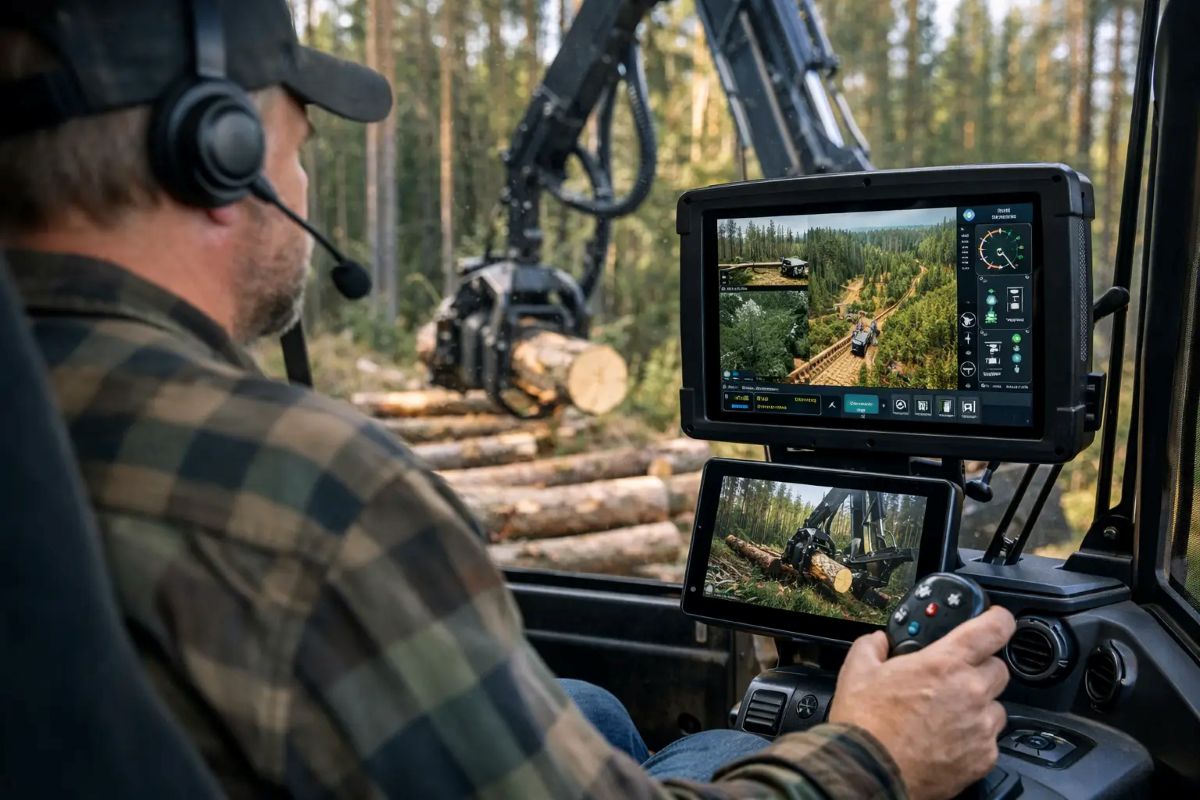
A harvesting site can produce plenty of paperwork without anyone sitting down to create it. Production figures, timber stack measurements, weighbridge tickets, machine hours, fuel, lorry movements, safety checks and invoices all need recording somewhere.
Forestry software is meant to bring that information into order. The question for a working contractor is simpler: does it save enough time, reduce enough mistakes or improve enough decisions to earn its place alongside the machines?
For some businesses, the answer is clearly yes. For others, a costly system becomes another screen to feed after a long shift. The difference usually comes down to choosing software that fits the way the job actually runs, rather than trying to rebuild the business around a sales demonstration.
-
The WeighPro Wireless Weighing Link represents a precise and dependable weighing system designed specifically for round timber, eliminating the need for re-calibration. This system offers operators minimal maintenance requirements, boasting an impressive battery life of up to two years between recharges.
-
That’s a remarkable amount of work hours for a single machine, the Norcar 600 owned by Erkki Rinne is taken well care of, it even has the original Diesel engine.
-
It is not possible to eliminate chain shot, but there are simple steps that can be taken to reduce the risk.
-
Arwel takes great pride in the fact that the mill has no waste whatsoever, “the peelings are used for children’s playgrounds, gardens and for farm animals in barns in the winter and the sawdust has multiple uses in gardens and farms as well.
-
Timber hauliers need to encourage young blood in, and also look after the hauliers we have, we need make the sector a safe and positive place to work.
FIND US ON
Where forestry software earns its keep
The strongest case is not usually in a single feature. It is in stopping the same information being written down, texted, copied into a spreadsheet and then chased at the end of the month. When a site manager, harvester operator, forwarder operator, haulier and office all work from different versions of the facts, somebody eventually loses time or money.
A decent system can connect production and dispatch records with the commercial side of the job. That might mean recording roadside volumes by assortment, allocating loads to the correct contract, checking the haulage status and matching a weighbridge ticket to the load before invoicing. On a busy contract with several destinations, that is more than tidier administration. It is control of margin.
Machine management is another area where the right package can pay. Hours, planned servicing, defect reports, breakdown history and parts spend are useful when they are visible before a problem turns into a stopped machine. A contractor running several harvesters, forwarders and timber lorries does not need a vague reminder that a service is due. They need an accurate view of which machine is approaching an interval, what work is booked, and whether downtime can be planned around production.
There is also a safety and compliance case. Risk assessments, daily checks, LOLER records, operator competence, incident reporting and environmental controls can be stored and retrieved more reliably than a stack of damp paperwork in a pick-up. That does not make the site safer by itself. The operator still has to carry out the check properly. But it makes gaps harder to hide and evidence easier to produce when a client, auditor or regulator asks for it.
Start with the bottleneck, not the software
Before looking at suppliers, identify where information currently breaks down. If the office spends every Friday chasing load details, haulage and dispatch should be the priority. If servicing is reactive and machines are regularly off the job waiting for routine work, maintenance planning deserves attention. If cash is slow because paperwork comes back late from site, focus on tickets, approvals and invoicing.
This sounds obvious, but it is where many forestry software purchases go wrong. A contractor sees a polished platform covering harvesting, mapping, carbon reporting, accounting and asset management, then buys far more than the team will ever use. The result is an expensive system with patchy data, while the whiteboard and WhatsApp group remain the real operating system.
Smaller firms may only need a practical job record, digital timesheets, service reminders and a clean way to track timber movements. A larger harvesting and haulage operation may need separate permissions for operators, supervisors, transport staff and accounts, with live reporting across several sites. Neither approach is automatically better. The right level depends on the size of the operation, contract requirements and who will be responsible for keeping records current.
Ask what happens when there is no signal
Forestry work is often carried out where mobile coverage is poor and site conditions are not kind to tablets or phones. Any supplier claiming to support field teams should be pressed on offline working. Can an operator complete a check, record a load or enter production without signal? Does the data sync reliably later? What happens if two people amend the same job record before reconnecting?
This is not a minor technical detail. If the system only works with a strong connection, people will revert to notes in the cab and transfer them later, which brings back the duplication it was bought to remove.
Also look at the practical interface. Operators should be able to use it with gloves off, in poor light, on a wet day, without spending ten minutes searching through menus. A form that asks for every conceivable field may please an administrator, but it will not be completed consistently at the end of a hard shift.
Production data is useful only when it is trusted
Modern harvesting machinery already generates a great deal of information. StanForD data, machine monitoring platforms and telematics can show production, hours, fuel use, locations and fault codes, depending on the make, model and service agreement. Forestry software can add value by bringing that information together with site, timber and commercial records.
But machine data is not magic. Head calibration, species settings, product matrices and correct operator practice still matter. A production report is only as dependable as the information behind it. If the harvester measurement is drifting, or roadside stock is recorded inconsistently, dashboards can make a poor figure look authoritative.
The best businesses use the numbers as a prompt for investigation, not a substitute for judgement. A sudden change in tonnes per productive machine hour could point to steep ground, poorer timber, a difficult extraction distance, a mechanical issue, an inexperienced operator or a data error. Software can show the change quickly. It cannot tell you the whole story without someone who knows the site asking the right questions.

Haulage needs its own discipline
Timber transport is where small administrative errors can become expensive quickly. A missed collection, wrong destination, disputed ticket or unrecorded waiting time affects more than one load. It can disrupt a mill intake, leave timber sitting at roadside and sour a relationship with a haulier or customer.
For operations managing their own transport, useful functions include load allocation, delivery status, driver communication, ticket capture, vehicle checks and records of weights by customer or contract. The important point is that the workflow must suit the people moving the timber. Drivers need clear instructions and a quick way to report exceptions. Transport managers need visibility without ringing every lorry for an update.
There is a trade-off here. Live vehicle tracking and detailed load data can give better control, but they also create more information to monitor and more questions around data access. Agree who sees what, how long records are retained and whether subcontract hauliers are expected to use the same system before making it a contract condition.
Implementation is the part suppliers cannot do for you
The software itself may be straightforward. Getting the business to use it consistently is the difficult bit. Someone needs to set up customers, sites, products, machines, users, cost codes and reporting rules correctly. Someone also needs the authority to say which record is the official one when the old spreadsheet disagrees with the new platform.
Run a pilot on one live contract before rolling it across the fleet. Use a job with enough activity to test production, dispatch, tickets and invoicing, but not the most complicated site of the year. Let operators and office staff challenge the process. If entering a load takes too long or a report does not answer the question management actually asks, fix that before expanding.
Training should be role-specific. A harvester operator does not need an accounts tutorial, and the person producing invoices does not need to learn every machine inspection screen. Short, relevant training has a better chance of sticking than one long presentation full of features nobody will use.
Questions worth asking before you sign
Do not judge forestry software only on its headline functions. Ask whether your data can be exported in a usable format if you later leave the platform. Check the full cost after the first year, including user licences, support, setup, mobile access, integrations and extra modules. Establish where the data is hosted, what support is available outside office hours, and whether the supplier understands UK timber measurement, haulage paperwork and forestry contracting.
It is also worth asking for references from businesses that resemble yours. A system working well for a large estate or an international timber buyer may still be a poor fit for a three-machine contractor with owner-operated haulage. Speak to users about implementation, not just the demo. That is where the real value, and the real frustration, usually appears.
The right system should make the end of the week calmer: fewer missing tickets, clearer machine plans, better sight of stock and less time spent turning site notes into an invoice. Start with that practical test. If forestry software cannot improve the work between the cab, roadside, lorry and office, it is not ready to earn its keep.
Contact forestmachinemagazine@mail.com to get your products and services seen on the world’s largest professional forestry online news network.
#homeoflogging #writtenbyloggersforloggers #loggingallovertheworld
Written by loggers for loggers and dedicated to bringing you the latest forestry news