
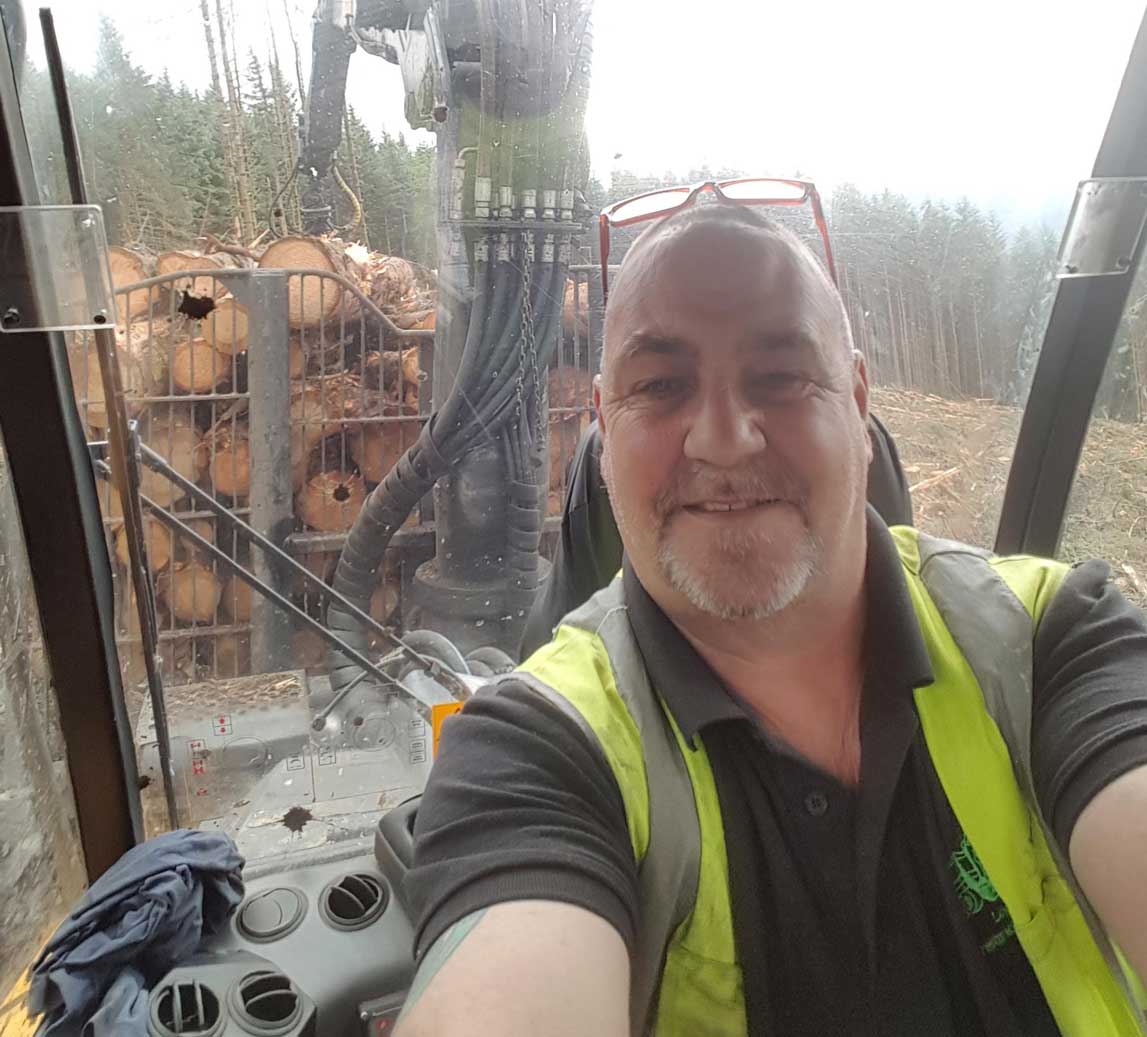

UK Timber Harvesting is a closely guarded secret when it comes to forestry equipment sales, so I decided to dig into it to see if I could find out a bit more.
UK Timber Harvesting -On our recent trip to FinnMETKO, I had a great conversation with a harvesting contractor about the official statistics for harvesting machinery sales. I had just seen the 6-monthly figures for Sweden, broken down into harvesters/forwarders/agri forwarders and skidders. It then broke these down into individual manufacturers’ sales for each machine type, with figures compared to the same periods in previous years.
-
The WeighPro Wireless Weighing Link represents a precise and dependable weighing system designed specifically for round timber, eliminating the need for re-calibration. This system offers operators minimal maintenance requirements, boasting an impressive battery life of up to two years between recharges.
-
That’s a remarkable amount of work hours for a single machine, the Norcar 600 owned by Erkki Rinne is taken well care of, it even has the original Diesel engine.
-
It is not possible to eliminate chain shot, but there are simple steps that can be taken to reduce the risk.
-
Arwel takes great pride in the fact that the mill has no waste whatsoever, “the peelings are used for children’s playgrounds, gardens and for farm animals in barns in the winter and the sawdust has multiple uses in gardens and farms as well.
-
Timber hauliers need to encourage young blood in, and also look after the hauliers we have, we need make the sector a safe and positive place to work.
FIND US ON
It seems odd that this information isn’t accessible in the UK, especially since it is readily available in many other countries. It raises questions about why information sharing differs so much across regions.
The figures that are readily available is the amount of timber which is harvested.
2024 UK Timber Harvesting Statistics
We harvested a total of 10.7 million green tonnes of timber-9.9 million of softwood and 0.8 million of hardwood.
If we assume that an average mechanised harvesting team (harvester and forwarder) produces between 25,000 and 35,000 m³ each year, that would mean that there are 300-400 mechanised harvesting teams working in the UK.
But there is the catch!
Not every harvesting team uses a harvester and forwarder; some have an excavator-harvester conversion and forwarder. Longer extraction might need a harvester and two forwarders. Others have chainsaw felling with a forwarder, Skyline or high lead, skidder, specialised LGP equipment or roadside processors.
If we say the UK has 350 productive harvesting teams averaging 30,000 m³ each year, that would give us an annual harvest of 10.5million m³, the scale of our annual harvest.
Given those figures this should give us total machine numbers of around;
Harvesters 300-400
Forwarders 300-450
Excavator Harvester Conversions 100-200
Skidders 50-100
Skyline/High Lead 20-50
These figures serve as a benchmark for the volume of timber that can be harvested.
Other factors to consider
In 2025, Tilhill reported a machinery fleet comprising 35 harvesters and 33 forwarders, highlighting the significant concentration of mechanised capacity within certain segments of the industry.
This situation poses significant challenges for manufacturers, as we don’t need to expand our fleet to cut timber; instead, we focus solely on replacing existing machines as they reach the end of their lifespan.
The real fleet requirement is considerably more complicated
Our primary concern appears to be utilisation. With 350 productive harvesting teams achieving an average output of 30,000 m³ annually, we meet our harvesting requirements without needing to increase the number of machines. However, if the existing machines operate at a higher productivity level for a longer period each year, this could present a significant challenge for manufacturers.
How often have we heard;
The Paperwork isn’t ready for the next site
The job is on hold as timber prices are too low
The mill is full
The road isn’t ready
It’s too wet
Site preparation hasn’t been done
The list of excuses goes on and on
Forest Research says UK roundwood removals increased 8% in 2024 to 10.7 million green tonnes, while deliveries to processors were 10.4 million tonnes.
So the UK actually harvested more timber, not less,yet contractors can still be struggling.
Why? Because harvested volume isn’t the same thing as profitability.
A contractor can harvest 30,000 tonnes but make very little money if:
* machine costs have risen;
* finance costs are high;
* fuel and AdBlue are increasing.
* wages have risen;
* repair bills are increasing;
* machines are heavier and more expensive;
* mobilisation costs are high;
* timber prices are weak;
* mills restrict deliveries;
* machines spend too much time travelling between small sites.
This is the crucial distinction
The UK may not be facing a crisis in harvesting capacity; rather, it seems to be grappling with issues related to harvesting utilisation and profitability. This situation could pose a far more significant challenge for contractors.
If I had to summarise the UK position today
🟢 Machine capacity: probably broadly sufficient
🟠 Skilled operators: increasingly constrained
🟠 Machine utilisation: major issue
🔴 Contractor profitability: major issue
🔴 Consistent timber demand: major issue
🟠 Site accessibility/ground conditions: significant constraint
🔴 Long-term replacement of the contractor workforce: serious concern
And that leads to a rather important question for the UK industry:
If the UK suddenly increased woodland harvesting by another 2–3 million tonnes a year, would we actually have enough operators and profitable harvesting capacity to do it?
I suspect the answer is no—not without bringing more contractors, operators and machines into the sector.
It still doesn’t answer why UK harvesting machinery sales are kept secret!
Contact forestmachinemagazine@mail.com to get your products and services seen on the world’s largest professional forestry online news network.
#homeoflogging #writtenbyloggersforloggers #loggingallovertheworld
Written by loggers for loggers and dedicated to bringing you the latest forestry news