
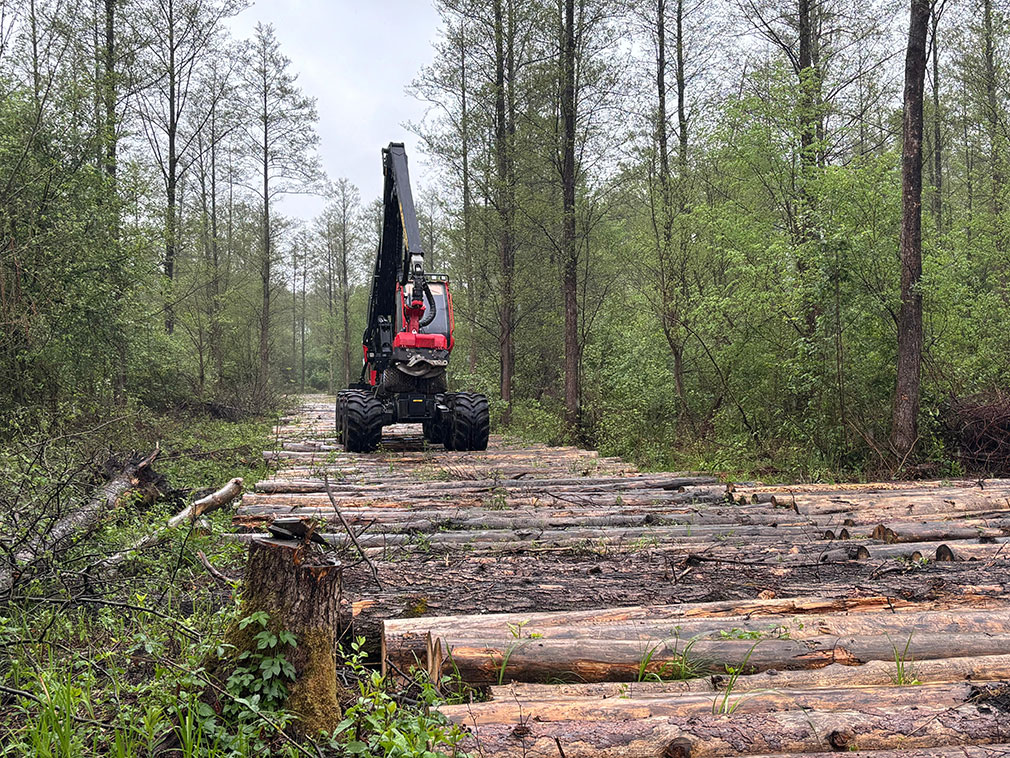
In the UNESCO Spreewald Biosphere Reserve, a log corduroy road is currently being constructed using round timber to enable low-impact access to a wetland area. A Komatsu 951XC harvester equipped with an S172 head is being used for the project. The approximately 800-metre-long timber road will provide the foundation for future forestry operations.
Komatsu 951XC-The Spreewald region in Brandenburg, Germany, is one of Europe’s most distinctive natural landscapes. The region is characterized by a widely branched network of natural and man-made waterways as well as permanently wet, partly marshy soils. As a UNESCO Biosphere Reserve, the Spreewald places special demands on forestry operations, as the sensitive site conditions and the low load-bearing capacity of the soils make the use of conventional machinery considerably more difficult.
-
The WeighPro Wireless Weighing Link represents a precise and dependable weighing system designed specifically for round timber, eliminating the need for re-calibration. This system offers operators minimal maintenance requirements, boasting an impressive battery life of up to two years between recharges.
-
That’s a remarkable amount of work hours for a single machine, the Norcar 600 owned by Erkki Rinne is taken well care of, it even has the original Diesel engine.
-
It is not possible to eliminate chain shot, but there are simple steps that can be taken to reduce the risk.
-
Arwel takes great pride in the fact that the mill has no waste whatsoever, “the peelings are used for children’s playgrounds, gardens and for farm animals in barns in the winter and the sawdust has multiple uses in gardens and farms as well.
-
Timber hauliers need to encourage young blood in, and also look after the hauliers we have, we need make the sector a safe and positive place to work.
FIND US ON
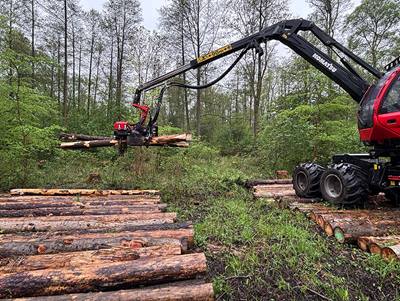
Against this backdrop, a special forestry operation is currently being carried out: in a wetland area, a Komatsu 951XC harvester combined with an S172 head is building a road made of roundwood, known as a corduroy road. The planned road will be approximately 800 metres long and will serve as a stable foundation for further access to the area.
The main challenge lies in the ground conditions. The subsoil is soft and unstable, which means machines cannot be used without preparatory measures. Building the corduroy road makes it possible to create the necessary infrastructure for the subsequent work steps.
The aim is to enable adapted management of the area in the future. Timber harvesting will be carried out manually with chainsaws. A cable yarding system is planned for transporting the timber. At the end of the cable line, the felled trees will be processed by a harvester. A forwarder will then handle the onward transport of the logs from the stand.
The construction of the corduroy road is therefore the first and decisive step in enabling a structured and soil-friendly operation in this challenging environment. This application demonstrates how practical solutions can be developed through the targeted use of modern forestry technology, even under extreme site conditions.
This junction has been designed so that work can be carried out in parallel: On one side, the harvester processes the stems, while on the other side the cable yarder is positioned. The cable yarder handles timber extraction from the protected area of the biosphere reserve, where the use of machinery is not possible.

Sign up for our free monthly newsletter here
Contact forestmachinemagazine@mail.com to get your products and services seen on the world’s largest professional forestry online news network.
#homeoflogging #writtenbyloggersforloggers #loggingallovertheworld
Written by loggers for loggers and dedicated solely to the equipment used in forestry operations.